Andhra Pradesh High Court Directive on NFSA Vigilance Committees
Source:deccan-chronicle ↗
Why It Matters
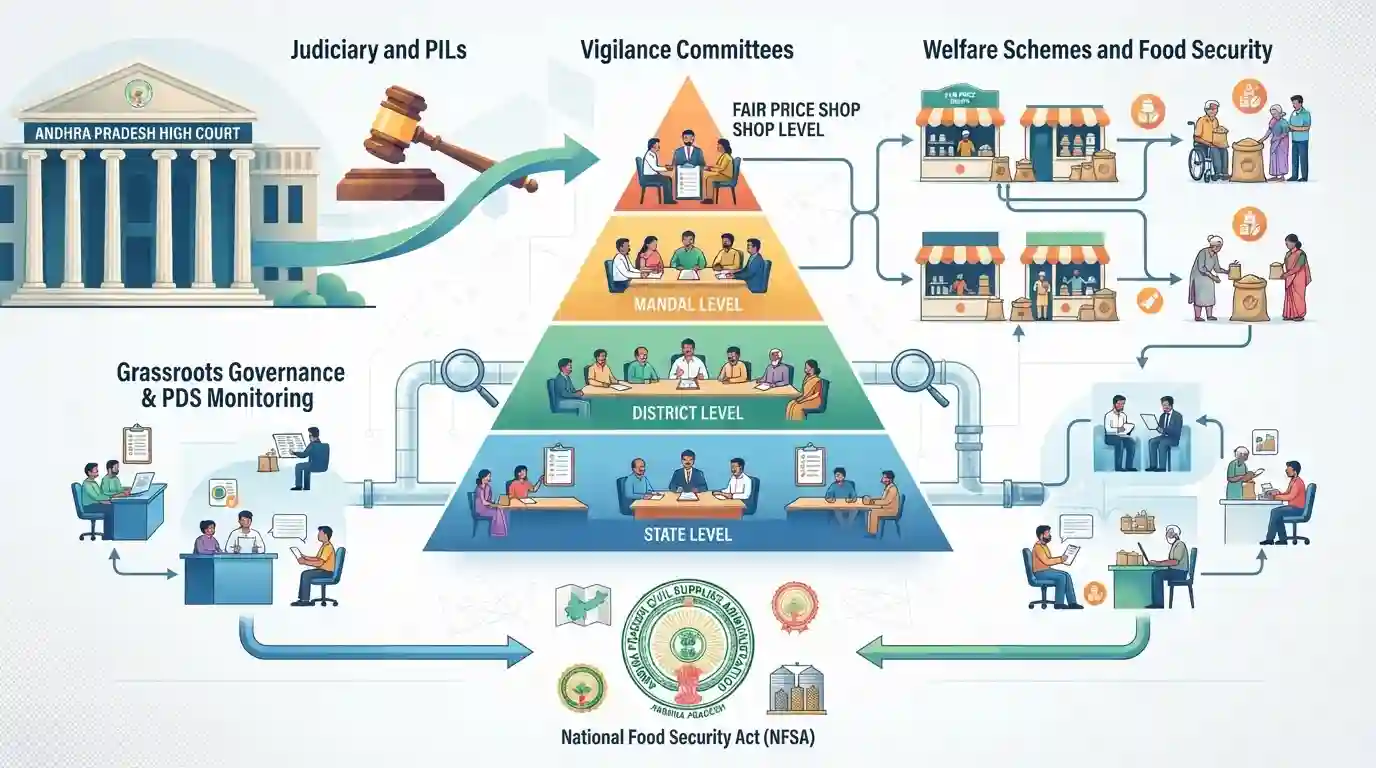
This judicial directive reinforces statutory accountability mechanisms under the NFSA 2013, ensuring that grassroots welfare monitoring systems like Vigilance Committees are functional, which is vital for reducing leakages in the Public Distribution System (PDS).
Summary
The Andhra Pradesh High Court has directed the state government to set up and operationalize statutory vigilance committees at the state, district, mandal, and fair price shop levels within two months. This measure is intended to ensure strict supervision and transparency in the implementation of the National Food Security Act (NFSA), 2013, across the state.
Key Points
- The Andhra Pradesh High Court has directed the state government to set up and operationalize multi-tier vigilance committees within two months.
- These committees must be established at the state, district, mandal, and fair price shop (FPS) levels to supervise the implementation of the National Food Security Act (NFSA), 2013.
- The division bench of Chief Justice Lisa Gill and Justice Challa Gunaranjan issued this order in response to a Public Interest Litigation (PIL) filed by K. Akhil Sri Guruteja, chairman of the Help the People Charitable Trust.
- The petitioner had requested that these committees meet at least once in three months and post details of their meetings on the state portal.
- The state government asserted that GO No. 8 (June 30) and previous orders (e.g., GO No. 16 of July 2023) had initiated the formation and scheduled regular meetings of these committees, which the court has now ordered to be fully executed.
Important Terms
National Food Security Act, 2013 (NFSA)

A landmark Indian law that legalizes the right to food, providing highly subsidized food grains to approximately two-thirds of the population under targeted welfare schemes.
UPSC context
Paper III (Economy) & Paper IV (Welfare Schemes). Tests food distribution frameworks and statutory welfare governance.
Targeted Public Distribution System (TPDS)
A government-managed system that distributes essential food grains and commodities to targeted low-income households through a nationwide network of Fair Price Shops.
UPSC context
Paper III (Economy). Tests administrative efficiency in PDS implementation, leakage control, and grassroots distribution mechanisms.
Andhra Pradesh High Court
The highest judicial authority in Andhra Pradesh, based in Amaravati, responsible for safeguarding fundamental rights and ensuring executive accountability through judicial review.
UPSC context
Paper II (Polity and Governance). Tests state judicial structure, writ jurisdiction, and the impact of judicial intervention on administration.
Help the People Charitable Trust
An active non-governmental organization in Andhra Pradesh whose Public Interest Litigations (PILs) have triggered landmark judicial directions on PDS monitoring and school safety.
UPSC context
Paper II (Polity & Governance). Tests the role of civil society organizations, NGOs, and PILs in promoting grassroots administrative transparency.
GO No. 8 (June 30)
A Government Order issued by Andhra Pradesh setting up a state-level vigilance committee and mandating district, mandal, and FPS-level oversight panels under the NFSA.
UPSC context
Paper II (AP Administration). Tests state-level statutory policy execution and local administrative compliance for welfare programs.
GO No. 16 (July 25, 2023)
An administrative order by the Andhra Pradesh government establishing the framework and frequency for regular meetings of public distribution system vigilance committees.
UPSC context
Paper II (AP Governance). Tests institutional oversight mechanism structure and regular review procedures of public distribution welfare networks.
Prelims Trap
Vigilance Committees under the NFSA are optional executive bodies that do not extend down to the individual Fair Price Shop (FPS) level.
Section 29 of NFSA 2013 makes these committees a statutory mandate, not optional, and explicitly requires them at four levels, including the FPS level.
Static Concepts Connected
What are the statutory grievance redressal bodies mandated under the NFSA 2013?
- DGRO: Section 15 mandates a District Grievance Redressal Officer in each district for localized complaint handling.
- State Food Commission: Section 16 mandates State Food Commissions to monitor implementation, conduct research, and hear appeals against DGRO decisions.
- Vigilance Committees: Section 29 mandates multi-tier monitoring bodies at State, District, Block/Mandal, and Fair Price Shop levels with diverse social representation.
What is the administrative setup of Civil Supplies in Andhra Pradesh?
- APSECCL: AP State Essential Commodities Corporation handles the procurement, warehousing, and distribution logistics of essential goods.
- MDU Door Delivery: AP utilizes Mobile Dispensing Units (MDUs) for direct door-step delivery of ration to beneficiaries, altering traditional FPS operations.
Cross-Topic Patterns
AP PDS + Democratic Decentralization
Linking multi-tier vigilance committees with PRIs at the FPS level ensures local social audit teeth, reinforcing Article 47 (nutrition) and Article 243G (Panchayat powers) in AP.
Judicial Activism + Welfare Delivery
The AP High Court's strict two-month directive demonstrates how PILs enforce statutory mandates of the NFSA to secure Article 21's Right to Food.

APPSC is likely to test the statutory basis (Sec 29 NFSA), specific tiers, and mandatory representation rules of PDS Vigilance Committees.
Linked PYQs · 2
Linked PYQs · 2
- 2023APPSC_PRELIMSGS1
Which of the following is not a feature of MGNREGS? I. Guaranteed minimum wage employment II. Rights-based employment scheme III. Generation of wage employment in rural areas IV. Provision of nutritious food Choose the correct answer using the codes given below:
- 2023APPSC_PRELIMSGS1
The CCRC introduced by Government of Andhra Pradesh stands for
