Security Clearance Revocation for Foreign Ground Handling Firm
Source:Indian Express ↗
Why It Matters
This case illustrates the direct impact of international geopolitics—specifically, a foreign nation's diplomatic stance—on its commercial operations and investments within India. It also highlights the regulatory role of BCAS in securing critical national infrastructure and the use of the Arbitration and Conciliation Act by foreign companies for dispute resolution in India.
Summary
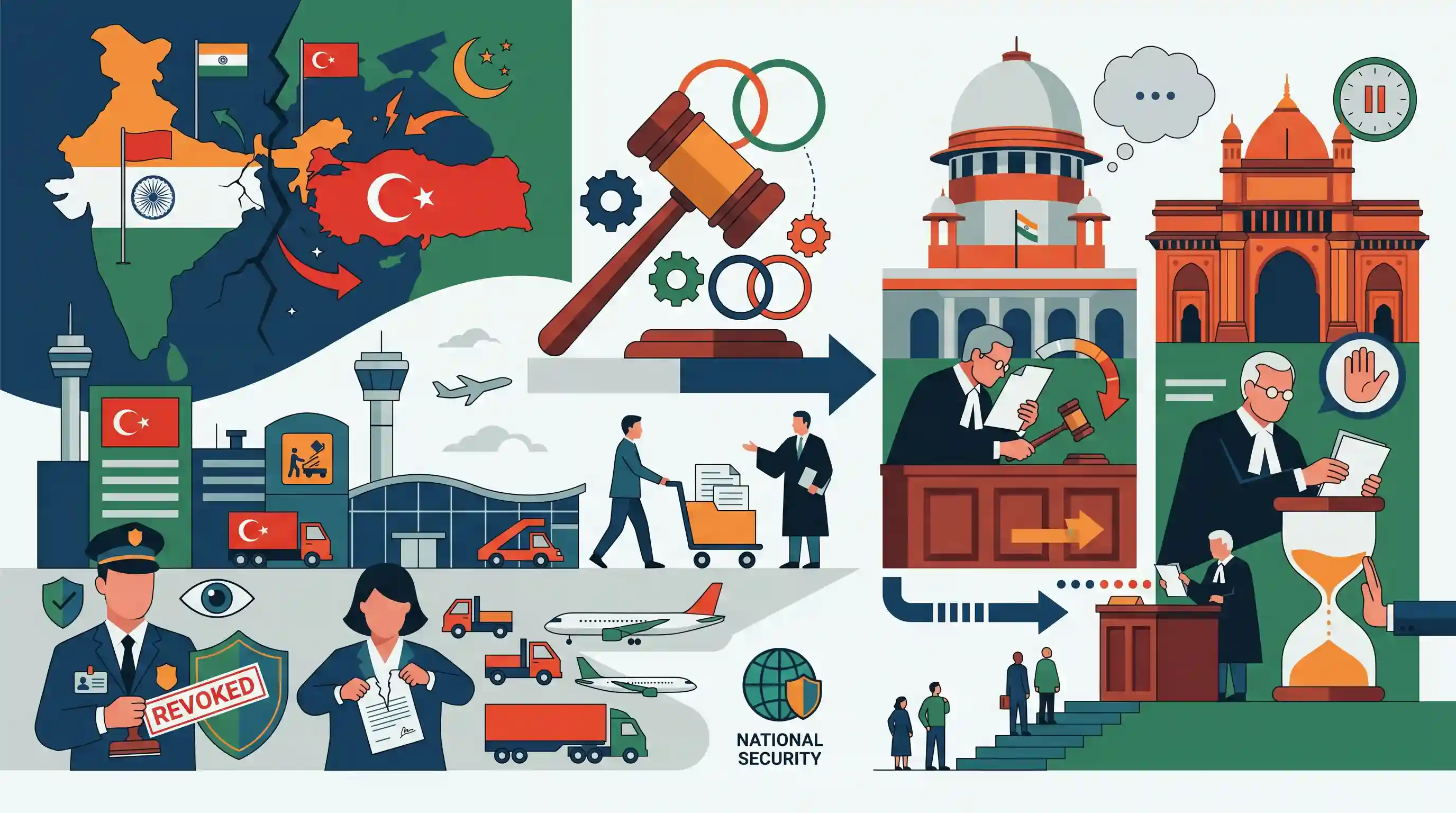
The Bombay High Court has deferred hearing a plea by the Indian subsidiary of Turkish ground-handling firm Celebi against the revocation of its security clearance by the Bureau of Civil Aviation Security (BCAS) and the subsequent termination of its contract by Mumbai International Airport Limited (MIAL). The BCAS revoked the clearance citing 'national security' concerns, reportedly stemming from strained India-Turkey relations over Turkey's pro-Pakistan stance on international platforms. Celebi has approached the courts under the Arbitration and Conciliation Act. The Bombay HC adjourned the matter to await a verdict from the Delhi High Court, which is hearing the primary challenge against the BCAS revocation order.
Key Points
- The Bureau of Civil Aviation Security (BCAS) revoked the security clearance of the Indian arm of Turkish firm Celebi, citing national security concerns.
- The revocation is implicitly linked to deteriorating India-Turkey relations, notably due to Turkey's vocal support for Pakistan on various international platforms.
- Following the BCAS order, multiple Indian airports, including Mumbai International Airport Limited (MIAL), terminated their ground handling contracts with Celebi.
- Celebi approached both the Bombay and Delhi High Courts seeking relief under the Arbitration and Conciliation Act.
- The Bombay High Court has deferred the hearing of Celebi's plea regarding the MIAL contract termination until the Delhi High Court issues its verdict on the core issue of the BCAS clearance revocation.
Important Terms
Bureau of Civil Aviation Security (BCAS)

A regulatory body under the Ministry of Civil Aviation responsible for setting aviation security standards and issuing mandatory security clearances for airport operators, airlines, and ground-handling agencies in India.
UPSC context
GS-II (Statutory/Regulatory Bodies) and GS-III (Internal Security); tests understanding of the security architecture for critical infrastructure.
Arbitration and Conciliation Act, 1996
The primary Indian legislation governing domestic and international commercial arbitration, providing a framework for Alternative Dispute Resolution (ADR) to settle disputes outside the formal court system.
UPSC context
GS-II (Government Policies) and GS-III (Economy); critical for topics on Ease of Doing Business and commercial dispute resolution.
National Security Clearance
A mandatory vetting process by Indian agencies to ensure that foreign entities or investments in sensitive sectors (like aviation) do not jeopardize India's sovereignty, integrity, or strategic national interests.
UPSC context
GS-III (Internal Security and FDI); tests the intersection of geopolitical relations and foreign investment policy.
Public-Private Partnership (PPP)
A collaborative infrastructure model, such as Mumbai International Airport Limited (MIAL), where government and private entities share risks and rewards to provide public services and modernize facilities.
UPSC context
GS-III (Infrastructure/Investment Models); tests knowledge of development strategies and private sector participation in civil aviation.
Alternative Dispute Resolution (ADR)
Methods including arbitration, mediation, and conciliation designed to resolve legal conflicts without traditional litigation, aimed at reducing the burden on the judiciary and providing faster outcomes.
UPSC context
GS-II (Judiciary and Governance); relevant for legal reforms and reducing judicial pendency.
Prelims Trap
"BCAS functions as an attached office under the Ministry of Home Affairs."
Because it manages 'national security' at airports, aspirants often mistakenly assume BCAS falls under the Ministry of Home Affairs. It is actually under the Ministry of Civil Aviation.
Static Concepts Connected
What is the mandate and administrative control of the BCAS?
- Primary Mandate: It is the nodal regulatory authority for civil aviation security in India.
- Administrative Control: It functions as an independent attached office under the Ministry of Civil Aviation, not the Ministry of Home Affairs.
- Legal Backing: It draws its regulatory powers from the Aircraft Act, 1934, and the Aircraft Security Rules, 2022.
How do 'National Security Exceptions' function in international trade and investment?
- GATT Article XXI: Allows WTO members to breach standard obligations to protect essential security interests, often used to curb hostile FDI.
- Domestic FDI curbs: India's FDI policy allows the government to review, block, or revoke investments/licenses from specific nations on security grounds (e.g., Press Note 3 of 2020).
Cross-Topic Patterns
Turkey's FATF stance & bilateral economic friction
Turkey’s historical attempts to shield Pakistan from the FATF grey/blacklist directly impact Indian economic and strategic policymaking, leading to retaliatory curbs on Turkish FDI and operational licenses.
Arbitration rights vs. National Security exceptions
Courts frequently balance commercial rights under the Arbitration and Conciliation Act against executive decisions rooted in uncodified "national security" concerns, a rising theme in infra-contract disputes.

Expect a GS-2 Mains question linking bilateral friction (Turkey/China) with domestic economic protectionism via national security clauses.
Linked PYQs · 2
Linked PYQs · 2
- 2015MainsGS2
What are the major changes brought in the Arbitration and Conciliation Act, 1996 through the recent Ordinance promulgated by the President? How far will it improve India's dispute resolution mechanism? Discuss.
- 2024MainsGS2
Explain and distinguish between Lok Adalats and Arbitration Tribunals. Whether they entertain civil as well as criminal cases ?
