Madras High Court ruling on Karur stampede SIT and highway rallies
Source:The Hindu ↗
Why It Matters
This article highlights the tension between the fundamental right to peaceful assembly and the need for public order and safety. It is crucial for understanding the judiciary's role in mandating executive action (SOPs for crowd management) and the criteria courts use to decide whether to transfer a state police investigation to the CBI via PILs.
Summary
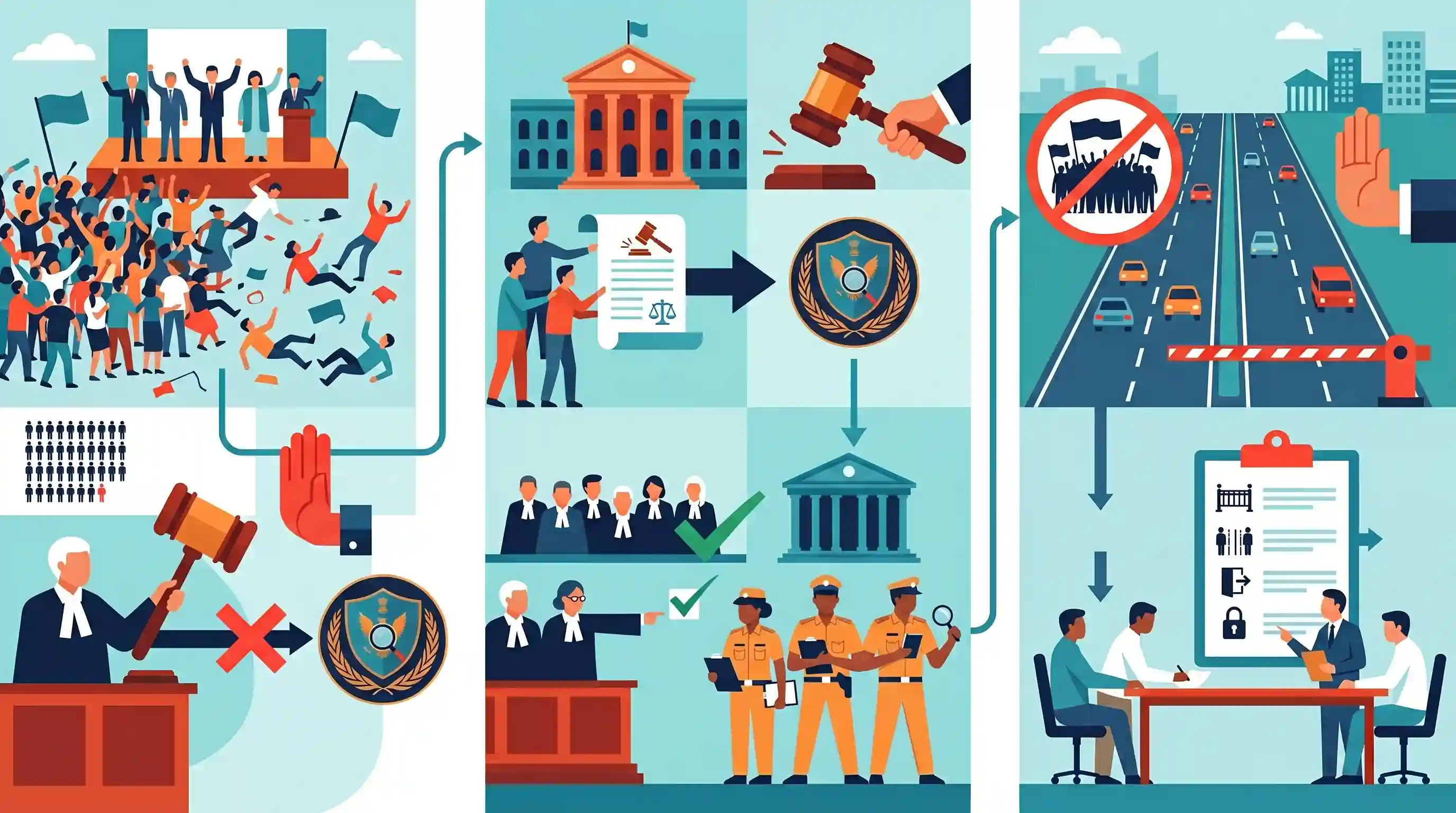
The Madras High Court has declined a PIL seeking a CBI probe into a stampede at a Tamilaga Vettri Kazhagam (TVK) rally in Karur that resulted in 41 deaths, expressing confidence in the state-appointed SIT. Additionally, the court ordered a ban on granting permissions for political rallies on National and State Highways until the Tamil Nadu government establishes strict Standard Operating Procedures (SOPs) to ensure crowd control and public safety.
Key Points
- The Madurai Bench of the Madras High Court dismissed PILs demanding a CBI probe into the Karur stampede, which claimed 41 lives during a TVK political rally.
- The court ruled that the ongoing investigation by the state-appointed Special Investigation Team (SIT) is adequate and shows no signs of political interference.
- Emphasizing public safety, the High Court directed the Tamil Nadu government to stop granting permission for political rallies on National and State Highways.
- This restriction will remain in place until the state formulates and implements comprehensive Standard Operating Procedures (SOPs) for crowd management and event safety.
Important Terms
Central Bureau of Investigation (CBI)

The premier central agency investigating high-profile corruption and special crimes. It operates under the Delhi Special Police Establishment Act, 1946, and generally requires state consent for investigations within state boundaries.
UPSC context
GS Paper II: Statutory bodies and federalism; tests knowledge of jurisdictional limits and state-center administrative relations.
Special Investigation Team (SIT)
An ad-hoc, specialized task force appointed by the government or judiciary to investigate specific, sensitive, or high-profile cases requiring focused expertise or impartiality.
UPSC context
GS Paper II/III: Governance and Criminal Justice; tests understanding of specialized investigative mechanisms beyond permanent agencies.
Public Interest Litigation (PIL)
A legal mechanism allowing individuals or groups to file petitions in court for the protection of public interest, relaxing the traditional rule of 'locus standi'.
UPSC context
GS Paper II: Judiciary; fundamental for topics like judicial activism and access to justice for the marginalized.
General Consent (CBI)
The administrative approval granted by a state to the CBI under Section 6 of the DSPE Act, allowing it to investigate cases in the state without seeking individual permissions.
UPSC context
GS Paper II: Center-State Relations; relevant for examining federal tensions and the autonomy of central vs. state law enforcement.
Standard Operating Procedure (SOP)
Standardized, step-by-step instructions issued by authorities to ensure safety and uniformity in operations, such as crowd control and disaster management during public gatherings.
UPSC context
GS Paper III: Disaster Management; tests ability to propose administrative solutions for public safety and risk mitigation.
Writ Jurisdiction (Article 226)
Powers granted to High Courts under Article 226 to issue directions, orders, or writs for the enforcement of Fundamental Rights and for other legal purposes.
UPSC context
GS Paper II: Constitution/Judiciary; tests knowledge of High Courts' broader powers compared to the Supreme Court's Article 32.
Prelims Trap
"High Courts require the explicit consent of the State Government to transfer a local investigation to the CBI."
While the CBI generally needs state consent under the DSPE Act, the Supreme Court and High Courts can order a CBI probe anywhere in India without the state's permission.
Static Concepts Connected
What are the constitutional grounds for restricting the right to assemble?
- Article 19(1)(b): Guarantees all citizens the fundamental right to assemble peaceably and without arms.
- Article 19(3) limits: Allows the State to impose reasonable restrictions in the interest of India's sovereignty/integrity, or public order.
- Section 163 BNSS (formerly 144 CrPC): Executive magistrates can prohibit assemblies (usually 5 or more persons) to prevent imminent danger to human life, health, or public order.
How does the CBI assume jurisdiction over cases in a state?
- General Rule (Consent): Under Section 6 of the DSPE Act, the CBI requires the consent of the respective State Government to investigate crimes within that state.
- Constitutional Courts: The Supreme Court and High Courts have extraordinary powers to direct the CBI to investigate a case without needing the state's consent.
- Union Territories: The CBI has original jurisdiction to investigate offenses in Union Territories and does not require separate consent.
Cross-Topic Patterns
Article 19 vs. Highway Transit Rights
The ban on highway rallies echoes the Shaheen Bagh ruling: the fundamental right to assemble (Art 19) must be balanced against the public's fundamental right to commute freely on public infrastructure.
NDMA crowd control guidelines and asphyxia
Links judicial intervention with GS3 Disaster Management. NDMA’s framework emphasizes scientific capacity planning (limit 5 persons/sq meter) to prevent "compressive asphyxia" at mega-events and religious gatherings.

Expect a GS2/Prelims statement mixing Article 19(1)(b) assembly rights with NDMA crowd management protocols and Shaheen Bagh precedents.
Linked PYQs · 3
Linked PYQs · 3
- 2021MainsGS2
The jurisdiction of the Central Bureau of Investigation (CBI) regarding lodging an FIR and conducting probe within a particular State is being questioned by various States. However, the power of the States to withhold consent to the CBI is not absolute. Explain with special reference to the federal character of India.
- 2024MainsGS2
Explain the reasons for the growth of public interest litigation in India. As a result of it, has the Indian Supreme Court emerged as the world's most powerful judiciary ?
- 2024MainsGS3
What is disaster resilience? How is it determined? Describe various elements of a resilience framework. Also mention the global targets of Sendai Framework for Disaster Risk Reduction (2015–2030).
