Madras High Court Ruling on Political Rallies and Public Order SOPs
Source:The Hindu ↗
Why It Matters
The event bridges fundamental rights (Article 19 - freedom of assembly) with public order restrictions. It is highly relevant for GS2 (Judiciary's role in ordering CBI probes, evolution and limits of PILs) and GS3 (Disaster management, specifically crowd control SOPs during mega public events).
Summary
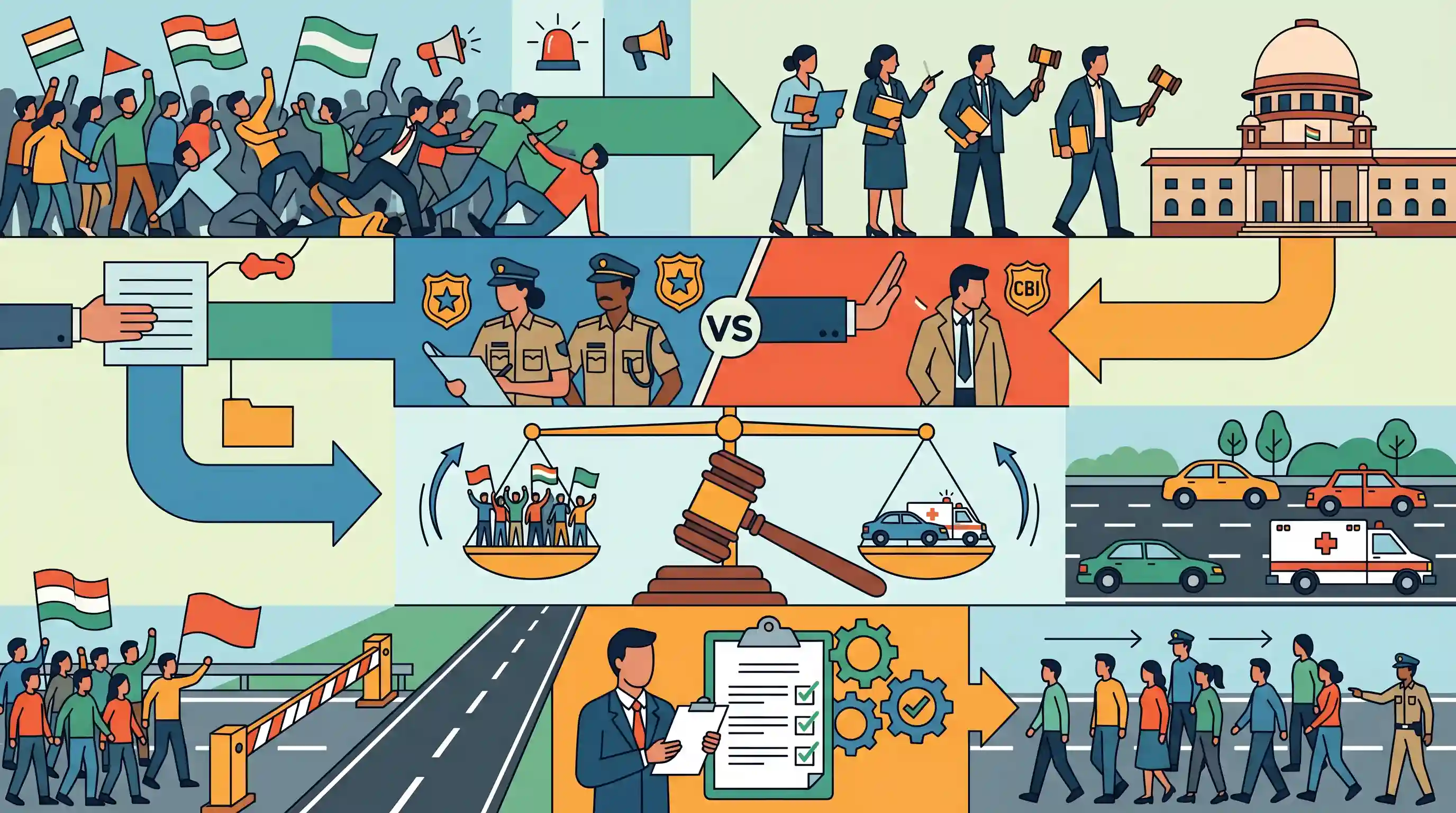
The Madurai Bench of the Madras High Court dismissed multiple Public Interest Litigations (PILs) seeking a CBI probe into the Karur stampede, which occurred during a political rally by actor Vijay's Tamilaga Vettri Kazhagam (TVK) and claimed 41 lives. Satisfied with the ongoing state police investigation, the court emphasized that a CBI inquiry is an extraordinary measure not warranted in this case. Crucially, addressing public safety concerns, the court directed the Tamil Nadu government to halt permissions for political rallies and public meetings on National and State Highways until comprehensive Standard Operating Procedures (SOPs) for crowd management are established. This highlights the balance between the right to political assembly and public safety imperatives.
Key Points
- The Madras High Court declined to transfer the investigation of the Karur stampede (which killed 41 people at a TVK rally) to the CBI, citing satisfactory progress by the State police.
- The court dismissed multiple Public Interest Litigations (PILs) seeking the CBI probe, reiterating that such probes should only be ordered in exceptional circumstances.
- To prevent future tragedies, the court directed the Tamil Nadu government not to permit political rallies or public meetings on National and State Highways until stringent SOPs are formalized.
- The ruling underscores the importance of proactive crowd management and the imposition of reasonable restrictions on public assemblies to ensure public order and safety.
Important Terms
Public Interest Litigation (PIL)

Legal action initiated by public-spirited individuals or groups to protect the rights of marginalized sections or enforce public interest, relaxing the traditional rule of 'locus standi'.
UPSC context
GS Paper II: Judiciary. Tests judicial activism, access to justice, and the check on executive/legislative failures.
Central Bureau of Investigation (CBI)
India's premier investigating agency, deriving powers from the Delhi Special Police Establishment Act, 1946, responsible for probing high-profile corruption, economic offenses, and serious crimes.
UPSC context
GS Paper II: Statutory/Regulatory Bodies. Tests federalism (state consent issues) and institutional autonomy.
SOPs for Crowd Management
Standardized protocols for risk assessment, venue capacity, and emergency response (e.g., NDMA guidelines) to prevent and manage man-made disasters like stampedes during mass gatherings.
UPSC context
GS Paper III: Disaster Management. Tests strategies for mitigating man-made disasters and administrative preparedness for public safety.
Right to Peaceful Assembly
A fundamental right guaranteed under Article 19(1)(b), allowing citizens to gather without arms, subject to 'reasonable restrictions' like public order and sovereignty.
UPSC context
GS Paper II: Fundamental Rights. Tests the balance between individual liberties and the state's duty to maintain public order.
Madurai Bench of Madras High Court
A permanent bench of the Madras High Court established in 2004 at Madurai to provide judicial access for thirteen southern districts of Tamil Nadu.
UPSC context
GS Paper II: Judiciary. Tests knowledge of judicial structure, jurisdiction, and the decentralization of the high court system.
Prelims Trap
The High Court cannot order a CBI investigation without the prior consent of the concerned State Government.
While the CBI generally requires State consent under the DSPE Act, Constitutional Courts (SC and High Courts) can unilaterally mandate a CBI probe without it.
Static Concepts Connected
What are the constitutional limits on the Right to Assemble?
- Article 19(1)(b): Guarantees all citizens the fundamental right to assemble peaceably and without arms.
- Reasonable Restrictions: Article 19(3) allows the State to impose restrictions in the interests of the sovereignty and integrity of India, or public order.
- Highway Protests: The Supreme Court has established that public spaces and highways cannot be occupied indefinitely for assemblies or protests, prioritizing the right to public movement.
Under what conditions can a CBI probe be ordered in a State?
- General Rule: Under Section 6 of the DSPE Act, the CBI generally requires the consent of the respective State Government to exercise its powers within that state.
- Judicial Direction: The Supreme Court and High Courts can order a CBI investigation anywhere in the country without State consent, to protect fundamental rights and ensure fair trials.
- Extraordinary Measure: Courts use this power sparingly (only in rare and exceptional cases) so as not to undermine the state police or the federal structure.
Cross-Topic Patterns
Crowd Management as a Public Order Subject
Stampedes bridge Disaster Management (NDMA guidelines) and Polity (Public Order as a State subject). The judicial halt on highway rallies underscores how states enforce NDMA frameworks via constitutional reasonable restrictions.
Limits of PIL in Criminal Investigations
The dismissal of PILs demanding CBI probes reflects judicial restraint. Courts maintain that constitutional remedies cannot bypass statutory state police machinery based on mere speculation, preserving federalism.

A 2026 Prelims question linking Article 19 reasonable restrictions (public order) with NDMA crowd management guidelines is highly likely.
Linked PYQs · 3
Linked PYQs · 3
- 2021MainsGS2
The jurisdiction of the Central Bureau of Investigation (CBI) regarding lodging an FIR and conducting probe within a particular State is being questioned by various States. However, the power of the States to withhold consent to the CBI is not absolute. Explain with special reference to the federal character of India.
- 2024MainsGS2
Explain the reasons for the growth of public interest litigation in India. As a result of it, has the Indian Supreme Court emerged as the world's most powerful judiciary ?
- 2020MainsGS3
Discuss the recent measures initiated in disaster management by the Government of India departing from the earlier reactive approach.
