Bihar Healthcare Establishment Regulations and Judicial Review
Source:uniindia ↗
Why It Matters
This regulatory reform represents a major policy step by the Bihar government to formalize and inspect small-scale private healthcare setups. For Bihar PSC, the decentralized administrative structure (State Council and District Registration Authorities headed by Civil Surgeons), the bed threshold (1 to 40 beds), the legal basis (Article 162), and the corresponding penalties under BNS are highly relevant to questions on state governance, administration, and public health schemes.
Summary
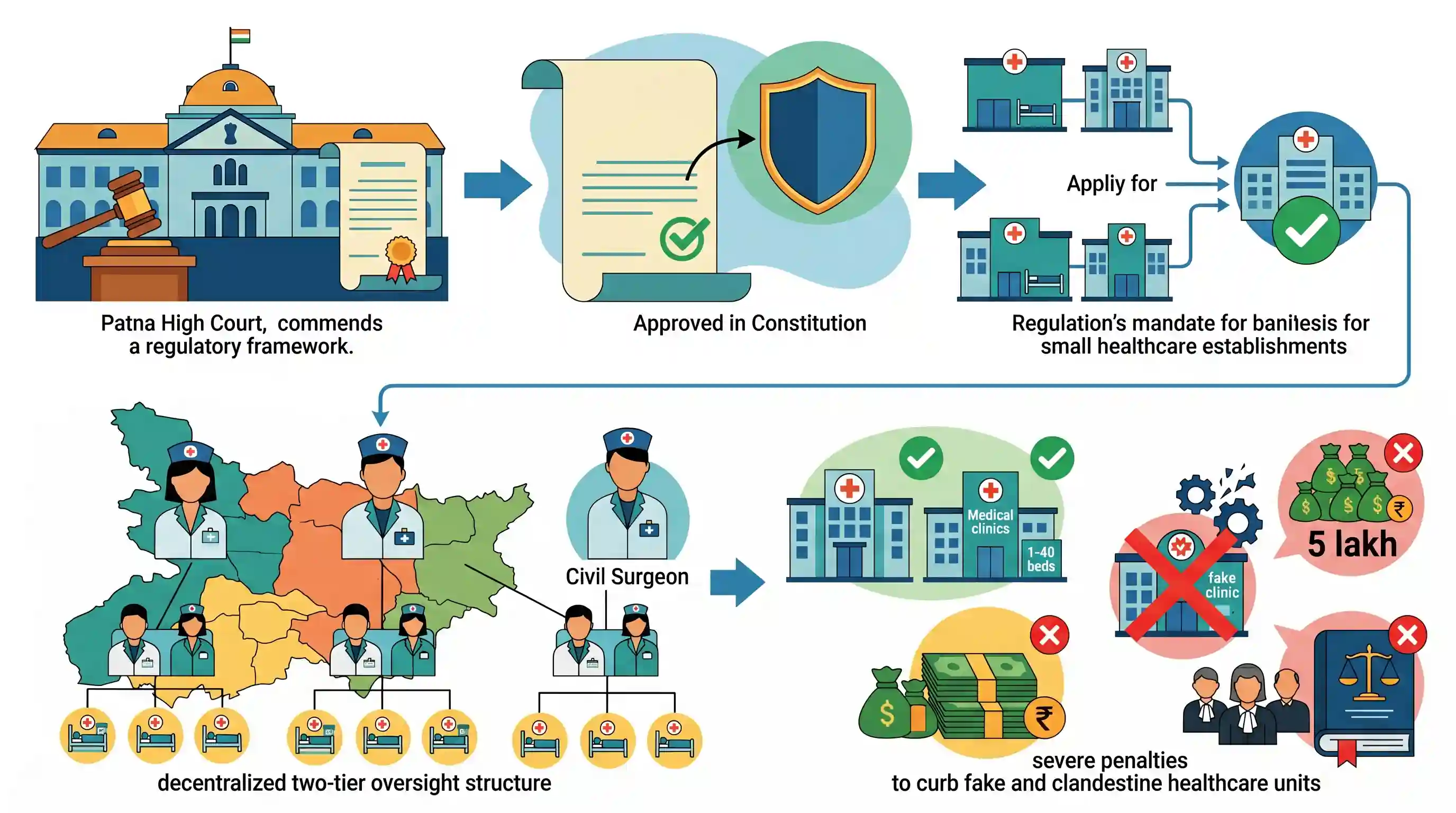
The Patna High Court has commended Bihar's new regulatory framework, the 'Bihar Small and Medium Healthcare Establishments (Establishment and Registration) Regulations, 2026,' promulgated under Article 162 of the Constitution. This regulation mandates registration for small-scale medical facilities (1 to 40 beds), instituting a decentralized two-tier oversight structure led by regional Civil Surgeons. Severe penalties, including fines up to Rs 5 lakh and prosecution under the Bharatiya Nyaya Sanhita (BNS), have been laid down to curb fake and clandestine healthcare units.
Key Points
- The Patna High Court, led by Justice Rajiv Roy, commended the Bihar government's proactive action plan to systematically eliminate unregistered, illegal private clinics and nursing homes.
- The Bihar Health Department officially notified the Bihar Small and Medium Healthcare Establishments (Establishment and Registration) Regulations, 2026, issued under Article 162 of the Constitution.
- The new regulations apply to all small-scale hospitals, nursing homes, and maternity clinics operating with 1 to 40 beds, making registration legally mandatory.
- The policy introduces a decentralized two-tier governance system comprising a State Council and District Registration Authorities headed by regional Civil Surgeons.
- Facilities must obtain streamlined online provisional registration within 15 days of application.
- Operating an unregistered healthcare facility attracts a fine of up to Rs 25,000, subsequent sealing, and prosecution under the Bharatiya Nyaya Sanhita (BNS).
- Obstructing official inspections or furnishing false information to authorities invites severe penalties extending up to Rs 5 lakh.
Important Terms
Bihar Small and Medium Healthcare Establishments (Establishment and Registration) Regulations, 2026

State-level rules making registration mandatory for clinics with 1 to 40 beds in Bihar, introducing a decentralized, online provisional registration process to improve patient safety and suppress illegal clinics.
UPSC context
GS Paper II: Governance & Public Health. Tests knowledge of state-level health sector reforms and regulatory frameworks.
Bharatiya Nyaya Sanhita
The primary official criminal code of India that replaced the Indian Penal Code (IPC) in July 2024, modernizing and consolidating offenses, punishments, and criminal procedures across the country.
UPSC context
GS Paper II: Criminal Justice Reforms. Tests understanding of legal modifications and the transition to native criminal laws.
Article 162 of the Constitution of India
A constitutional provision dictating that the executive power of a State extends to all matters upon which the State Legislature has the power to make laws.
UPSC context
GS Paper II: Federalism & State Executive. Tests understanding of the division of executive and legislative powers between Union and States.
Patna High Court
The constitutional High Court of Bihar, established in 1916, possessing writ jurisdiction to safeguard fundamental rights and supervise the state's subordinate judiciary and administration.
UPSC context
GS Paper II: Judiciary & Public Policy. Tests awareness of high court jurisdictions and judicial interventions in governance issues.
District Registration Authorities
Decentralized administrative bodies headed by regional Civil Surgeons, tasked with registering, regulating, and monitoring local clinical establishments to enforce statutory healthcare standards.
UPSC context
GS Paper II: Health Governance & Decentralization. Tests understanding of local administrative mechanisms implementing social sector schemes and regulatory acts.
State Council
An apex state-level body responsible for advising and overseeing healthcare standards, maintaining state clinical registries, and coordinating with district authorities in public health administration.
UPSC context
GS Paper II: Public Health & Regulatory Bodies. Tests understanding of statutory advisory bodies in state-level policy execution.
Prelims Trap
State executive power under Article 162 can only be exercised to implement existing statutory laws passed by the State Legislature.
Under Article 162, the executive can issue administrative regulations even in the absence of an active state law, provided it has legislative competence over the subject and does not violate existing statutes.
Static Concepts Connected
What is the scope of State Executive Power under Article 162 of the Indian Constitution?
- Legislative alignment: The executive power of a State is co-extensive and co-terminus with its legislative competence, covering State and Concurrent List subjects.
- Absence of law: The executive can issue administrative orders or guidelines on a subject even if no specific legislative Act exists on it, provided they do not infringe fundamental rights or violate existing laws.
- Concurrent limitation: On Concurrent List matters, the State's executive power is subordinate to and limited by the executive power expressly conferred upon the Union by parliamentary laws.
How does Article 252 enable Parliament to legislate on State List subjects like Public Health?
- Consent mechanism: If legislatures of two or more states pass resolutions requesting Parliament to enact a law on a State List subject, Parliament gains the power to legislate.
- Voluntary adoption: The resulting Act applies only to the consenting states and any other state that subsequently adopts it via legislative resolution.
- Amendment limit: Once passed under Article 252, such an Act can only be amended or repealed by Parliament, not by the individual state legislatures.
Cross-Topic Patterns
Judicial directives and executive governance
Courts using suo motu powers to force state executives to frame regulations under Article 162 highlights the expanding role of the judiciary in filling regulatory vacuums in public health.
Article 252 and health federalism
The uneven state-by-state adoption of the Central Clinical Establishments Act 2010 illustrates how constitutional provisions like Article 252 balance national standardization with state-level federal autonomy.

2026 Prelims may test the limits of executive power under Article 162 versus Article 252 legislative procedures for State List subjects.
Linked PYQs · 1
Linked PYQs · 1
- 2019BPSC_PRELIMSGS1
In NITI Aayog's Health Index, 2019, Bihar scored
