Sixteenth Finance Commission Modifies Devolution and GDP Criteria
Source:The Hindu ↗
Why It Matters
The Finance Commission dictates the financial relations between the Union and the States. Understanding its recommendations, especially changes in horizontal devolution criteria and the debate over cesses/surcharges, is crucial for answering questions on fiscal federalism, cooperative federalism, and Centre-State disputes.
Summary
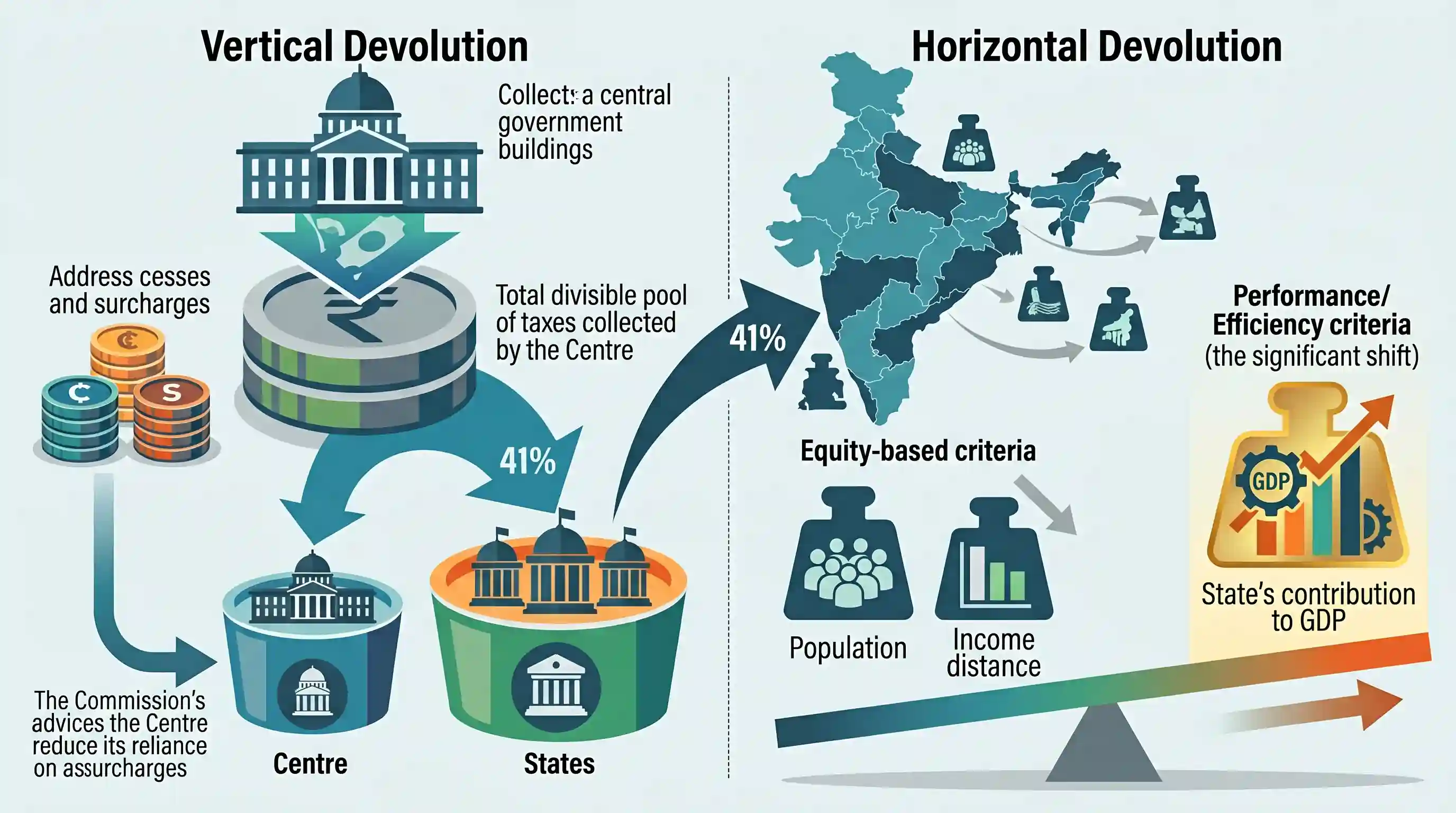
The 16th Finance Commission, headed by Dr. Arvind Panagariya, has submitted its recommendations for the period 2026-31. While maintaining the vertical devolution of the divisible pool of taxes to states at 41%, the Commission declined states' requests to cap or include cesses and surcharges in the divisible pool. However, it urged the Centre to gradually reduce its reliance on them. In a significant shift in horizontal devolution, the FC introduced 'State's contribution to GDP' as a new criterion to reward economic efficiency and performance, partially shifting the balance away from purely equity-based parameters like income distance and population. The report maintains a broad status quo on vertical sharing while signaling a directional shift towards incentivizing states' growth contributions.
Key Points
- The 16th Finance Commission (FC) has recommended retaining the vertical devolution of taxes to states at 41%, resisting states' demands to raise it to 50%.
- Cesses and surcharges, which have grown to comprise ~19% of Gross Tax Revenues, remain outside the divisible pool as per Article 270, though the FC advised the Centre to progressively reduce them.
- A new criterion for horizontal devolution, 'State's contribution to GDP', was introduced to reward states for economic efficiency and growth, addressing long-standing grievances of industrialised states.
- The shift marginally reduces the overwhelming dominance of 'equity' and 'needs' criteria (like income distance and population) seen since the 13th FC, establishing a directional change towards rewarding performance.
- The Commission also advised states to focus on power sector reforms and better targeting of subsidies to maintain fiscal health.
Important Terms
16th Finance Commission

A constitutional body chaired by Dr. Arvind Panagariya recommending tax sharing for 2026-31; it maintained vertical devolution at 41% and introduced "State’s contribution to GDP" as a horizontal distribution criterion.
UPSC context
GS-II/GS-III (Federalism/Economy). Tests knowledge of current fiscal recommendations and performance-based incentives in Centre-State relations.
Article 280 of the Constitution
Constitutional provision under which the President constitutes a Finance Commission every five years to recommend the distribution of net tax proceeds between the Union and States.
UPSC context
GS-II (Polity). Essential for understanding the constitutional mechanism governing India's fiscal federal structure and resource allocation.
Article 270 of the Constitution
Governs the distribution of net proceeds of Union taxes (the divisible pool) between the Centre and States, specifically excluding revenue from cesses and surcharges.
UPSC context
GS-II (Polity). Tests conceptual clarity on the constitutional framework of financial relations and the definition of shared tax revenue.
Vertical Devolution
The division of the central divisible pool of taxes between the Union government and all state governments collectively (held at 41% for 2026-31).
UPSC context
GS-III (Economy). Focuses on vertical fiscal imbalance and the Union’s power over revenue versus States' expenditure responsibilities.
Horizontal Devolution
The formula-based distribution of the states' total share of central taxes among individual states, balancing equity (income distance) and efficiency (performance).
UPSC context
GS-III (Economy). Tests understanding of inter-state equity, demographic shifts, and the trade-off between rewarding growth versus supporting backward regions.
Divisible Pool
The portion of central tax revenue that is shared with states, excluding collection costs and revenues from cesses and surcharges.
UPSC context
GS-III (Economy). Significant for analyzing the impact of "cess and surcharge" on the actual financial share received by States.
State’s contribution to GDP
A new 10% weightage criterion introduced by the 16th FC to reward states for their economic performance and growth contribution to the national GDP.
UPSC context
GS-III (Economy). Tests ability to evaluate shifts toward efficiency-based fiscal federalism and its impact on regional disparities.
Prelims Trap
"The 16th Finance Commission mandated the inclusion of cesses and surcharges in the divisible pool of taxes."
Article 270 explicitly excludes cesses and surcharges from the divisible pool. The FC cannot alter this constitutional boundary; it can only advise the Centre to reduce reliance on them.
Static Concepts Connected
What are the core constitutional provisions governing the Finance Commission?
- Article 280: Mandates the President to constitute a Finance Commission every five years or earlier to recommend tax distribution.
- Article 270: Defines the divisible pool of taxes levied by the Union but shared with States, explicitly excluding cesses and surcharges (Article 271).
- Article 275: Provides for statutory grants-in-aid to states in need, distributed based on the Finance Commission's recommendations.
What is the difference between Vertical and Horizontal tax devolution?
- Vertical Devolution: The distribution of net tax proceeds between the Union government and all state governments collectively (e.g., maintaining at 41%).
- Horizontal Devolution: The formula or criteria used to allocate the collective states' share among individual states (e.g., population, income distance, and now GDP contribution).
Cross-Topic Patterns
Demographic Dividend vs. Fiscal Penalty
Southern states with lower fertility rates historically faced reduced allocations under population-heavy criteria. The new 'GDP contribution' metric attempts to balance this long-standing equity vs. efficiency debate.
Power Sector Drain on State Finances
The 16th FC's focus on power reforms echoes schemes like UDAY and RDSS, highlighting chronic DISCOM losses as a systemic macroeconomic risk tied to state fiscal deficit limits.

Expect a multi-statement Prelims question on Article 270/271, cesses vs surcharges, and the 16th FC's new 'GDP contribution' metric.
Linked PYQs · 5
Linked PYQs · 5
- 2025MainsGS2
Examine the evolving pattern of Centre-State financial relations in the context of planned development in India. How far have the recent reforms impacted the fiscal federalism in India?
- 2021MainsGS2
How have the recommendations of the 14th Finance Commission of India enabled the States to improve their fiscal position?
- 2018MainsGS2
How is the Finance Commission of India constituted? What do you know about the terms of reference of the recently constituted Finance Commission? Discuss.
- 2015PrelimsGS1
With reference to the Fourteenth Finance Commission, which of the following statements is/are correct? 1. It has increased the share of States in the central divisible pool from 32 percent to 42 percent. 2. It has made recommendations concerning sector-specific grants. Select the correct answer using the code given below.
- 2025PrelimsGS1
Which of the following statements with regard to recommendations of the 15th Finance Commission of India are correct? I. It has recommended grants of ₹ 4,800 crores from the year 2022-23 to the year 2025-26 for incentivizing States to enhance educational outcomes. II. 45% of the net proceeds of Union taxes are to be shared with States. III. ₹ 45,000 crores are to be kept as performance-based incentive for all States for carrying out agricultural reforms. IV. It reintroduced tax effort criteria to reward fiscal performance. Select the correct answer using the code given below.
