Allahabad High Court Rehabilitation Order and Atrocities Act
Source:theprint ↗
Why It Matters
The article illustrates the ongoing societal and legal challenges in addressing atrocities against vulnerable sections, the practical implementation of the SC/ST Act, and the vital role of High Courts in enforcing rehabilitation and the Right to Life under Article 21.
Summary
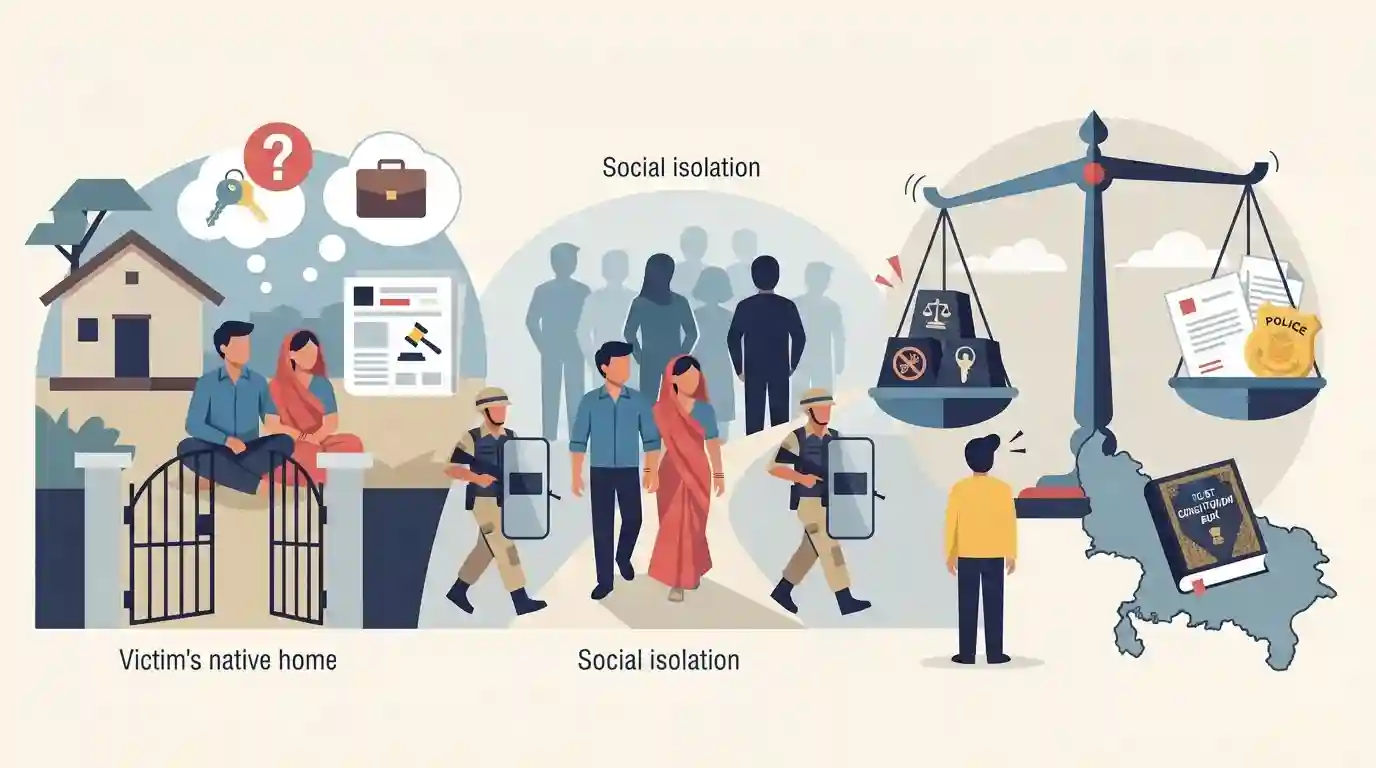
The family of the 2020 Hathras rape victim has cautiously welcomed the Allahabad High Court's directive ordering the Uttar Pradesh government to provide them with a house in Noida or Ghaziabad and a job within three months. Despite the court order, the family remains skeptical about its implementation, citing past unfulfilled promises. Living under tight CRPF security in their native village, the family faces ongoing social boycott and safety concerns, underscoring the severe challenges marginalized communities encounter when seeking justice under the SC/ST (Prevention of Atrocities) Act.
Key Points
- The Allahabad High Court directed the Uttar Pradesh government to provide the 2020 Hathras victim's family with housing in Noida or Ghaziabad and a government job within three months.
- The family, currently living under CRPF security in Bulgarhi village, had declined prior offers of housing in Aligarh, Kasganj, or Etah due to safety concerns.
- In March 2023, the SC/ST court in Hathras acquitted three of the four accused in the case and found the prime accused guilty only of culpable homicide not amounting to murder, not rape.
- The case highlights the systemic challenges in securing justice and rehabilitation for victims of atrocities, as well as the crucial role of the judiciary in enforcing the state's obligations towards marginalized communities.
Important Terms
SC/ST (Prevention of Atrocities) Act

A landmark 1989 social justice legislation designed to prevent caste-based violence, discrimination, and humiliation against marginalized communities, ensuring stringent punishments and victim rehabilitation.
UPSC context
GS Paper 2 (Social Justice). Tests knowledge of statutory protections, marginalized sections, and mechanisms for ending caste violence.
Allahabad High Court
The high court with jurisdiction over Uttar Pradesh. It directed the state government to provide housing and employment rehabilitation to the 2020 Hathras victim's family.
UPSC context
GS Paper 2 (Judiciary). Important for UPPSC to examine judicial activism upholding Article 21 and compelling state accountability.
Central Reserve Police Force (CRPF)
India's largest Central Armed Police Force. Under Supreme Court directions, CRPF personnel provide round-the-clock security and witness protection to the Hathras victim's family.
UPSC context
GS Paper 3 (Internal Security). Relevant for understanding central forces' deployment for specialized security roles and witness protection.
National Human Rights Commission (NHRC)
An independent statutory body established under the Protection of Human Rights Act, 1993, responsible for monitoring human rights violations and ensuring constitutional guarantees of dignity.
UPSC context
GS Paper 2 (Statutory Bodies). Tests institutional frameworks for protecting vulnerable groups from custodial and caste violence.
SC/ST Court
Designated judicial courts established under the SC/ST (Prevention of Atrocities) Act to ensure speedy trials, grievance redressal, and exclusive justice delivery for caste-based crimes.
UPSC context
GS Paper 2 (Judiciary). Highlights the specialized justice delivery mechanisms designed to resolve systemic delays in atrocities cases.
Prelims Trap
"Article 17 (Abolition of Untouchability) falls under the Right against Exploitation."
Aspirants mistakenly group Article 17 here due to the nature of atrocities. However, Article 17 falls under the "Right to Equality" (Articles 14-18), not Exploitation (23-24).
Static Concepts Connected
What are the key features of the SC/ST (Prevention of Atrocities) Act, 1989?
- Special Courts: Mandates the establishment of exclusive Special Courts for the speedy trial of offenses against marginalized communities.
- No Anticipatory Bail: Section 18 explicitly bars the application of anticipatory bail (Section 438 of CrPC) for persons accused under this Act.
- Relief and Rehabilitation: Provides strict statutory frameworks for the immediate compensation, relief, and socio-economic rehabilitation of victims.
How has the Judiciary expanded Article 21 regarding victim rehabilitation?
- Right to Dignity: The Right to Life is interpreted to include adequate housing and livelihood, recognizing that mere physical survival is insufficient for dignity.
- State Obligation: Judgments impose affirmative obligations on the State to provide socio-economic rehabilitation to victims of atrocities, ensuring meaningful restorative justice.
Cross-Topic Patterns
Article 21 and executive welfare gaps
The High Court's directive for housing and jobs underscores the gap between executive welfare implementation and the judicial enforcement of Article 21 rights for marginalized groups.
NCSC and NHRC intersecting mandates
Severe atrocities against marginalized communities often trigger overlapping investigations by both the National Human Rights Commission (NHRC) and the National Commission for Scheduled Castes (Article 338).

Expect a multi-statement UPPSC prelims question combining Article 17's placement, DPSP Article 46, and the SC/ST Act's bail provisions.
Linked PYQs · 1
Linked PYQs · 1
- 2024UPPSC_PRELIMSGS1
Which of the following are envisaged by the Right against Exploitation in the Constitution of India ? 1. Abolition of untouchability 2. Prohibition of human trafficking and forced labour 3. Prohibition of employment of children in factories and mines 4. Protection of interests of minorities Select the correct answer from the codes given below :
