China Stance on Bangladesh Tribunal Verdict and Non Interference
Source:The Hindu ↗
Why It Matters
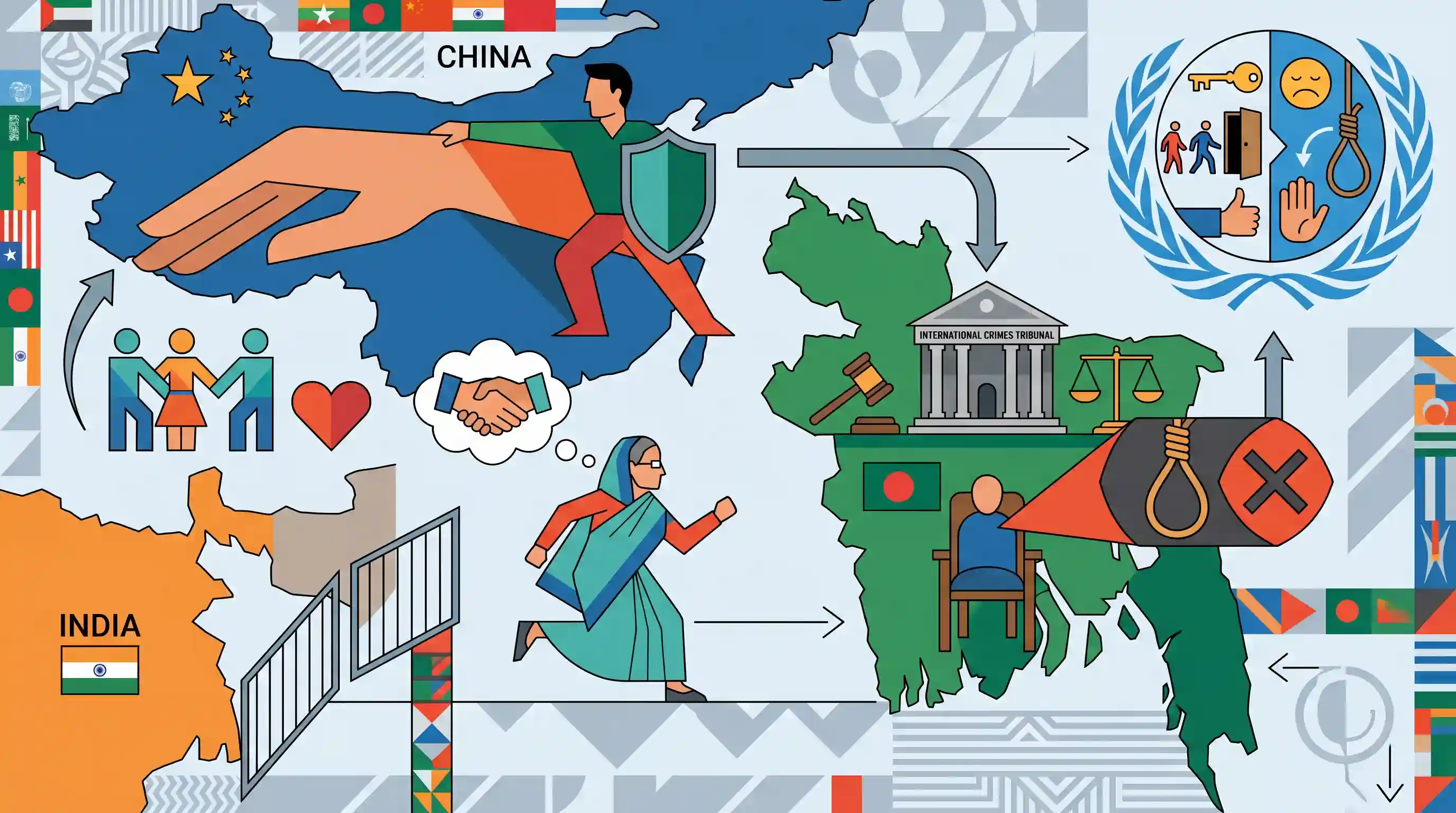
The geopolitical fallout of Sheikh Hasina's ouster and subsequent death sentence deeply impacts India-Bangladesh bilateral relations, particularly given her asylum in India and potential extradition demands. China's calculated non-interference stance allows Beijing to court the new administration in Dhaka, illustrating the strategic competition between India and China in South Asia. Additionally, it highlights issues around international tribunals, political asylum, and the UN's stance on capital punishment.
Summary
China has characterized the death sentence issued to Bangladesh's former Prime Minister Sheikh Hasina by the International Crimes Tribunal (ICT) in absentia as an "internal affair" of Bangladesh. The Chinese Foreign Ministry underscored its policy of non-interference and reaffirmed its commitment to good neighbourliness with Dhaka. Meanwhile, Hasina remains in India after fleeing widespread student-led protests that toppled her government. The United Nations responded by calling the verdict a significant step for victims of the crackdown, while simultaneously expressing regret over the imposition of the death penalty.
Key Points
- Bangladesh's International Crimes Tribunal sentenced former PM Sheikh Hasina to death in absentia for crimes against humanity during student-led protests.
- Hasina has been residing in India since fleeing the political unrest in August 2024, raising potential bilateral extradition complexities.
- China officially termed the death sentence an internal affair of Bangladesh, adhering to its foreign policy of non-interference.
- Chinese officials emphasized a commitment to good neighbourliness and maintaining friendly relations with the Bangladeshi people.
- The UN acknowledged the verdict as an important step for the victims of the crackdown but reiterated its principled stance against the death penalty.
Important Terms
International Crimes Tribunal (ICT)

A domestic court in Bangladesh (not an international one) established to prosecute individuals for genocide, crimes against humanity, and war crimes, including those from the 1971 war and 2024 unrest.
UPSC context
GS II: Statutory, regulatory and various quasi-judicial bodies; neighborhood relations. Important for understanding legal proceedings in Bangladesh affecting India.
Principle of Non-Interference
A diplomatic doctrine—core to the 1954 Panchsheel Agreement—stating that sovereign states must not intervene in the domestic legal, political, or social affairs of another nation.
UPSC context
GS II: Bilateral, regional and global groupings; India-China relations. Tests understanding of regional diplomatic frameworks.
Extradition Treaty
A legal agreement between two nations (e.g., India-Bangladesh 2013) for the reciprocal surrender of individuals accused or convicted of extraditable crimes to face trial or punishment.
UPSC context
GS II: Bilateral relations; International Law. Essential for analyzing the legal complexities of repatriating high-profile political figures.
Crimes Against Humanity
Widespread or systematic acts committed as part of a state or organizational policy to target civilians, including mass murder, torture, and enforced disappearances.
UPSC context
GS II: International relations; Human Rights. Tests knowledge of the legal thresholds for prosecuting political leadership in international law.
Doctrine of Superior Command Responsibility
The legal principle under which a leader is held criminally liable for crimes committed by subordinates if they failed to prevent or punish such actions despite having control.
UPSC context
GS II: International Law; India and neighborhood. Relevant for analyzing the specific legal basis for convictions of heads of state.
Capital Punishment (Death Penalty)
The legal execution of an individual by the state as punishment for a crime; opposed by the UN in all circumstances as a violation of human rights.
UPSC context
GS II: Human rights; International organizations. Tests understanding of global human rights norms versus sovereign domestic laws.
Prelims Trap
"The International Crimes Tribunal (ICT) is a UN-backed international court."
Despite its misleading name, the ICT is a purely domestic special court established by Bangladesh under a 1973 national law. It is not an international or UN-backed tribunal.
Static Concepts Connected
What governs extradition requests and refusals in India?
- Extradition Act 1962: All international extradition requests to India are governed domestically by the Extradition Act, 1962.
- Dual Criminality: The alleged action must be considered a punishable crime under the laws of both India and the requesting country.
- Political Offence Exception: Section 31 allows India to refuse extradition for political offences, though bilateral treaties usually exclude murder and terrorism from this protection.
How is the UN's stance on the death penalty internationally formalized?
- ICCPR Protocol: The Second Optional Protocol to the International Covenant on Civil and Political Rights (ICCPR), adopted in 1989.
- Abolition Commitment: It legally commits all ratifying member states to abolish capital punishment within their jurisdictions, forming the basis of the UN's principled opposition.
Cross-Topic Patterns
Extradition laws + India's refugee vacuum
The Hasina extradition dilemma highlights the tension between the 2013 India-Bangladesh Extradition Treaty and India's lack of a formal, codified national refugee or asylum framework.
Non-interference + China's foreign policy
China's dismissal of the verdict as an 'internal affair' reflects its routine use of the 1954 Panchsheel principle of non-interference to navigate geopolitical shifts without alienating new regimes.
ICCPR + Global death penalty abolition
The UN's response reflects the Second Optional Protocol to the ICCPR (1989), showcasing the friction between domestic judicial sovereignty and international human rights commitments regarding capital punishment.

The 'political offence exception' and 'dual criminality' in India's Extradition Act 1962 are prime targets for a 2026 Prelims question.
Linked PYQs · 4
Linked PYQs · 4
- 2022MainsGS2
Do you think that BIMSTEC is a parallel organisation like the SAARC ? What are the similarities and dissimilarities between the two ? How are Indian foreign policy objectives realized by forming this new organisation?
- 2015MainsGS2
Project 'Mausam' is considered a unique foreign policy initiative of the Indian Government to improve relationship with its neighbours. Does the project have a strategic dimension? Discuss.
- 2025PrelimsGS1
Consider the following statements in respect of BIMSTEC : I. It is a regional organization consisting of seven member States till January 2025. II. It came into existence with the signing of the Dhaka Declaration, 1999. III. Bangladesh, India, Sri Lanka, Thailand and Nepal are founding member States of BIMSTEC. IV. In BIMSTEC, the subsector of 'tourism' is being led by India. Which of the statements given above is/are correct?
- 2023PrelimsGS1
Consider the following statements: 1. Recently, all the countries of the United Nations have adopted the first-ever compact for international migration, the 'Global Compact for Safe, Orderly and Regular Migration (GCM)'. 2. The objectives and commitments stated in the GCM are binding on the UN member countries. 3. The GCM addresses internal migration or internally displaced people also in its objectives and commitments. How many of the above statements are correct?
