Bangladesh Tribunal Verdict and Political Turmoil in Neighborhood
Source:Indian Express ↗
Why It Matters
Understanding the political dynamics in Bangladesh is crucial for UPSC aspirants, as instability in the neighborhood directly impacts India's border security, foreign policy (Neighbourhood First), and regional diplomacy. The incident also offers a case study on the importance of independent institutions and due process in democratic transitions.
Summary
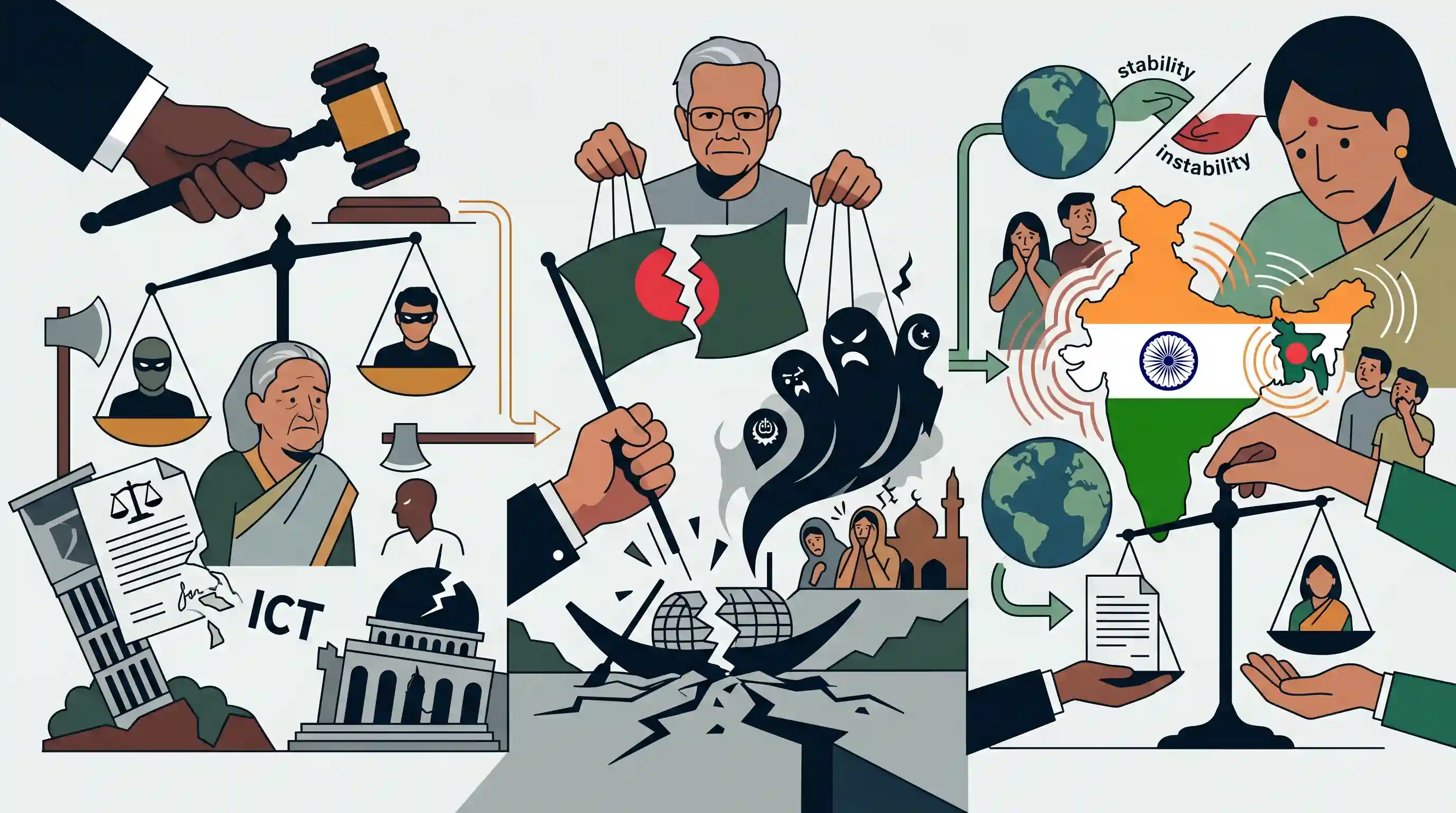
The editorial criticizes the death sentence handed to former Bangladesh Prime Minister Sheikh Hasina by the International Crimes Tribunal (ICT) as a politically motivated travesty of justice. It highlights the lack of due process, the partisan nature of the tribunal, and the questionable democratic credentials of the Muhammad Yunus-led interim government, which has also banned Hasina's Awami League. The ensuing political vacuum and rise in Islamist extremism pose a threat to regional stability and minority rights. Furthermore, the verdict places India in a delicate diplomatic position regarding Dhaka's extradition requests for Hasina.
Key Points
- A domestic International Crimes Tribunal (ICT) in Bangladesh sentenced former PM Sheikh Hasina to death for the deaths of protesters during the anti-quota agitation, in a trial widely criticized for lacking due process and judicial independence.
- The interim government led by Muhammad Yunus has faced backlash for supporting the verdict and banning Hasina’s Awami League, raising concerns about the democratic legitimacy of the elections planned for 2026.
- The political instability and rise of Islamist politics since Hasina's ouster have escalated threats against Hindus and other minorities in Bangladesh.
- The conviction presents a major diplomatic challenge for India, which is currently hosting Hasina and faces pressure from Dhaka for her extradition.
Important Terms
International Crimes Tribunal (ICT)

A domestic tribunal in Bangladesh established to prosecute genocide and crimes against humanity; recently used to sentence former PM Sheikh Hasina for the 2024 protest crackdowns.
UPSC context
GS Paper II (Neighborhood Relations/Judiciary). Tests understanding of neighboring legal systems and their impact on regional human rights and stability.
Awami League
A major Bangladeshi political party historically led by Sheikh Hasina; it was banned in 2025 and barred from the 2026 elections following the 2024 student uprising.
UPSC context
GS Paper II (Neighborhood Relations). Relevant for understanding political shifts in neighboring states and their repercussions on India's strategic interests.
India-Bangladesh Extradition Treaty
A 2013 bilateral agreement (amended 2016) that facilitates the transfer of fugitives; it requires "dual criminality" but allows refusal for "political offenses" or lack of good faith.
UPSC context
GS Paper II (Bilateral Relations). Crucial for questions on security cooperation, legal diplomacy, and the challenges of high-profile extraditions.
Interim Government
The temporary administration led by Muhammad Yunus, formed to manage Bangladesh's transition and organize elections following the collapse of the Hasina government in August 2024.
UPSC context
GS Paper II (Governance/Democracy). Concerns the stability of neighboring regimes and India's diplomatic engagement during transitions of power.
Crimes Against Humanity
Serious, systematic offenses committed against a civilian population; the specific legal charge leading to Sheikh Hasina's death sentence for her role in suppressing 2024 protests.
UPSC context
GS Paper II (International Law/Human Rights). Tests knowledge of legal standards for accountability and the mandate of special tribunals.
Dual Criminality
A legal requirement in extradition law stating that the act must be a punishable crime in both the requesting country and the country holding the suspect.
UPSC context
GS Paper II (International Relations). A technical term essential for analyzing bilateral legal treaties and extradition processes.
Prelims Trap
The International Crimes Tribunal (ICT) of Bangladesh operates under the jurisdiction of the International Criminal Court (ICC).
The ICT is a domestic, ad-hoc court established in 2009 under Bangladesh's national law. It has no structural linkage to the UN or ICC.
Static Concepts Connected
What are the grounds for refusing extradition under the Indian Extradition Act, 1962?
- Political character: Requests can be denied if the Indian government deems the offense to be of a political nature, though terrorism and murder of heads of state are typically excluded.
- Discriminatory intent: Refusal is permitted if the extradition request is perceived as a pretext to prosecute or punish someone based on their race, religion, or political opinions.
- Dual criminality: The act in question must be a punishable offense under the domestic laws of both the requesting state and India.
How does Bangladesh fit into India's regional economic and strategic frameworks?
- Top trade partner: Bangladesh is India's largest trading partner in South Asia, with bilateral trade reaching approximately $14 billion in FY24.
- Trade agreements: Bilateral trade relies on the South Asian Free Trade Area (SAFTA), with ongoing negotiations for a bilateral Comprehensive Economic Partnership Agreement (CEPA).
- Strategic connectivity: Restored rail links and access to Chattogram and Mongla ports provide vital transit corridors connecting mainland India to its landlocked Northeastern states.
Cross-Topic Patterns
Extradition treaties vs. Political offenses
Tests how bilateral extradition treaties interact with domestic laws (Extradition Act 1962), particularly the "political offense" exception and sovereign discretion, echoing past UK and Malaysia extradition disputes.
Neighborhood instability and the CAA
The targeted violence against Hindu minorities in post-Hasina Bangladesh directly connects to the geopolitical rationale underlying India's Citizenship Amendment Act (CAA) and cross-border refugee management.
Neighborhood First vs. Domestic regime change
The crisis highlights the fragility of India's "Neighborhood First" policy when domestic regime changes in adjacent nations threaten strategic connectivity projects (like the Northeast transit routes) and trade zones.

UPSC 2026 will likely test the 'political offense' and 'dual criminality' exceptions under the Extradition Act 1962 via IR statements.
Linked PYQs · 2
Linked PYQs · 2
- 2023MainsGS2
“Constitutionally guaranteed judicial independence is a prerequisite of democracy.” Comment.
- 2022MainsGS2
India is an age-old friend of Sri Lanka.’ Discuss India's role in the recent crisis in Sri Lanka in the light of the preceding statement.
