India environmental crisis and regulatory challenges for governance
Source:The Hindu ↗
Why It Matters
This article provides a critical analysis of India's environmental trajectory, which is highly relevant for UPSC aspirants answering questions on environmental governance, the socioeconomic impacts of climate change, groundwater depletion, urban flooding, and the ongoing debate between developmental imperatives and ecological conservation.
Summary
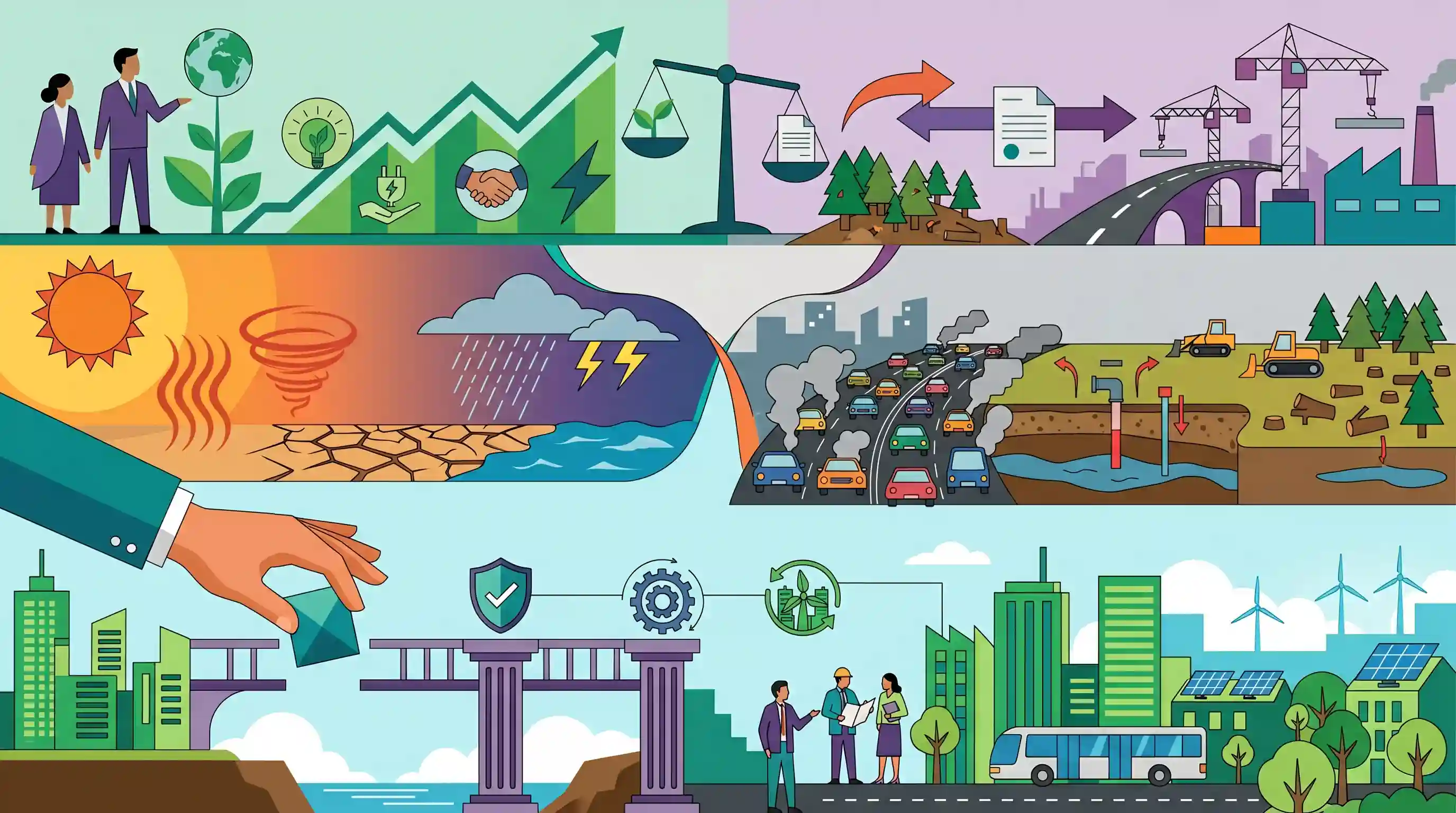
The article examines whether India's environmental crisis is worsening, highlighting the intersection of climate change impacts—such as extreme weather events, heatwaves, and erratic monsoons—with localized ecological degradation like groundwater depletion, air pollution, and deforestation. It scrutinizes the paradox of India's ambitious global climate commitments versus domestic regulatory shifts, such as recent amendments to the Forest Conservation Act and EIA norms, which critics argue prioritize infrastructure development over ecological conservation. The piece underscores the urgent need to bridge this gap through robust enforcement of environmental laws like the Environment (Protection) Act, 1986, and the adoption of sustainable urban planning to mitigate the exacerbating crisis.
Key Points
- Increasing frequency and intensity of extreme weather events, including urban flooding and severe heatwaves, underscore a worsening environmental crisis in India.
- Persistent ecological degradation is evident in severe air and river water pollution, alongside alarming rates of groundwater depletion that threaten national water security.
- Recent regulatory shifts, such as amendments to the Forest Conservation Act and the easing of EIA norms, have sparked concerns about prioritizing infrastructure and strategic development over ecological integrity.
- There is a notable dichotomy between India's ambitious international climate commitments (e.g., net-zero targets and advocacy for carbon markets) and the on-ground enforcement of domestic environmental regulations.
- Mitigating the crisis requires a robust implementation of the Environment Protection Act, sustainable urban resilience planning, and integrated policies to balance economic growth with environmental conservation.
Important Terms
Environment (Protection) Act, 1986

An 'umbrella' legislation enacted under Article 253 following the Bhopal Gas Tragedy, empowering the Central Government to coordinate environmental protection, set pollutant standards, and regulate hazardous substances.
UPSC context
GS Paper III: Environment; a foundational statute for pollution control and statutory authorities like the CGWA.
Forest Conservation (Amendment) Act, 2023
A recent legislative change limiting the Act's scope to notified forest lands and exempting strategic border projects (within 100km) and eco-tourism from the requirement of prior central forest clearance.
UPSC context
GS Paper III: Conservation; critical for understanding the tension between national security, infrastructure, and ecological preservation.
Environmental Impact Assessment (EIA) Notification
A statutory process under the EPA 1986 used to evaluate the potential environmental socio-economic impacts of proposed industrial or infrastructure projects before granting mandatory 'green' clearances.
UPSC context
GS Paper III: Environmental Impact Assessment; specifically tests the balance between ease of doing business and environmental safeguards.
Paris Agreement
A 2015 legally binding international treaty under the UNFCCC aiming to limit global warming to well below 2°C, preferably 1.5°C, compared to pre-industrial levels through national pledges.
UPSC context
GS Paper III: Climate Change; focuses on India's global commitments and the 'Nationally Determined Contributions' (NDCs) framework.
UNFCCC
The primary international environmental treaty aimed at stabilizing greenhouse gas concentrations, serving as the parent framework for the Paris Agreement and the Kyoto Protocol.
UPSC context
GS Paper III: International Conventions; foundational for all climate-related questions in both Prelims and Mains.
Central Ground Water Authority (CGWA)
A regulatory body constituted under the Environment (Protection) Act, 1986, to manage and regulate groundwater development, including issuing 'No Objection Certificates' for extraction.
UPSC context
GS Paper III: Resource Conservation; frequently tested in Prelims regarding its statutory origin and regulatory functions.
Ministry of Environment, Forest and Climate Change (MoEFCC)
The nodal ministry of the Government of India responsible for planning, promoting, and coordinating environmental and forestry programs, as well as overseeing climate change policies.
UPSC context
GS Paper II & III: Institutional Framework; responsible for implementing EIA norms and international environmental treaties.
Prelims Trap
"The Forest (Conservation) Amendment Act 2023 applies to all land defined as a forest in its dictionary meaning."
False. The 2023 amendment overrides the Godavarman judgment by restricting the Act's applicability strictly to land officially recorded as 'forest' in government records post-1980.
Static Concepts Connected
What is the statutory basis for Environmental Impact Assessment (EIA) in India?
- Statutory Backing: EIA derives its legal mandate from the Environment (Protection) Act, 1986, rather than a dedicated EIA statute.
- EIA Notification 2006: It is primarily governed by the EIA Notification 2006, which categorizes projects into Category A (national clearance) and Category B (state clearance).
- Public Consultation: Stage 3 of the EIA process mandates public hearings, though recent regulatory amendments have created broad exemption categories bypassing this step.
How did the Forest (Conservation) Amendment Act 2023 alter forest classification?
- Recorded Forests Only: The Act now only applies to land declared under the Indian Forest Act, 1927, or officially recognized in records post-1980.
- Border Exemptions: Strategic linear projects within 100 km of international borders or the Line of Control are broadly exempted from forest clearance.
- Pre-1996 Diverted Land: Forest land legally diverted for non-forest use before December 12, 1996, is no longer protected under this Act.
Cross-Topic Patterns
Net Zero targets vs. Domestic Policy
India's updated NDC (Panchamrit) targets emission intensity reduction, yet domestic push for strategic infrastructure frequently dilutes EIA norms. Expect questions contrasting international UNFCCC commitments with domestic statutory rollbacks.
Urban Flooding + Disaster Management
Urban flooding merges physical geography (erratic monsoons, heat-induced microclimates) with governance (NDMA guidelines on urban planning). Frequently tested in GS-3 Mains as a recurring disaster management failure.

Expect a 2026 Prelims multi-statement question contrasting the 1996 Godavarman 'dictionary' forest definition with the 2023 FCA amendments.
Linked PYQs · 5
Linked PYQs · 5
- 2024MainsGS3
Flooding in urban areas is an emerging climate-induced disaster. Discuss the causes of this disaster. Mention the features of two such major floods in the last two decades in India. Describe the policies and frameworks in India that aim at tackling such floods.
- 2024MainsGS3
Industrial pollution of river water is a significant environmental issue in India. Discuss the various mitigation measures to deal with this problem and also the government's initiatives in this regard.
- 2025MainsGS3
Examine the factors responsible for depleting groundwater in India. What are the steps taken by the government to mitigate such depletion of groundwater?
- 2022PrelimsGS1
Which one of the following has been constituted under the Environment (Protection) Act, 1986?
- 2019PrelimsGS1
Consider the following statements : The Environment Protection Act, 1986 empowers the Government of India to 1. state the requirement of public participation in the process of environmental protection, and the procedure and manner in which it is sought 2. lay down the standards for emission or discharge of environmental pollutants from various sources Which of the statements given above is/are correct?
