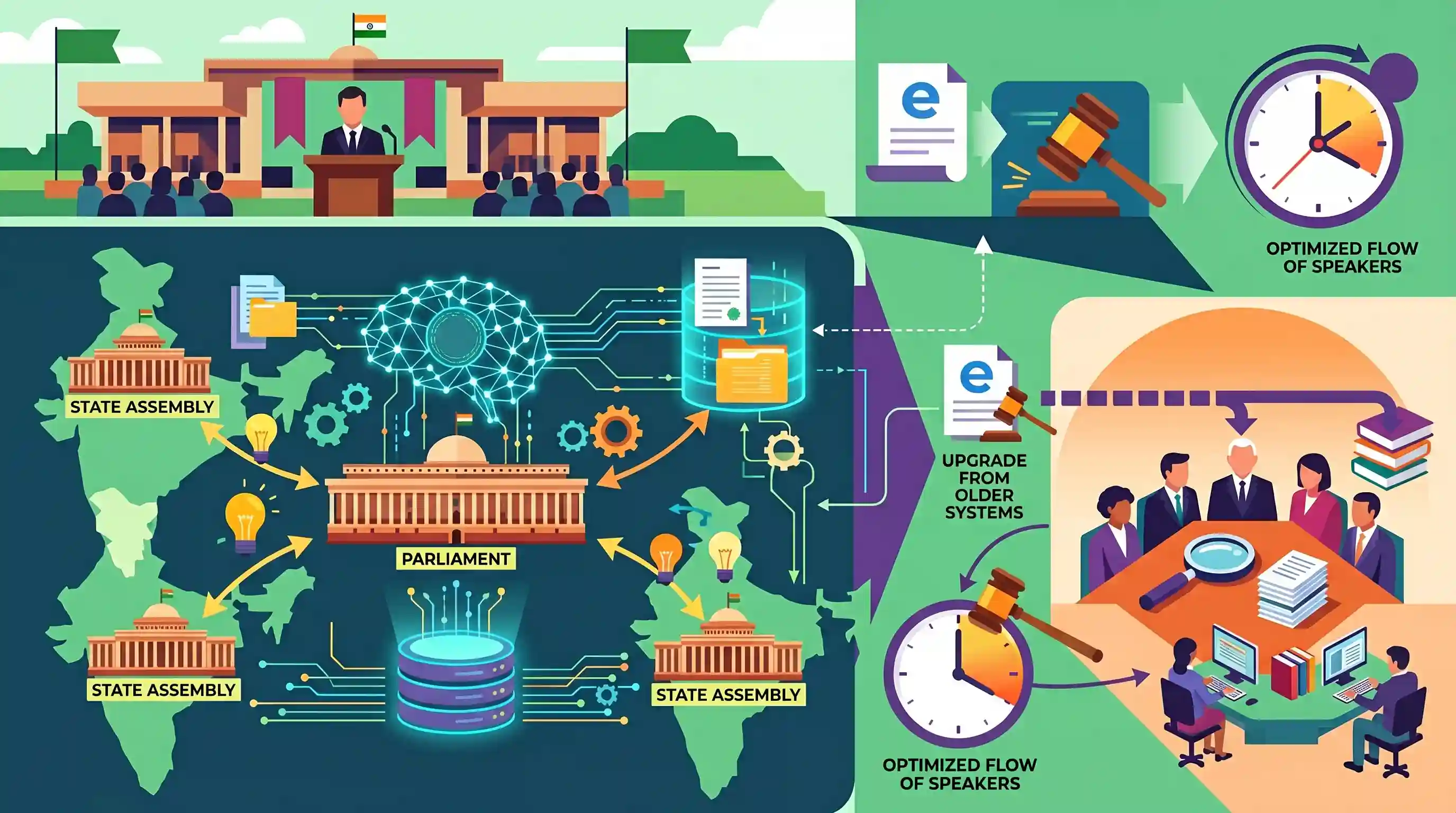
AI platform proposed to connect Parliament and state assemblies
Source:Indian Express ↗
Why It Matters
The integration of AI and e-governance in legislative functioning (beyond just NEVA) reflects the evolving nature of parliamentary democracy in India. Additionally, the focus on capacity building, research support, and the committee system touches directly upon the efficiency and accountability of the legislature, a core syllabus area in GS Paper 2.
Summary
The article discusses the North Zone Conference of the Commonwealth Parliamentary Association (CPA) held in Chandigarh. A prominent highlight of the event is the proposal to create a nationwide, AI-enabled digital platform connecting Parliament and all State Assemblies. Led by Lok Sabha Speaker Om Birla, this initiative advances the digitalization started by the National e-Vidhan Application (NEVA) by aiming to digitize all legislative debates and facilitate the cross-state sharing of best governance practices. Furthermore, Haryana Speaker Harvinder Kalyan highlighted internal reforms such as streamlining Zero Hour and creating dedicated research wings to strengthen the critical legislative committee system and enhance the capacity of MLAs.
Key Points
- Haryana hosted the North Zone Conference of the Commonwealth Parliamentary Association (CPA) focusing on the role of legislatures in realizing the goals of Viksit Bharat-2047.
- A major proposal is underway to connect Parliament and all State Assemblies via a common AI-enabled digital platform, building upon the paperless framework of the National e-Vidhan Application (NEVA).
- The AI platform aims to digitize legislative records and debates, allowing states to seamlessly exchange innovations and best practices (e.g., Kerala's legislative research institute).
- Haryana Assembly Speaker Harvinder Kalyan emphasized the need for a strong legislative committee system, dedicated research support for MLAs, and streamlined Zero Hour proceedings to improve governance and accountability.
Important Terms
National e-Vidhan Application (NEVA)

A Mission Mode Project under the Digital India initiative designed to digitize the legislative processes of all Indian State Assemblies into paperless institutions under 'One Nation, One Application'.
UPSC context
GS Paper 2: E-governance, transparency, and the functioning of State Legislatures. Tests knowledge of digital reforms in governance.
Commonwealth Parliamentary Association (CPA)
An international organization of Commonwealth parliaments that promotes democratic governance, rule of law, and parliamentary cooperation through regional conferences and knowledge sharing among legislators.
UPSC context
GS Paper 2: International associations and parliamentary diplomacy. Relevant for comparative governance and institutional cooperation.
Zero Hour
An informal Indian parliamentary innovation (not in Rules of Procedure) where members can raise matters of urgent public importance without prior notice immediately after Question Hour.
UPSC context
GS Paper 2: Parliamentary devices and conduct of business. Tests understanding of legislative accountability mechanisms.
Viksit Bharat-2047
The government's long-term roadmap to transform India into a developed nation by the centenary of its independence (2047), focusing on economic prosperity, social advancement, and modern governance.
UPSC context
GS Paper 2 & 3: Governance, growth, and development. Central theme for long-term policy analysis and developmental goals.
Parliamentary Committees
Small bodies of legislators (Standing or Ad Hoc) established to conduct detailed scrutiny of bills, budgets, and ministry performance that the full House cannot perform.
UPSC context
GS Paper 2: Functions and responsibilities of the Union and State Legislatures. Crucial for understanding executive oversight.
Prelims Trap
The National e-Vidhan Application (NeVA) is a Mission Mode Project implemented by the Ministry of Electronics and IT (MeitY).
NeVA is spearheaded by the Ministry of Parliamentary Affairs (MoPA), not the Ministry of Electronics and IT, despite being a core Digital India project.
Static Concepts Connected
What distinguishes 'Zero Hour' in the Indian Parliamentary system?
- Indian Innovation: Emerged in 1962 and is an informal device that is not mentioned in the Rules of Procedure of the Houses.
- Purpose: Allows members to raise matters of urgent public importance without the mandatory prior notice required for other motions.
- Timing: Commences immediately after the Question Hour and lasts until the regular agenda for the day is taken up.
What are the core features of the National e-Vidhan Application (NeVA)?
- Core Vision: A Mission Mode Project aiming to make all legislative houses paperless under the 'One Nation, One Application' theme.
- Nodal Ministry: Implemented by the Ministry of Parliamentary Affairs (MoPA), which provides the technical and financial rollout support.
- Funding Pattern: Follows a Centrally Sponsored Scheme model: 60:40 for general States, 90:10 for NE/Hilly States, and 100% for UTs.
Cross-Topic Patterns
Legislative Tech & E-governance
Integrating AI into parliamentary debates expands Digital India beyond executive delivery, pushing the boundaries of e-governance directly into legislative efficiency and cross-state coordination.
State Models for Capacity Building
UPSC Mains often questions the decline of Parliamentary Committees; the article's focus on Kerala's dedicated research institute provides a strong forward-looking solution for institutional reform in GS-II.

Expect a Prelims question comparing Question Hour (Rules) with Zero Hour (convention), alongside NeVA's nodal ministry (MoPA).
Linked PYQs · 3
Linked PYQs · 3
- 2023MainsGS2
Discuss the role of Presiding Officers of state legislatures in maintaining order and impartiality in conducting legislative work and in facilitating best democratic practices.
- 2021MainsGS2
Do Department-related Parliamentary Standing Committees keep the administration on its toes and inspire reverence for parliamentary control? Evaluate the working of such committees with suitable examples.
- 2020MainsGS2
The emergence of Fourth Industrial Revolution (Digital Revolution) has initiated e-Governance as an integral part of government". Discuss.
