Haryana and Rajasthan Sign Yamuna Water Implementation Pact
Source:The Hindu ↗
Why It Matters
Inter-state river water sharing and irrigation projects (such as Indira Gandhi Canal, Mahi Bajaj Sagar, and Narmada Canal) are highly high-yielding topics in the RPSC RAS Prelims and Mains Geography and Economy sections. Resolving this 32-year-old water dispute directly impacts the water-stressed Shekhawati region of Rajasthan, making it a crucial topic for current affairs and regional geography questions.
Summary
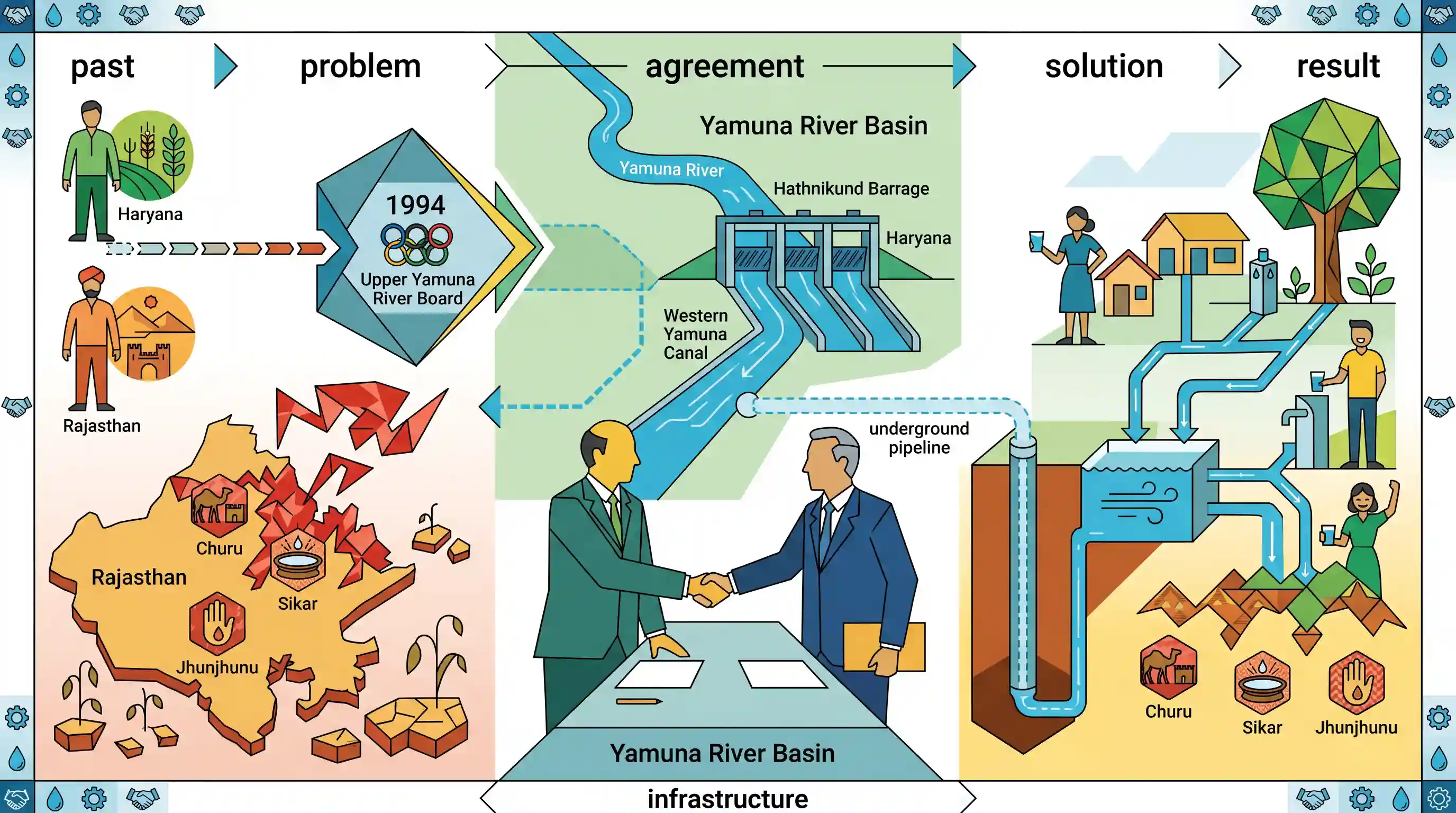
Haryana and Rajasthan signed a Memorandum of Agreement (MoA) on June 29, 2026, to implement the long-delayed 1994 Upper Yamuna River Board (UYRB) agreement. This historic move will allow Rajasthan to draw its share of monsoon water from Haryana's Hathnikund Barrage via an underground pipeline routed through the Western Yamuna Canal. The project will secure a sustainable drinking water supply for the water-stressed districts of Churu, Sikar, and Jhunjhunu.
Key Points
- On June 29, 2026, Haryana and Rajasthan signed a historic Memorandum of Agreement (MoA) in New Delhi to implement the 32-year-old 1994 Yamuna water-sharing agreement.
- The MoU was signed in the presence of Union Home Minister Amit Shah, Union Jal Shakti Minister C.R. Patil, Haryana CM Nayab Singh Saini, and Rajasthan CM Bhajan Lal Sharma.
- Under this agreement, Rajasthan's designated share of Yamuna water will be supplied from the Hathnikund Barrage (Haryana) during monsoon months via an underground pipeline routed through the Western Yamuna Canal system.
- The project aims to provide a long-term drinking water solution for the highly water-stressed districts of Churu, Sikar, and Jhunjhunu in Rajasthan's Shekhawati region.
- The original Yamuna water-sharing agreement was signed on May 12, 1994, by the five Upper Yamuna Basin states (UP, Haryana, Rajasthan, HP, and Delhi), with Uttarakhand added in 2000, but had remained unimplemented due to the absence of a dedicated canal system for Rajasthan.
- Rajasthan CM Bhajan Lal Sharma also highlighted the reference of the Narmada Canal project, which was implemented in 2003 to supply irrigation and drinking water to the desert districts of Jalore and Barmer.
Important Terms
1994 Yamuna Water Agreement

An inter-state water-sharing pact signed by Haryana, Rajasthan, Uttar Pradesh, Himachal Pradesh, Delhi, and later Uttarakhand, to allocate the surface water flows of the Upper Yamuna River Basin.
UPSC context
GS Paper II/III: Tests knowledge of inter-state river water disputes, cooperative federalism, and basin-wide resource management.
Upper Yamuna River Board (UYRB)
A subordinate office under the Union Ministry of Jal Shakti, established in 1995 to regulate and manage the allocation of available water flows among Upper Yamuna basin states.
UPSC context
GS Paper II: Tests governance mechanisms, inter-state dispute resolution institutions, and regulatory frameworks for resource sharing.
Union Ministry of Jal Shakti
The central government ministry formed in 2019 to optimize water resources management, coordinate inter-state river basin projects, and implement clean drinking water and sanitation initiatives.
UPSC context
GS Paper II: Tests institutional structures for national water governance, integrated water resource management, and major central schemes.
Hathnikund Barrage
A concrete water regulation and diversion structure on the Yamuna River in Haryana. It replaces the old Tajewala Barrage and feeds the Western and Eastern Yamuna Canals.
UPSC context
GS Paper I: Key for mapping major river infrastructure, downstream flood management in Delhi, and canal irrigation geography.
Western Yamuna Canal
A historic canal network originating from the Hathnikund Barrage, originally built in 1335 by Firoz Shah Tughlaq, now serving as a vital irrigation and water transfer channel.
UPSC context
GS Paper I/III: Connects medieval public works (Tughlaq era) to modern irrigation infrastructure and agricultural productivity in North India.
Narmada Canal Project
An inter-state contour canal delivering water from Gujarat's Sardar Sarovar Dam to Rajasthan's arid Jalore and Barmer districts, notable for making micro-irrigation sprinkler systems mandatory.
UPSC context
GS Paper III: Tests micro-irrigation policies, regional desert development schemes, and inter-state canal water distribution.
Prelims Trap
The Upper Yamuna River Board is a statutory tribunal constituted under Article 262 to adjudicate interstate disputes.
The UYRB is an administrative subordinate office under the Ministry of Jal Shakti, not a judicial/constitutional tribunal set up under Article 262.
Static Concepts Connected
What is the constitutional framework for inter-state river water disputes?
- Article 262: Empowers Parliament to adjudicate inter-state river disputes and bar the Supreme Court's jurisdiction over them.
- Seventh Schedule: Places 'Water' under State List (Entry 17), subject to Union control over inter-state rivers (Entry 56).
- Key Acts: Parliament passed the Inter-State River Water Disputes Act, 1956 and the River Boards Act, 1956.
What is the historical significance of the Western Yamuna Canal?
- Medieval Origin: Originally built by Sultan Firoz Shah Tughlaq in 1355 AD to channel Yamuna waters to Hisar.
- British Restoration: Restructured and revived by British engineers in the early 19th century to boost agricultural revenues.
- Geographic Source: Originates at the Hathnikund Barrage in Haryana, where the river debouches from the Himalayas.
Cross-Topic Patterns
Medieval canals as modern infrastructure
Highlights how 14th-century Tughlaq canal networks act as the structural framework for cutting-edge 21st-century piped water security projects.
Mandatory micro-irrigation and climate adaptation
Using Narmada Canal's statutory sprinkler irrigation model as a policy blueprint to resolve acute groundwater depletion in Rajasthan's arid zones.

Geographical mapping of Yamuna tributaries combined with the history of Tughlaq-era canal systems will likely feature in Prelims 2026.
Linked PYQs · 3
Linked PYQs · 3
- 2018RPSC_PRELIMSGS1
In Rajasthan, for the first time, which of the following projects has made sprinkler irrigation mandatory?
- 2018RPSC_PRELIMSGS1
Match the following: List-I – List-II (Major Irrigation Project) (Districts benefited by irrigation facilities) A. Siddhmukh Project (i) Jalore and Barmer B. Narmada Project (ii) Jalore, Pali and Jodhpur C. Jawai Project (iii) Udaipur and Pratapgarh D. Jakham Project (iv) Hanumangarh and Churu Code:
- 2023RPSC_PRELIMSGS1
The Mahi Bajaj Sagar project is a joint venture of:
