Anti Drug Enforcement Strategies and Technological Initiatives
Source:Indian Express ↗
Why It Matters
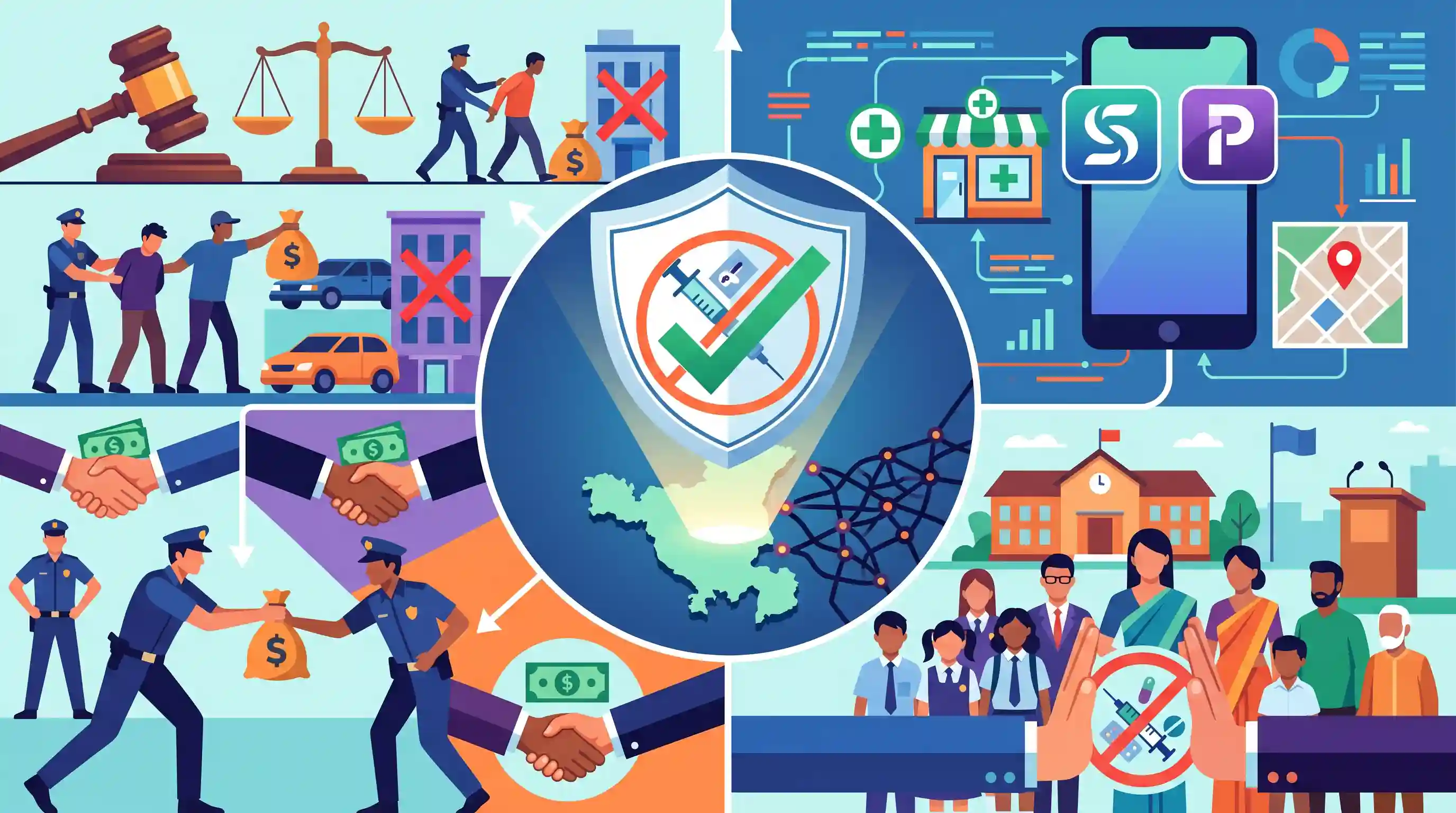
It serves as a valuable case study for Mains GS3 on how states are countering drug trafficking through a multi-pronged approach: legal instruments (PIT-NDPS Act), financial tracking (property attachment), community engagement, and technological interventions (e-governance via apps).
Summary
The Haryana Narcotics Control Bureau (NCB) has intensified its crackdown on drug trafficking by launching a statewide 'Drug-Free Haryana' mission. The initiative combines stringent legal action, including the use of the PIT-NDPS Act and property attachment, with technological solutions like the 'Saathi' and 'Prayas' mobile apps to monitor chemists and track offenders. By incentivizing enforcement through cash rewards and engaging the public and educational institutions, the NCB aims to combat the organized crime of drug trafficking holistically.
Key Points
- The Haryana Narcotics Control Bureau (NCB) has launched a comprehensive anti-drug campaign, aiming to transform the fight against narcotics into a statewide public movement.
- Law enforcement is taking decisive action against habitual drug offenders under the PIT-NDPS Act, including the attachment of properties acquired through drug trafficking.
- Two mobile applications have been introduced to aid enforcement: 'Saathi' for monitoring pharmaceutical sales by chemists, and 'Prayas' for tracking drug traffickers and maintaining data on addicts.
- To incentivize enforcement, a reward of Rs 51,000 has been announced for officials who successfully dismantle active drug trafficking gangs.
- The campaign integrates targeted awareness drives in educational institutions alongside dedicated anti-drug toll-free helplines.
Important Terms
PIT-NDPS Act

A 1988 Central Act providing for the preventive detention of individuals involved in illicit drug trafficking to prevent future offenses, bypassing immediate trial for public security.
UPSC context
GS-III (Internal Security); tests knowledge of legal frameworks against organized crime and constitutional safeguards under Article 22.
Drug-Free Haryana mission
A comprehensive state initiative combining stringent law enforcement, technological surveillance, and community-led awareness programs (like the 'Dhakad' scheme) to eliminate substance abuse in Haryana.
UPSC context
GS-II (Governance/Social Justice); evaluates state-level models for social issues and effective policy implementation.
Saathi app
An e-governance tool used by Haryana authorities to track the inventory and sale of pharmaceutical and habit-forming drugs by chemists to prevent illegal diversion.
UPSC context
GS-III (Internal Security/E-governance); demonstrates the role of technology in law enforcement and monitoring supply chains.
Prayas app
A mobile application developed for the Haryana NCB to maintain a database of drug addicts, track their rehabilitation progress, and monitor the movement of traffickers.
UPSC context
GS-II (Health/Social Justice); highlights data-driven approaches to addiction management and offender tracking.
Haryana Narcotics Control Bureau (NCB)
The specialized state-level agency acting as the nodal body for intelligence, coordination, and enforcement against narcotic crimes within the state.
UPSC context
GS-III (Internal Security); relates to the institutional framework for managing internal security threats and organized crime.
Prelims Trap
The PIT-NDPS Act is the primary statute used to prosecute and convict first-time consumers of narcotic drugs.
The PIT-NDPS Act specifically provides for the preventive detention of habitual traffickers, not standard prosecution. General prosecution of consumers falls under the NDPS Act.
Static Concepts Connected
What are the Golden Crescent and Golden Triangle drug routes?
- Golden Crescent: Iran, Afghanistan, and Pakistan. It is a major source of opium and heroin affecting Northwest India, particularly Punjab, Haryana, and J&K.
- Golden Triangle: Myanmar, Laos, and Thailand. It is a major global source of illicit synthetic drugs and heroin primarily affecting Northeast India.
How do Indian laws target property acquired through illicit drug trafficking?
- Property Forfeiture: Chapter VA of the NDPS Act allows competent authorities to trace, seize, and forfeit properties derived directly or indirectly from illicit drug traffic.
- Burden of Proof: The law often places the burden of proof on the accused to demonstrate that the seized property was not acquired through illicit narcotics trade.
Cross-Topic Patterns
Tech-driven drug enforcement
The use of apps like 'Saathi' and 'Prayas' mirrors national platforms like NIDAAN, showing a clear shift towards data-backed policing and e-governance in internal security.
Pharmaceutical diversion crisis
Tracking retail chemists highlights the alarming shift from traditional plant-based narcotics (opium) to the illicit abuse of synthetic pharmaceutical drugs (like tramadol) in North India.

Expect a 2026 prelims match-the-following question pairing portals (NIDAAN, Saathi) with their exact drug-enforcement or security mandate.
Linked PYQs · 4
Linked PYQs · 4
- 2024MainsGS3
Explain how narco-terrorism has emerged as a serious threat across the country. Suggest suitable measures to counter narco-terrorism.
- 2022MainsGS3
Discuss the types of organised crimes. Describe the linkages between terrorists and organised crime that exist at the national and transnational levels.
- 2018MainsGS3
India's proximity to two of the world's biggest illicit opium-growing states has enhanced her internal security concerns. Explain the linkages between drug trafficking and other illicit activities such as gunrunning, money laundering and human trafficking. What counter-measures should be taken to prevent the same?
- 2024MainsGS2
e-governance is not just about the routine application of digital technology in service delivery process. It is as much about multifarious interactions for ensuring transparency and accountability. In this context evaluate the role of the 'Interactive Service Model' of e-governance.
