Haryana Land Policy 2025: Infrastructure Acquisition and Reforms
Source:Indian Express ↗
Why It Matters
Land acquisition is a major bottleneck for infrastructure development in India. Haryana's 2025 policy offers a unique, decentralized model utilizing voluntary sales and official aggregators to streamline acquisition. It serves as an excellent case study for GS3 answers on overcoming infrastructure hurdles, preventing agricultural distress sales, and modernizing land reforms.
Summary
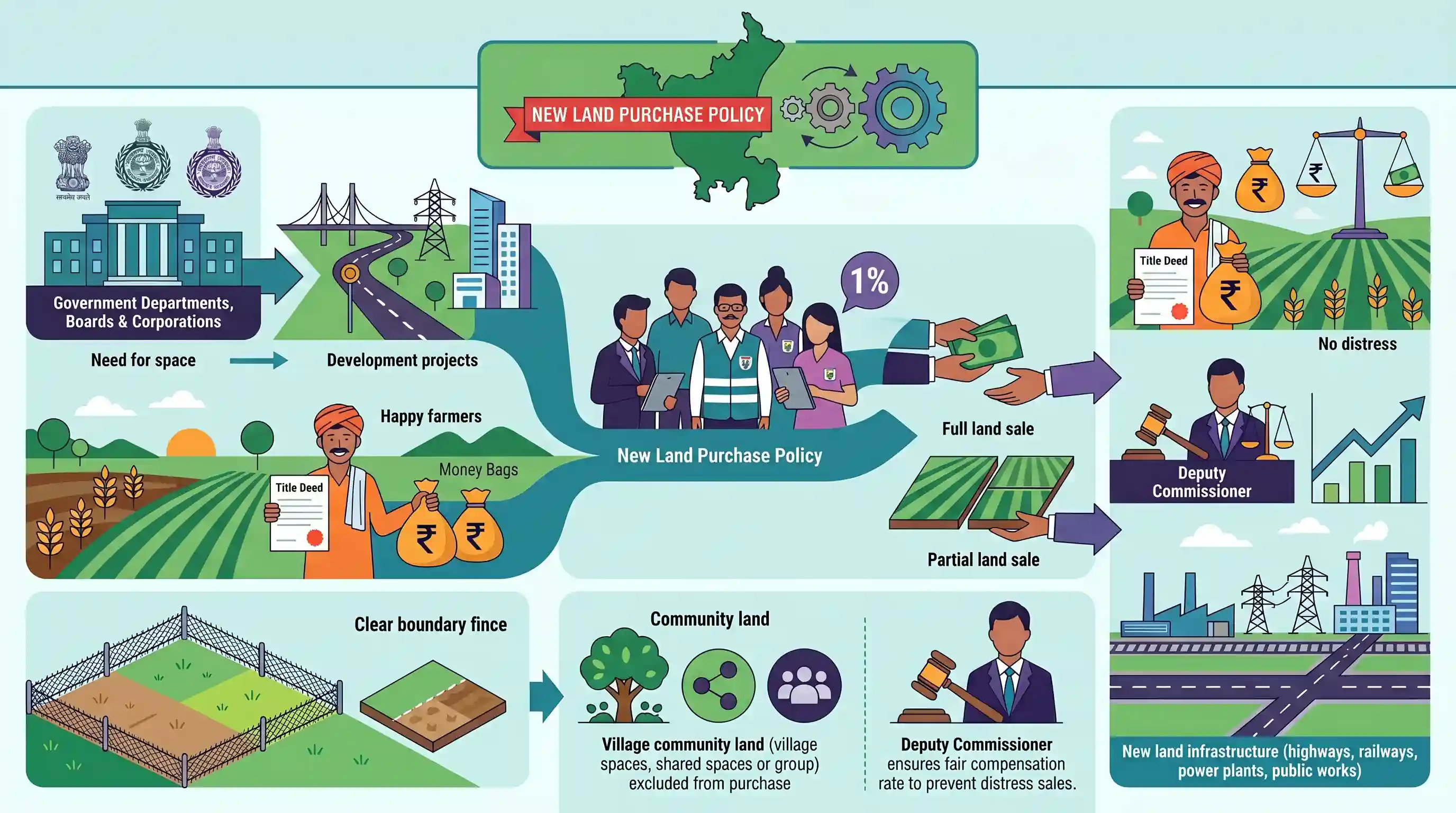
The Haryana cabinet has approved the New Land Purchase Policy for Development Projects, 2025, superseding the previous 2017 policy. Designed to streamline land acquisition for public infrastructure, the policy creates a transparent framework for landowners to voluntarily sell their property—partially or fully—to government departments, boards, and corporations. By formalizing the role of empanelled 'aggregators' who earn a 1% facilitation fee, the state seeks to ease the often-contentious land aggregation process. Crucially, the policy avoids title disputes by excluding community lands ('shamilat deh') and empowers the Deputy Commissioner to ensure fair compensation rates, thereby preventing distress sales and encouraging landowner participation in state development.
Key Points
- The Haryana government approved the New Land Purchase Policy for Development Projects, 2025, to facilitate the voluntary sale of land for state infrastructure and development needs.
- The policy allows landowners to sell their shares either partially or fully, aiming to prevent distress sales by providing optimal and fair compensation.
- A formal mechanism introduces 'aggregators'—empanelled via an online portal—who facilitate land aggregation and receive a 1% facilitation fee for their services.
- To ensure clear land titles, the policy expressly prohibits the acquisition of lands classified as 'shamilat deh' (common land) or 'mushtarkamalkan'.
- The Deputy Commissioner is tasked with ensuring the reasonableness of the rates at which land is offered, safeguarding the financial interests of the sellers.
Important Terms
New Land Purchase Policy for Development Projects, 2025 (Haryana)

A state-level framework enabling landowners to voluntarily sell property to government entities through a digital portal, allowing for partial sales and streamlining acquisition for public infrastructure.
UPSC context
Relevant for GS Paper II (Governance) and GS Paper III (Infrastructure), testing knowledge of state-led alternatives to the 2013 Land Acquisition Act.
Shamilat Deh
Village common lands in Punjab and Haryana reserved for collective community use like grazing or playgrounds, governed by the Punjab Village Common Lands (Regulation) Act, 1961.
UPSC context
Significant for GS Paper III (Land Reforms) and GS Paper II (Local Governance), focusing on communal rights and legal disputes in land tenure.
Land Aggregator
Empanelled individuals or agencies who facilitate land pooling and negotiations between private owners and the government in exchange for a performance-based fee or commission.
UPSC context
Pertains to GS Paper III (Public-Private Partnerships/Infrastructure), illustrating market-based mechanisms used to simplify complex land acquisition processes.
Distress Sale
A situation where a property owner is forced to sell land at a low price due to urgent financial need or lack of competitive buyers.
UPSC context
Critical for GS Paper III (Agriculture and Farmers' Welfare), highlighting socio-economic vulnerabilities that policy interventions aim to mitigate.
Land Reforms
Institutional changes in land ownership and management, including redistribution, tenancy regulation, and consolidation, aimed at ensuring social justice and efficient development.
UPSC context
A core theme in GS Paper III (Indian Economy/Land Reforms), testing the evolution of land laws since independence and contemporary state-led reforms.
Collector Rate
The minimum value at which a property can be registered for sale in a specific area, fixed by the local administration for revenue purposes.
UPSC context
Relevant for GS Paper III (Mobilization of Resources/Infrastructure), as it serves as the benchmark for government compensation and aggregator incentives.
Prelims Trap
"Direct voluntary land purchase by states requires mandatory Social Impact Assessment under LARR 2013."
States increasingly bypass LARR's mandatory SIA and consent requirements by enacting separate voluntary direct-purchase or land-pooling policies to fast-track infrastructure. LARR applies to coercive acquisition.
Static Concepts Connected
What are the key consent and SIA mandates under the LARR Act 2013?
- Consent threshold: Requires 80% landowner consent for private projects and 70% for Public-Private Partnerships (PPP).
- Social Impact Assessment (SIA): Mandatory assessment to ensure the project serves a "public purpose" and to evaluate the social costs on displaced families.
- Compensation multiplier: Mandates compensation at 2 to 4 times the market value in rural areas and 2 times in urban areas.
What is 'Shamilat Deh' in the context of Indian land tenure?
- Community ownership: Refers to village common lands traditionally reserved for community use (e.g., grazing grounds, ponds, pathways) rather than individual ownership.
- Custodianship: Control and management usually vest in the Gram Panchayat under state-specific Panchayati Raj or village common land acts.
- Legal protection: The Supreme Court has consistently ruled against the commercial alienation or privatization of village common lands by state governments.
Cross-Topic Patterns
Voluntary purchase bypassing LARR 2013 mandates
States like Haryana, Gujarat, and AP increasingly use voluntary purchase or land pooling policies to legally bypass the strict Social Impact Assessment (SIA) and consent mandates of the central LARR Act 2013.
E-Governance mapping and private land aggregators
The use of online portals to empanel private 'aggregators' connects local land aggregation to the central Digital India Land Records Modernization Programme (DILRMP), merging real estate tech with rural governance.

Questions on land acquisition in 2026 will likely test the legal differences between eminent domain under LARR and state pooling models.
Linked PYQs · 4
Linked PYQs · 4
- 2021MainsGS3
“Investment in infrastructure is essential for more rapid and inclusive economic growth.” Discuss in the light of India's experience.
- 2021MainsGS3
How did land reforms in some parts of the country help to improve the socio-economic conditions of marginal and small farmers?
- 2023MainsGS3
State the objectives and measures of land reforms in India. Discuss how land ceiling policy on landholding can be considered as an effective reform under economic criteria.
- 2024MainsGS3
What were the factors responsible for the successful implementation of land reforms in some parts of the country? Elaborate.
