Haryana Cab Aggregator EV Mandate and NCR Air Pollution Regulations
Source:Indian Express ↗
Why It Matters
This represents a critical case study in regional environmental governance addressing urban air pollution, while simultaneously showcasing an emerging regulatory framework for passenger safety and social security for platform workers in the gig economy.
Summary
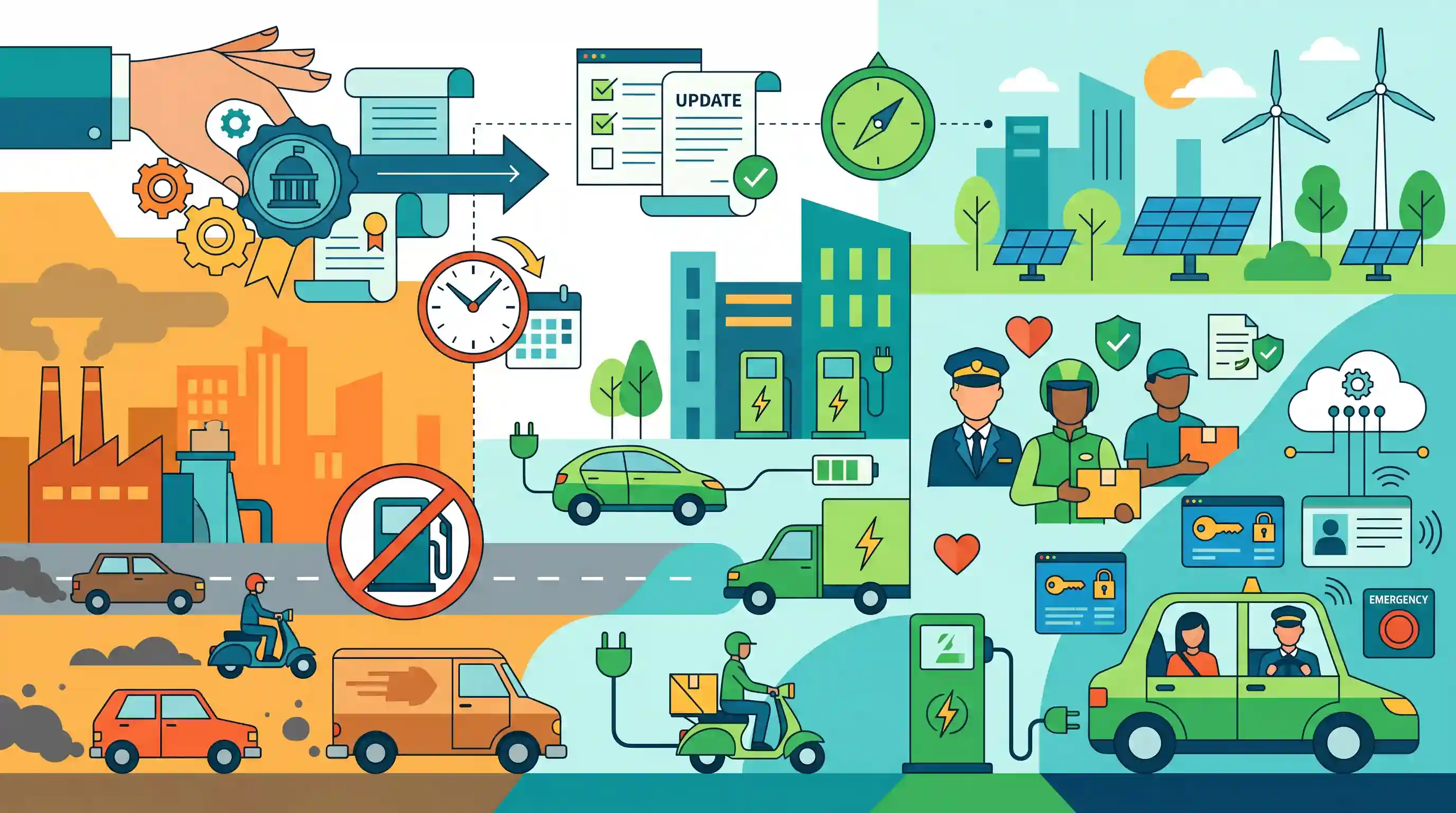
In a major move to combat vehicular pollution, the Haryana government has issued new regulations requiring cab aggregators, delivery partners, and e-commerce entities operating in the National Capital Region (NCR) to shift to green vehicles. From January 1, 2026, no petrol or diesel vehicles can be inducted into these fleets. Aligned with directives from the Commission for Air Quality Management (CAQM), the rules substitute existing provisions in the Haryana Motor Vehicles Rules, 1993. In addition to environmental mandates, the framework emphasizes passenger safety through digital authentication (VAHAN, SARATHI) and emergency systems, while stipulating health and term insurance for gig workers.
Key Points
- The Haryana Cabinet has introduced new regulations prohibiting cab aggregators and delivery service providers from adding petrol or diesel vehicles to their NCR fleets starting January 1, 2026.
- The rules substitute Rule 86A of the Haryana Motor Vehicles Rules, 1993, to enforce a phased transition to green mobility (EVs, CNG, and cleaner fuels) as mandated by the CAQM.
- New safety standards mandate location tracking, panic buttons, first aid, fire extinguishers, and digital authentication of drivers via VAHAN and SARATHI portals.
- The policy also seeks to improve social security for gig workers by requiring aggregators to provide health and term insurance to their drivers.
Important Terms
Commission for Air Quality Management (CAQM)

A statutory body formed under a 2021 Act to coordinate, monitor, and resolve air pollution issues in Delhi-NCR and adjoining states. It possesses powers to issue binding directions to state governments.
UPSC context
GS3 Environment (Pollution) and GS2 Statutory Bodies. Tests understanding of institutional frameworks for regional environmental governance.
VAHAN
A centralized national registry for vehicle registration details in India. It digitizes vehicle records to ensure transparency, security, and efficient e-governance for the Ministry of Road Transport and Highways.
UPSC context
GS2 E-governance; GS3 Infrastructure. Important for questions on ICT applications in public service delivery and transport.
SARATHI
A national database and portal for driving licenses in India. It enables online applications and digital authentication of driver identities, streamlining transport administration and improving road safety through centralized oversight.
UPSC context
GS2 E-governance. Part of the Parivahan Sewa project; tests knowledge of digital tools for administrative transparency.
Haryana Motor Vehicles Rules, 1993
The legal framework regulating road transport in Haryana. Recent 2024-25 amendments (Rule 86A) mandate the transition to green vehicles for aggregators and introduce social security (insurance) for gig workers.
UPSC context
GS3 Environment/Infrastructure. Relevant for state-level policy implementation regarding clean energy transition and gig economy regulation.
National Capital Region (NCR)
A multi-state planning region centered on Delhi, including districts of Haryana, UP, and Rajasthan. It is a critical focus area for coordinated urban planning and anti-pollution mandates.
UPSC context
GS1 Urbanization and GS3 Environment. Tests knowledge of regional planning and inter-state coordination for pollution control.
Prelims Trap
The Commission for Air Quality Management (CAQM) was established under the Environment (Protection) Act, 1986.
CAQM is a statutory body created by the CAQM Act, 2021. It replaced the EPCA, which was the body actually formed under the Environment (Protection) Act, 1986.
Static Concepts Connected
What is the statutory backing and mandate of CAQM?
- Statutory Body: Established via the CAQM Act, 2021, replacing the Supreme Court-mandated Environment Pollution (Prevention and Control) Authority (EPCA).
- Jurisdiction: Covers the National Capital Region and adjoining areas (like Punjab and parts of Rajasthan) that impact NCR air quality.
- Overriding Powers: Its directives and orders explicitly supersede those of the CPCB and State Pollution Control Boards in case of any conflict.
What are the VAHAN and SARATHI databases?
- Mission Mode Projects: Implemented by the Ministry of Road Transport and Highways as core components under the National e-Governance Plan.
- VAHAN: A centralized, national digital registry containing comprehensive vehicle registration data.
- SARATHI: A centralized national database for driving licenses and related driver authentication records.
Cross-Topic Patterns
Gig Worker Rights & Federalism
While the Centre's Code on Social Security remains pending, states like Rajasthan (Gig Worker Act) and Haryana (aggregator insurance rules) are independently pioneering platform labor welfare frameworks.
Urban Transport & CAQM directives
State-level commercial fleet transition rules demonstrate how CAQM acts as an active policy driver, forcing regional transport departments to phase out ICE vehicles to meet localized air quality targets.

Expect a 2026 Prelims question testing CAQM's overriding powers over CPCB/SPCBs, paired with state-led gig-worker welfare initiatives.
Linked PYQs · 4
Linked PYQs · 4
- 2020MainsGS3
What are the key features of the National Clean Air Programme (NCAP) initiated by the Government of India?
- 2021MainsGS3
Describe the key points of the revised Global Air Quality Guidelines (AQGs) recently released by the World Health Organisation (WHO). How are these different from its last update in 2005? What changes in India's National Clean Air Programme are required to achieve these revised standards?
- 2025PrelimsGS1
Consider the following types of vehicles : I. Full battery electric vehicles II. Hydrogen fuel cell vehicles III. Fuel cell-electric hybrid vehicles How many of the above are considered as alternative powertrain vehicles?
- 2019PrelimsGS1
In the context of proposals to the use of hydrogen-enriched CNG (H-CNG) as fuel for buses in public transport, consider the following statements: 1. The main advantage of the use of H-CNG is the elimination of carbon monoxide emissions. 2. H-CNG as fuel reduces carbon dioxide and hydrocarbon emissions. 3. Hydrogen up to one-fifth by volume can be blended with CNG as fuel for buses. 4. H-CNG makes the fuel less expensive than CNG. Which of the statements given above is/are correct?
