Haryana state budget allocation for agriculture and climate
Source:The Hindu ↗
Why It Matters
The budget highlights state-level innovations in fiscal governance, such as creating sector-specific utility companies (agri-discoms) and dedicated climate resilience funds, which are highly relevant for GS-3 topics on Indian Economy, Infrastructure, and Environment.
Summary
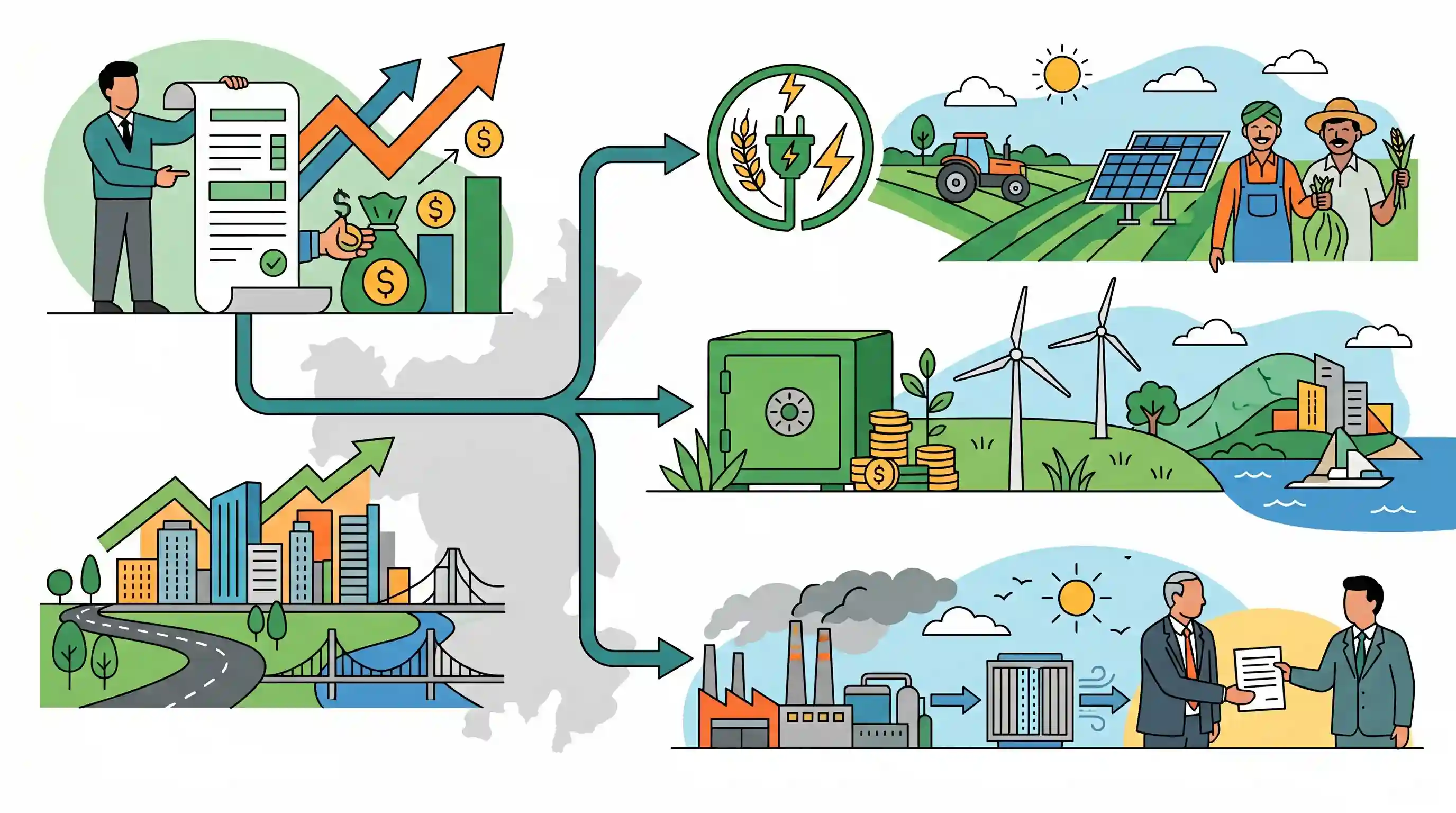
Haryana Chief Minister Nayab Singh Saini presented the state's 2026-27 Budget with a total outlay of ₹2.23 lakh crore. The budget emphasizes agricultural support and environmental sustainability through innovative measures such as the creation of a dedicated agricultural power distribution company ('Haryana Agri Discom') and the establishment of a 'Haryana Green Climate Resilience Fund'. Additionally, it outlines significant capital expenditure and acknowledges World Bank support for the state's clean air initiatives.
Key Points
- Haryana Chief Minister presented the 2026-27 State Budget with an outlay of ₹2.23 lakh crore, an increase of 10.28% from the revised allocation of the current fiscal.
- Capital expenditure is pegged at ₹28,205 crore, accounting for 12.6% of the total budget allocation.
- The government proposed setting up a third power distribution company, 'Haryana Agri Discom', exclusively dedicated to agricultural feeders and consumers.
- A 'Haryana Green Climate Resilience Fund' with an initial provision of ₹100 crore was established to promote renewable energy and zero-emission vehicles.
- The World Bank approved ₹2,716 crore in financial assistance for the 'Haryana Clean Air Project'.
Important Terms
Haryana Clean Air Project

A $300 million World Bank-supported initiative (approx. ₹2,716 crore) designed to improve air quality in Haryana and the NCR through enhanced monitoring, data-driven policymaking, and multi-sectoral pollution reduction strategies.
UPSC context
GS III: Environmental Pollution & Degradation. Tests knowledge of regional pollution control measures and international financial collaboration for environmental goals.
Haryana Green Climate Resilience Fund
A state fund with an initial ₹100 crore corpus established to accelerate investments in renewable energy, zero-emission vehicles, and climate-resilient agriculture to help Haryana achieve net-zero targets by 2070.
UPSC context
GS III: Conservation & Climate Change. Relevant for topics on state-led climate action and financing sustainable development.
Haryana Agri Discom
A proposed third power distribution utility in Haryana exclusively for the agriculture sector, aimed at providing uninterrupted electricity to over 7 lakh farmers across 5,084 agricultural feeders.
UPSC context
GS III: Economics of Animal Rearing/Agriculture & Infrastructure. Tests understanding of sector-specific DISCOM reforms and rural energy security.
World Bank
An international financial institution providing long-term loans and grants to developing countries; in Haryana, it is financing major environmental projects like the Clean Air initiative via low-interest loans.
UPSC context
GS II: Important International Institutions. Tests knowledge of the bank's role in sub-national development and environmental financing in India.
Saksham Fund
A ₹500 crore special fund proposed in the Haryana Budget 2026-27 to enhance industrial infrastructure in targeted cities and promote economic growth in older industrial areas.
UPSC context
GS III: Indian Economy (Infrastructure). Relevant for state-level industrial policy and urban-industrial development strategies.
Prelims Trap
"The Haryana Clean Air Project is a Central Sector Scheme funded under the National Clean Air Programme (NCAP)."
It is a state-level initiative directly assisted by the World Bank ($300 million), demonstrating direct multilateral climate and environmental financing to state governments, outside of NCAP.
Static Concepts Connected
What is the 'Airshed' approach in air pollution management?
- Topographical basis: A geographic area where local topography and meteorology trap or dictate the movement of pollutants, meaning air quality is shared regardless of political or administrative borders.
- Regional strategy: Shifts the regulatory focus from isolated city-level mitigation (like localized smog towers) to regional interventions addressing pollution emissions across the entire interconnected geographic zone.
Why do states segregate agricultural electricity demand?
- Feeder segregation: Physically separating farm power lines from domestic village lines ensures farmers receive rationed, predictable, high-quality daytime power without disrupting rural household supply.
- Subsidy isolation: An exclusive agricultural distribution network or Discom helps ring-fence massive farm power subsidies, preventing them from masking commercial inefficiencies and AT&C losses in the broader grid.
Cross-Topic Patterns
Airshed approach + CAQM mandate
The World Bank-backed project aligns perfectly with the Commission for Air Quality Management's (CAQM) statutory mandate, which explicitly uses an "airshed" approach to manage pollution across the entire National Capital Region.
Feeder segregation to Agri-Discoms
Creating an exclusive 'Agri Discom' is the administrative evolution of physical feeder segregation, aiming to strictly ring-fence farm subsidies and improve the financial health of existing state power distribution companies.

'Airshed' pollution management and direct multilateral climate financing to states are highly probable Prelims/Mains targets for 2026.
Linked PYQs · 5
Linked PYQs · 5
- 2021MainsGS3
Distinguish between Capital Budget and Revenue Budget. Explain the components of both these Budgets.
- 2019MainsGS3
The public expenditure management is a challenge to the Government of India in the context of budget making during the post-liberalization period. Clarify it.
- 2025MainsGS3
Explain how the Fiscal Health Index (FHI) can be used as a tool for assessing the fiscal performance of states in India. In what way would it encourage the states to adopt prudent and sustainable fiscal policies?
- 2020MainsGS3
Describe the benefits of deriving electric energy from sunlight in contrast to the conventional energy generation. What are the initiatives offered by our Government for this purpose?
- 2022MainsGS3
Do you think India will meet 50 percent of its energy needs from renewable energy by 2030 ? Justify your answer. How will the shift of subsidies from fossil fuels to renewables help achieve the above objective ? Explain.
