Haryana Welfare Measures for Agniveers and Federal Water Disputes
Source:Indian Express ↗
Why It Matters
The article serves as an excellent case study for multiple UPSC themes: the ongoing inter-state river water disputes highlighting friction in cooperative federalism, state-level interventions regulating alcohol (Directive Principles of State Policy), and integrating emerging technologies like AI into youth skill development programs.
Summary
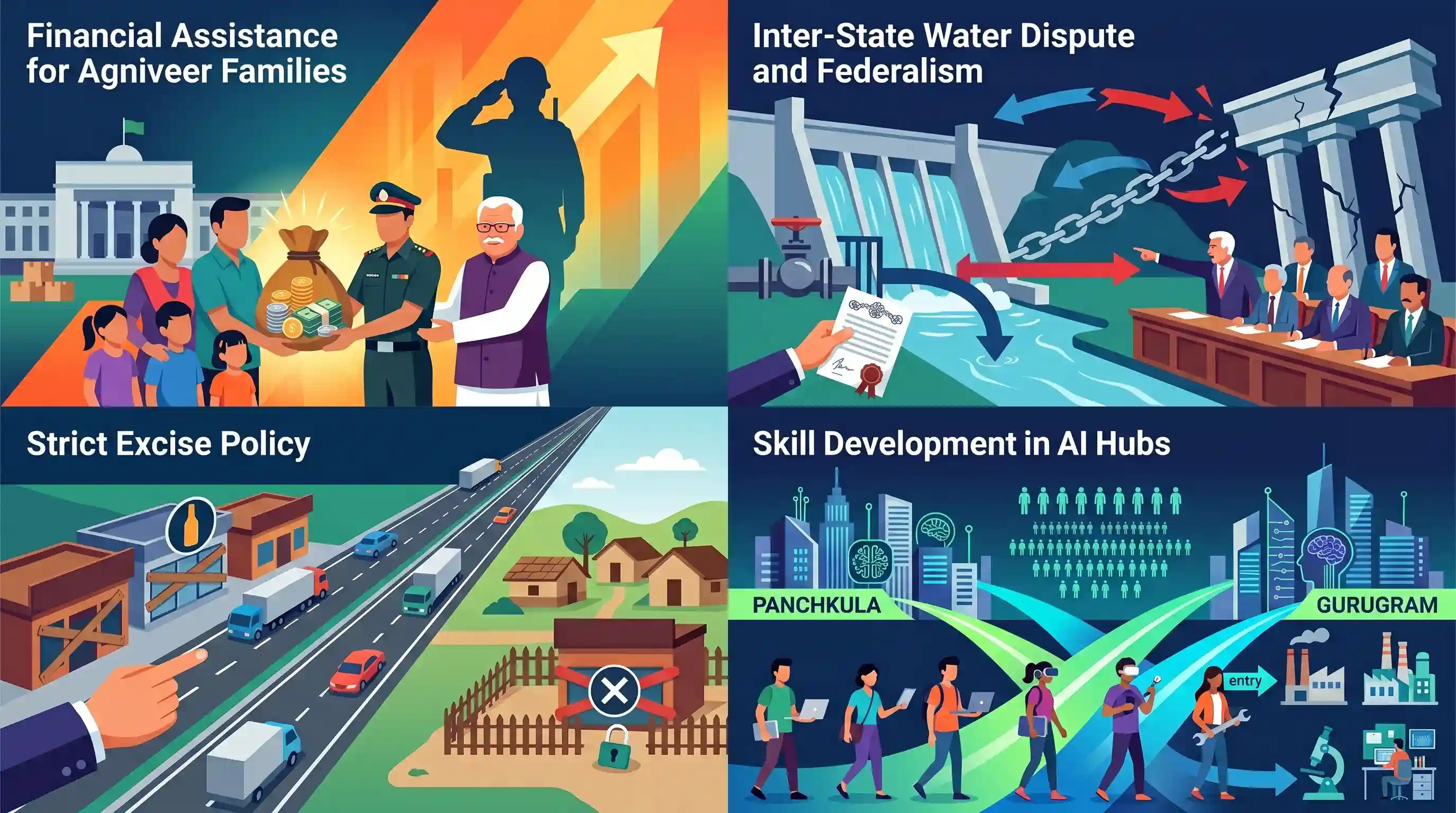
The Haryana government has announced a Rs 1 crore financial assistance package for the families of martyred Agniveers. Concurrently, the state Cabinet condemned a resolution by the Punjab Vidhan Sabha restricting water-sharing from the Bhakra dam, framing it as an attack on India's federal structure and constitutional norms. Additionally, Haryana approved its 2025-26 excise policy, implementing stringent regulations on highway liquor vends and shutting down vends in small villages. The government also revealed plans to transform Panchkula and Gurugram into Artificial Intelligence hubs to skill 1 lakh youth, bridging the gap between technology and employment.
Key Points
- The Haryana Cabinet announced a financial aid of Rs 1 crore for the families of martyred Agniveers.
- The Haryana government strongly condemned the Punjab Assembly's resolution limiting water-sharing from the Bhakra dam, citing a violation of India's constitutional federal structure.
- The new state excise policy for 2025-26 dictates that liquor vends must not be visible from state or national highways, and bans vends in villages with populations under 500.
- Panchkula and Gurugram will be developed into Artificial Intelligence hubs, with plans to provide employable skill training to 1 lakh youth in these cities.
Important Terms
Agnipath Scheme

A central recruitment scheme where youth (Agniveers) serve in the Indian Armed Forces for four years, with 25% retained for permanent service. Others transition to civilian life.
UPSC context
GS Paper II & III: Government policies/Security. Essential for debates on military reform, employment, and state-level rehabilitative benefits for veterans.
Bhakra Beas Management Board (BBMB)
A statutory body (est. 1966) that regulates the supply of water and power from the Bhakra-Nangal and Beas projects to North Indian states.
UPSC context
GS Paper II: Statutory bodies and federal water governance. Central to Punjab-Haryana inter-state friction.
Inter-State Water Disputes
Conflicts over the sharing and control of river waters between states, governed by Article 262 and the Inter-State River Water Disputes Act, 1956.
UPSC context
GS Paper II: Federal structure and challenges. Highlights the limitations of constitutional adjudication in politically sensitive resource sharing.
Cooperative Federalism
A federal model where the Centre and States collaborate to solve national problems, characterized by mutual consultation rather than unilateral decision-making.
UPSC context
GS Paper II: Governance and Federalism. Tested through examples of inter-state conflict vs. collaboration.
Dam Safety Act, 2021
A law providing a national framework for the surveillance, inspection, and maintenance of specified dams to prevent disasters and ensure uniform safety standards.
UPSC context
GS Paper II: Issues of jurisdiction between Union (Entry 56) and State (Entry 17) lists regarding water.
Skill Development
Initiatives focused on enhancing the workforce's proficiency—specifically in Artificial Intelligence here—to improve employability and leverage India's demographic dividend.
UPSC context
GS Paper III: Indian Economy and employment. Focuses on the transition from traditional labor to tech-oriented growth.
Prelims Trap
The Supreme Court has exclusive original jurisdiction under Article 131 over all inter-state river water disputes.
Under Article 262, Parliament can restrict the Supreme Court's jurisdiction over inter-state water disputes. The Inter-State River Water Disputes Act (1956) explicitly bars the SC from exercising jurisdiction over these specific disputes.
Static Concepts Connected
How does the Constitution handle Inter-State River Water Disputes?
- Article 262: Empowers Parliament to provide for the adjudication of any dispute with respect to the use, distribution, or control of waters of inter-state rivers or river valleys.
- Jurisdiction Bar: Parliament may by law provide that neither the Supreme Court nor any other court shall exercise jurisdiction over such inter-state water disputes.
- ISWD Act, 1956: Enacted under Article 262, it allows the Centre to constitute ad-hoc tribunals to resolve water disputes between states.
What is the Constitutional basis for state regulation of liquor?
- Article 47 (DPSP): Directs the State to raise nutrition levels, standard of living, and improve public health, specifically endeavoring to prohibit the consumption of intoxicating drinks and drugs.
- State List: Intoxicating liquors (their production, manufacture, possession, transport, purchase, and sale) fall exclusively under Entry 8 of the State List in the 7th Schedule.
Cross-Topic Patterns
Water disputes testing cooperative federalism
State legislative resolutions limiting resource sharing (like Punjab's on Bhakra) challenge cooperative federalism, often triggering protracted tribunal processes and challenging the statutory authority of bodies like the BBMB.
DPSP implementation combined with judicial guidelines
Haryana’s village vend ban implements Article 47 (DPSP), while its highway restriction directly enforces the 2016 Supreme Court highway-liquor ban aimed at curbing road accident fatalities.

Expect a 2026 Prelims question mapping major river/dam disputes (like Bhakra-Nangal/Sutlej) to respective inter-state tribunals.
Linked PYQs · 3
Linked PYQs · 3
- 2024MainsGS2
What changes has the Union Government recently introduced in the domain of Centre-State relations ? Suggest measures to be adopted to build the trust between the Centre and the States and for strengthening federalism.
- 2015MainsGS2
The concept of cooperative federalism has been increasingly emphasized in recent years. Highlight the drawbacks in the existing structure and the extent to which cooperative federalism would answer the shortcomings.
- 2022MainsGS3
Economic growth in the recent past has been led by increase in labour productivity." Explain this statement. Suggest the growth pattern that will lead to creation of more jobs without compromising labour productivity.
