Shringla defends India US trade deal and oil diversification strategy
Source:Indian Express ↗
Why It Matters
This article encapsulates two of India's most pressing geopolitical challenges: negotiating favorable bilateral trade agreements in a protectionist global environment, and ensuring energy security by diversifying oil import sources amidst international sanctions and regional conflicts.
Summary
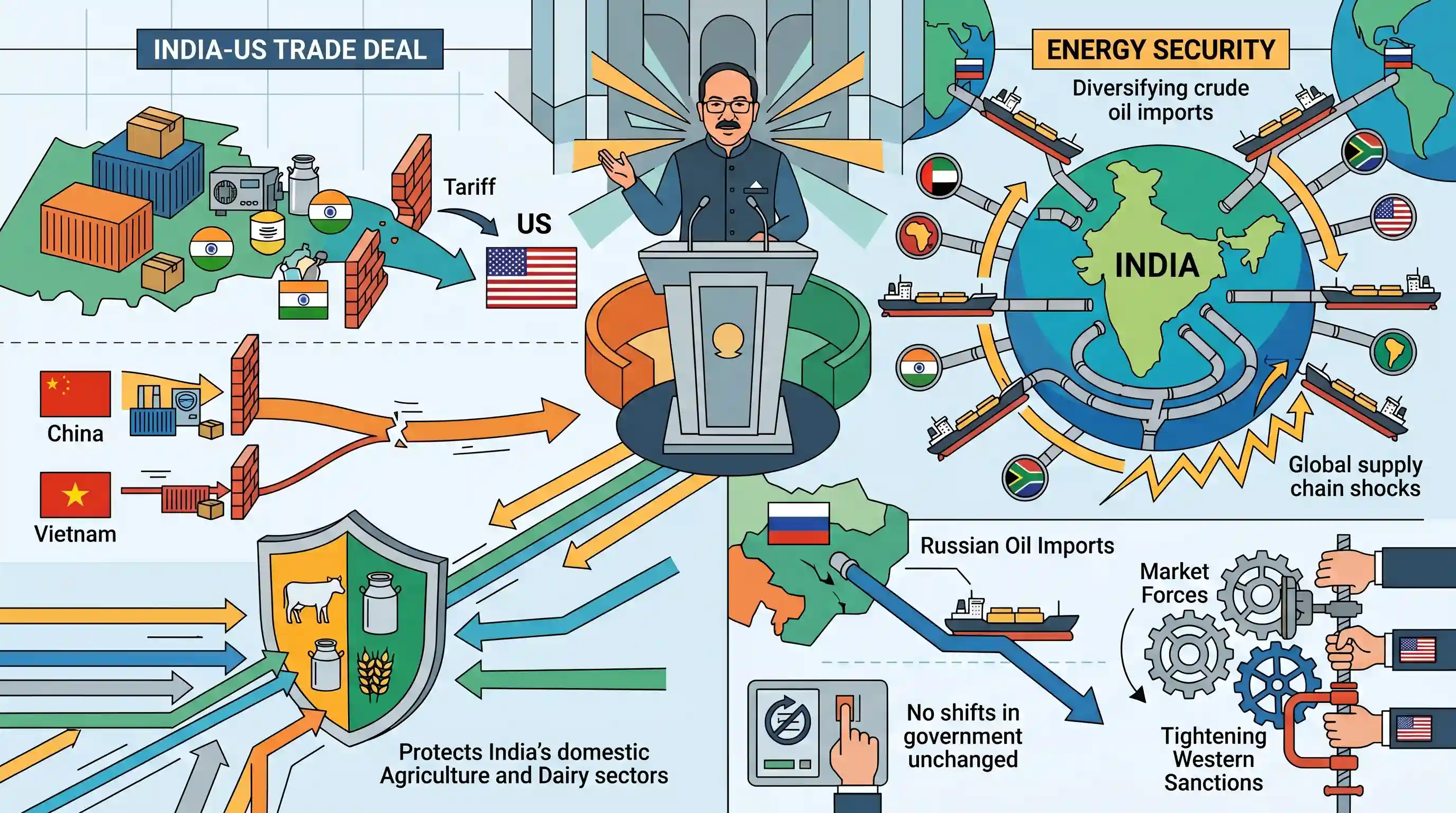
Former Foreign Secretary Harsh Vardhan Shringla highlighted the strategic necessity of India's recent trade and energy policies during a Rajya Sabha address. Defending the newly announced India-US trade deal, he noted that the agreement slashes US tariffs on Indian goods to 18%, offering a critical competitive edge over manufacturing rivals like China and Vietnam, while fully protecting India's domestic agriculture and dairy sectors. Furthermore, Shringla underscored India's strategy of diversifying its crude oil imports away from over-reliance on any single region to insulate the economy from global supply chain shocks. He clarified that the recent dip in Russian oil imports is a result of market forces and tightening Western sanctions, not a shift in government policy.
Key Points
- Former Foreign Secretary Harsh Vardhan Shringla defended the India-US trade deal in the Rajya Sabha, asserting it adheres to an "India First" approach while securing the agriculture and dairy sectors.
- He emphasized that India has strategically diversified its crude oil sources (importing from the US, Brazil, Guyana, and Venezuela) to mitigate supply chain risks arising from regional conflicts.
- The reduction in Russian oil imports is driven by market dynamics—specifically, narrowing price differentials and tighter Western sanctions—rather than government intervention.
- The trade agreement provides a major boost to Indian exporters, workers, and MSMEs by slashing US tariffs on Indian goods from 50% to 18%, making India more competitive than rivals like China and Vietnam.
- Bilateral trade between India and the US, currently at $212 billion, is projected to reach $300 billion by the end of the year.
Important Terms
India-US Trade Deal (2026)

A 2026 agreement reducing US tariffs on Indian goods to 18%, down from previous 50% peaks, while securing protections for India's sensitive agriculture and dairy sectors.
UPSC context
GS Paper II: Bilateral Agreements. Crucial for understanding trade diplomacy, "Make in India" competitiveness, and managing relations with major powers.
Strategic Autonomy
India's foreign policy doctrine of maintaining independent decision-making and avoiding formal military alliances to safeguard national interests across competing global power blocs.
UPSC context
GS Paper II: International Relations. A core concept tested regarding India's balancing act between the US, Russia, and the Global South.
Energy Security
A nation's ability to ensure a stable, affordable, and uninterrupted supply of energy resources through diversified imports, domestic production, and strategic reserves.
UPSC context
GS Paper III: Infrastructure and Energy. Focuses on India's vulnerability to global supply shocks and its diversification away from single-source reliance.
Rajya Sabha
The Upper House of India's Parliament, representing States and Union Territories, where members debate national policy and provide oversight on executive foreign policy decisions.
UPSC context
GS Paper II: Indian Polity. Essential for understanding the legislative process and the role of nominated members in policy discourse.
Mission 500
A strategic bilateral initiative launched to scale India-US trade to $500 billion by 2030 through cooperation in technology, defense, and energy sectors.
UPSC context
GS Paper II: Bilateral Relations. Represents the economic roadmap for India's most significant trading partnership and its impact on domestic growth.
Prelims Trap
India officially capped Russian oil imports as a policy concession for the US trade deal.
The dip in Russian oil imports is driven by market forces (narrowing price differentials) and tighter Western sanctions, not an Indian government policy shift.
Static Concepts Connected
How does India protect sensitive domestic sectors in Free Trade Agreements?
- Negative/Exclusion Lists: Keeping sensitive sectors like dairy, agriculture, and local MSME goods entirely out of tariff reduction commitments.
- Rules of Origin: Strict value-addition norms to prevent third-country routing, monitored via CAROTAR 2020 guidelines.
- Tariff Rate Quotas (TRQs): Allowing imports at lower or zero tariffs only up to a specified quantitative limit to shield local producers.
What is the framework of India's Strategic Petroleum Reserves (SPR)?
- Phase I locations: Located at Visakhapatnam, Mangaluru, and Padur, managed by the Indian Strategic Petroleum Reserves Limited (ISPRL).
- Phase II expansion: Expansion at Chandikhol (Odisha) and Padur is planned on a Public-Private Partnership (PPP) model.
- Energy Security Buffer: Designed to provide approximately 9.5 days of crude oil coverage to insulate the economy from global supply chain shocks.
Cross-Topic Patterns
Agriculture's role in FTA stalemates
India's firm stance on keeping dairy and agriculture out of FTA concessions mirrors its past withdrawal from RCEP, highlighting the political economy of protecting smallholder farmers.
Oil diplomacy pivots to Latin America
Diversifying crude imports to Brazil, Guyana, and Venezuela aligns with India's broader foreign policy pivot towards the Global South and deepening economic ties with Latin America.

Expect 2026 Prelims to test specific exemptions (agriculture/dairy) in the India-US trade pact alongside new crude import partners.
Linked PYQs · 3
Linked PYQs · 3
- 2020MainsGS2
What is the significance of Indo-US defence deals over Indo-Russian defence deals? Discuss with reference to stability in the Indo-Pacific region.
- 2025MainsGS3
What are the challenges before the Indian economy when the world is moving away from free trade and multilateralism to protectionism and bilateralism? How can these challenges be met?
- 2018MainsGS3
How would the recent phenomena of protectionism and currency manipulations in world trade affect macroeconomic stability of India?
