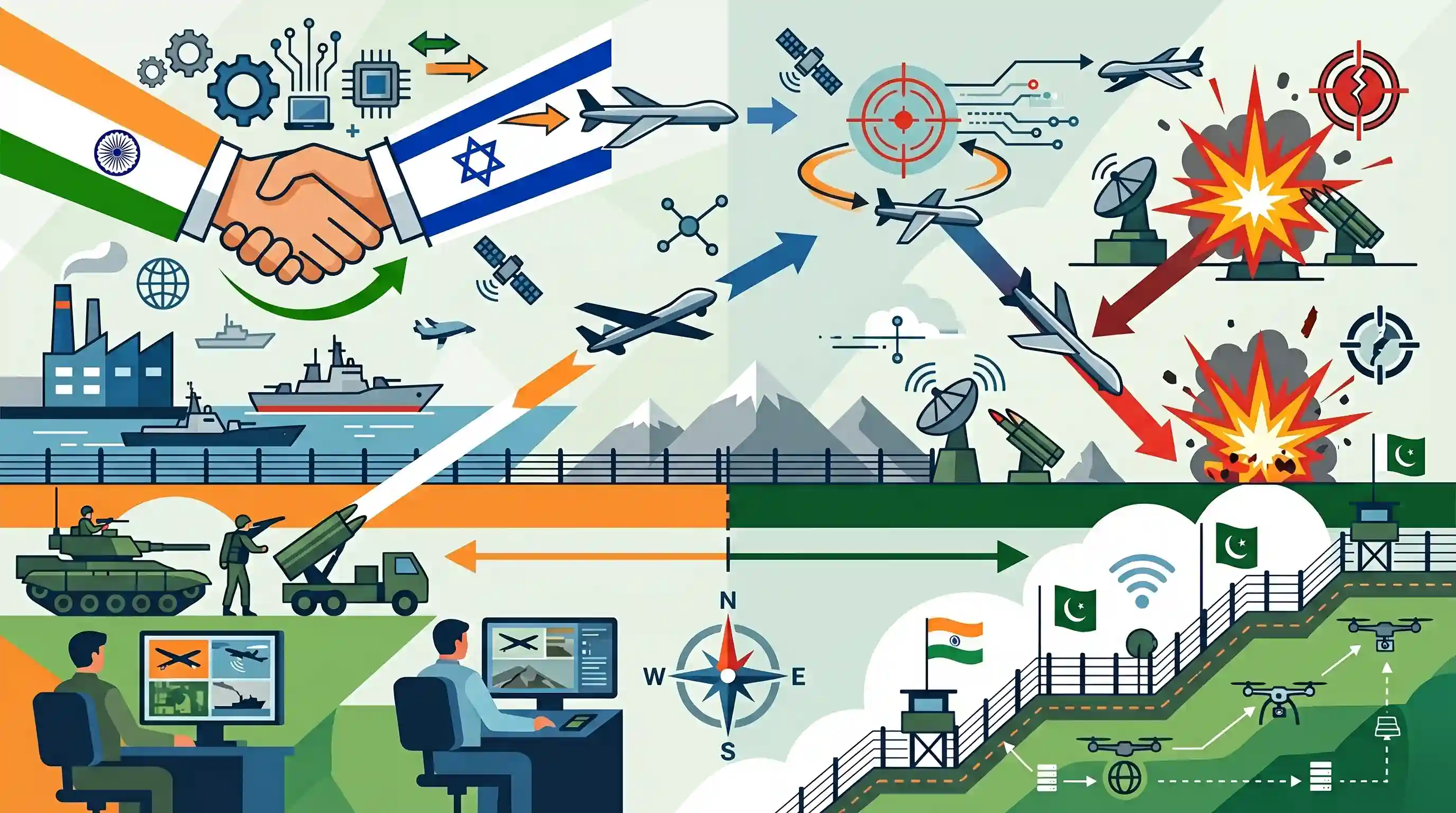
HAROP loitering munition capabilities used in border operations
Source:Indian Express ↗
Why It Matters
Loitering munitions and UAVs represent a critical evolution in modern asymmetric warfare. Understanding their capabilities is highly relevant for GS-3 Defense Technology and Internal Security (cross-border operations), as well as Prelims Science & Tech questions regarding drone mechanics.
Summary
The article explores the HAROP drone, an Israeli-made loitering munition that India is believed to have deployed against Pakistan during 'Operation Sindoor'. As a 'kamikaze' or suicide drone, the HAROP can loiter over a battlefield, autonomously locate targets (especially enemy air defenses), and dive into them to detonate its onboard warhead. The reported use of these advanced unmanned aerial vehicles (UAVs) marks a shift in tactical warfare along the border, providing India with enhanced standoff precision strike capabilities. Furthermore, it highlights the growing strategic depth of India-Israel defense ties and modernization efforts within the Indian Armed Forces.
Key Points
- The HAROP drone is a 'loitering munition' or 'kamikaze drone' designed by Israel Aerospace Industries (IAI).
- Unlike traditional missiles or reconnaissance UAVs, it can hover over a target area, search for targets, and self-destruct upon impact to destroy them.
- Reports suggest the Indian Armed Forces may have deployed HAROP drones during 'Operation Sindoor' for precision strikes against targets in Pakistan.
- The integration of loitering munitions offers a significant tactical advantage in cross-border operations, enabling precision strikes with zero risk to pilots.
- The deployment underscores the strengthening of defense and technological cooperation between India and Israel.
Important Terms
HAROP drone

An Israeli-developed loitering munition that combines UAV and missile features. It loiters for hours to identify and destroy high-value targets, like radars, by crashing into them with an onboard warhead.
UPSC context
GS Paper III (Security/S&T). Tests knowledge of advanced UAVs and India's precision strike capabilities in modern conflict scenarios.
Loitering munition
A category of weapons—often called "kamikaze drones"—that hover over a target area for an extended period, searching for targets and attacking only once a high-value objective is identified.
UPSC context
GS Paper III (S&T). Crucial for understanding the shift toward autonomous warfare, standoff strikes, and asymmetric defense technologies.
Operation Sindoor
A 2025 Indian tri-services military operation launched after a terror attack in Pahalgam. It involved precision strikes using drones and missiles against terror infrastructure and air defenses in Pakistan and PoK.
UPSC context
GS Paper III (Internal Security). Relevant for India's retaliatory doctrines, border management, and the use of technology in counter-terrorism operations.
Israel Aerospace Industries (IAI)
Israel's state-owned defense giant and a key strategic partner for India. It co-develops systems like the Barak-8 missile and supplies advanced UAVs, supporting India's military modernization.
UPSC context
GS Paper II (International Relations). Highlights the strategic depth of India-Israel bilateral ties and their impact on India’s defense self-reliance.
SEAD (Suppression of Enemy Air Defenses)
Military missions focused on neutralizing enemy surface-to-air missiles and radars. This creates "air corridors" for friendly aircraft to operate safely. HAROP drones are specifically designed for these roles.
UPSC context
GS Paper III (Security). Important for understanding air superiority, electronic warfare, and tactical shifts in regional military balances.
Prelims Trap
HAROP drones are autonomous fire-and-forget missiles that cannot be recalled once a target is selected.
HAROP has 'man-in-the-loop' technology. Operators can abort strikes mid-flight, allowing the drone to resume loitering, thus preventing collateral damage.
Static Concepts Connected
What distinguishes a loitering munition from conventional missiles and armed UAVs?
- Hover capability: They can loiter passively in the air for extended periods, searching or waiting for hidden targets to emerge before striking.
- Kamikaze nature: Unlike traditional UAVs (like Reaper) that fire external missiles and return to base, the drone itself is the warhead and self-destructs upon impact.
- Abort and re-engage: Unlike standard fire-and-forget cruise missiles, loitering munitions can be aborted mid-dive and instructed to resume loitering if ground conditions change.
How is India's military response to cross-border terrorism evolving?
- Proactive deterrence: Shifting away from historic 'strategic restraint' toward proactive, technology-driven punitive strikes (e.g., Balakot, Operation Sindoor).
- Non-contact warfare: Increasing reliance on unmanned technology (UAVs, loitering munitions) to neutralize cross-border targets with zero human casualty risk to Indian forces.
- Sub-conventional escalation: Using precision standoff weapons to effectively target hostile infrastructure while carefully keeping escalation strictly below the nuclear threshold.
Cross-Topic Patterns
Israel ties and Make in India
India-Israel defence ties are transitioning from a buyer-seller model to joint production, linking drone imports with Atmanirbhar Bharat initiatives like the Adani-Elbit UAV facility in Hyderabad.
Asymmetric Drone Warfare Shifts
Loitering munitions represent a global shift towards asymmetric warfare, prominently altering conventional air defence doctrines during the Ukraine-Russia conflict and Houthi Red Sea operations.

Expect a prelims question distinguishing loitering munitions from cruise missiles, focusing on 'man-in-the-loop' abort capabilities.
Linked PYQs · 4
Linked PYQs · 4
- 2023MainsGS3
The use of unmanned aerial vehicles (UAVs) by our adversaries across the borders to ferry arms/ammunitions, drugs, etc., is a serious threat to the internal security. Comment on the measures being taken to tackle this threat.
- 2025PrelimsGS1
With reference to Unmanned Aerial Vehicles (UAVs), consider the following statements : I. All types of UAVs can do vertical landing. II. All types of UAVs can do automated hovering. III. All types of UAVs can use battery only as a source of power supply. How many of the statements given above are correct?
- 2020MainsGS3
Analyze internal security threats and transborder crimes along Myanmar, Bangladesh and Pakistan borders including Line of Control (LoC). Also discuss the role played by various security forces in this regard.
- 2018MainsGS2
“India’s relations with Israel have, of late, acquired a depth and diversity, which cannot be rolled back.” Discuss.
