Haridwar Enhances Sanitation and Security for Kanwar Pilgrims
Source:socialnews ↗
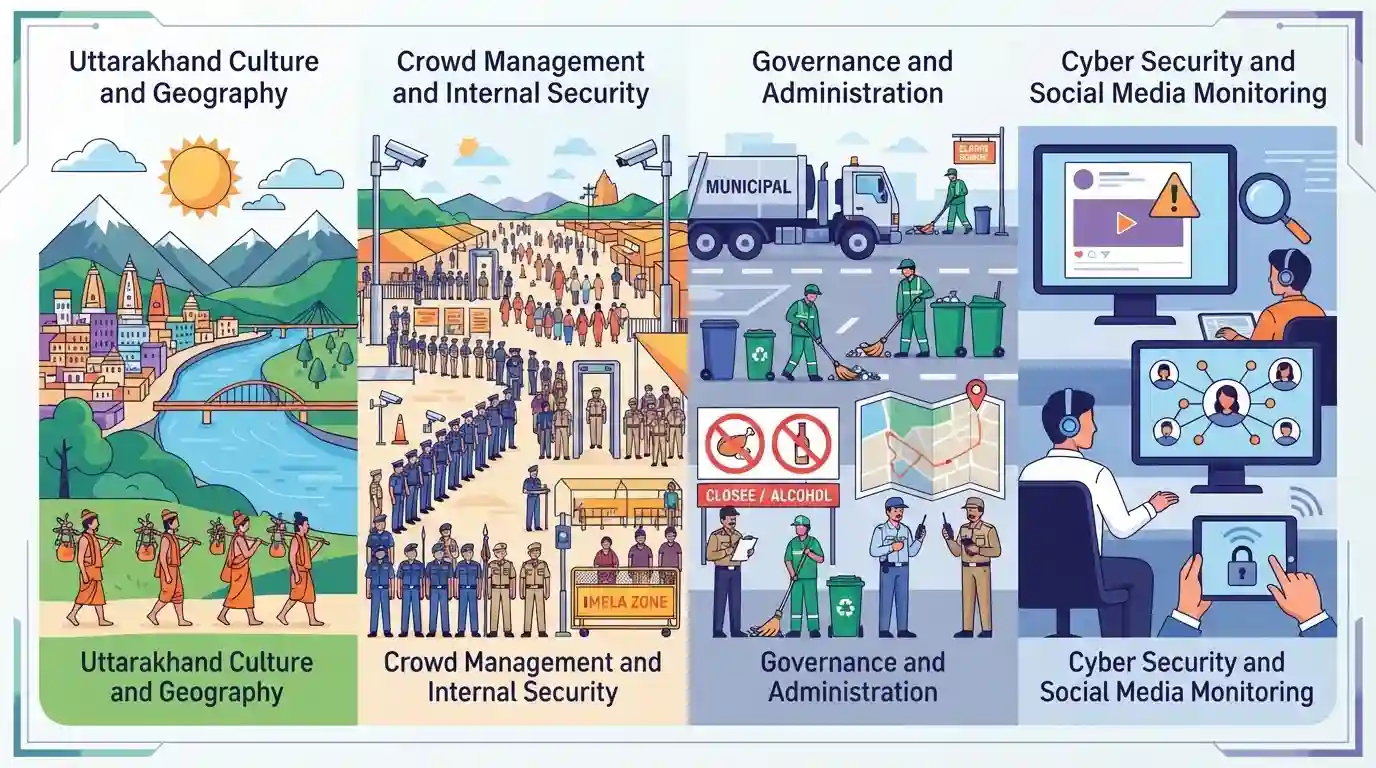
Why It Matters
Highlights the administrative, security, and cultural significance of large-scale religious congregations in Uttarakhand. It is highly relevant for UKPSC candidates understanding state governance, crowd management strategies, and the integration of cyber policing to maintain law and order during mega-events.
Summary
The administration in Haridwar has intensified sanitation, security, and cyber monitoring measures to manage the massive influx of devotees for the annual Kanwar Yatra. To maintain cleanliness, the Haridwar Municipal Corporation has deployed over 900 extra workers and specialized equipment across the mela zones. Security is heavily fortified with 6,000 police and paramilitary personnel, while meat and liquor shops along the route have been closed. Furthermore, authorities are vigilantly monitoring social media, having already taken down multiple fake videos and tracking over 160 accounts to prevent rumor-mongering and ensure peace during the pilgrimage.
Key Points
- The annual Kanwar Yatra is underway, drawing millions of Shiva devotees to Haridwar and Rishikesh to fetch holy water from the Ganges River.
- Haridwar Municipal Corporation has enhanced sanitation by deploying over 900 additional sanitation workers, mobile toilets, and specialized cleaning machines across the mela zones.
- Security has been bolstered with the deployment of 6,000 personnel, including paramilitary forces, bomb disposal squads, and dog squads.
- Meat and liquor shops along the Kanwar Yatra route have been temporarily shut down to respect the religious sentiments of the pilgrims.
- A dedicated social media monitoring cell is tracking over 160 accounts, actively removing fake videos and rumors to prevent communal tension and ensure public order.
Important Terms
Kanwar Yatra

An annual Hindu pilgrimage where millions of devotees collect holy water from the Ganges during the month of Shravan, presenting significant logistical, sanitation, and internal security challenges for state administrators.
UPSC context
Relevant for GS Paper 1 (Culture) and GS Paper 3 (Internal Security - crowd management and maintaining communal harmony).
Haridwar Municipal Corporation
The urban local governing body in Haridwar responsible for civic services. It executes critical sanitation, massive waste management, and public health campaigns during mega-congregations like the Kanwar Yatra.
UPSC context
GS Paper 2 (Local Governance). Illustrates the operational capacity and challenges of Urban Local Bodies during mass transient influxes.
Uttarakhand Police
The state law enforcement agency of Uttarakhand. It manages immense crowd surges, implements traffic routing, and deploys specialized security protocols to ensure peace during massive pilgrimages.
UPSC context
GS Paper 3 (Internal Security). Showcases the role of state police forces in disaster management and large-scale crowd control.
Cyber Patrolling
The proactive monitoring of digital platforms by specialized police units to counter fake news, AI-generated misinformation, and rumors designed to provoke communal tension during sensitive public gatherings.
UPSC context
GS Paper 3 (Cyber Security). Highlights the growing necessity of digital surveillance to maintain internal security and law and order.
Prelims Trap
"Freedom of religion under Article 25 prohibits the state from regulating associated economic activities like meat or liquor sales."
Article 25 explicitly allows the state to regulate secular economic activities associated with religious practices, and is subject to public order, morality, and health.
Static Concepts Connected
What are the constitutional grounds for restricting Article 25?
- Primary Restrictions: The state can restrict religious freedom on the specific grounds of public order, morality, and health.
- Secular Activities: The state can regulate or restrict any economic, financial, political, or other secular activity associated with a religious practice.
- Social Reform: The state can mandate social welfare and reform, including opening Hindu religious institutions of a public character to all classes.
What are the key strategies in NDMA Guidelines on Crowd Management?
- Capacity Planning: Scientific assessment of venue capacity, staggered admissions, and clear demarcation of entry/exit routes.
- Queue Management: Use of 'snake-line' barricading to prevent crush, manage continuous flow, and ease pressure on devotees.
- Tech Deployment: Real-time crowd monitoring using CCTV analytics, UAVs, and robust public address systems to prevent panic.
Cross-Topic Patterns
Social Media & Internal Security
The use of dedicated digital monitoring cells during religious festivals highlights the growing intersection of cyber intelligence and physical public order to combat algorithmically amplified fake news.
Geography of Pilgrimage Hubs
Haridwar's geographical placement where the Ganges exits the Siwaliks poses unique ecological and disaster risks, linking physical geography with solid waste management challenges during mega-events.

Mains 2026 could feature a 15-marker integrating NDMA crowd management guidelines with the internal security threat of social media rumors.
Linked PYQs · 2
Linked PYQs · 2
- 2025UKPSC_PRELIMSGS1
Which one of the following is incorrectly matched about festivals/exhibitions/expos held in Uttarakhand in 2025?
- 2025UKPSC_PRELIMSGS1
Which of the following districts of Uttarakhand has the highest agricultural land ?
