Uttarakhand Government Recommends Action in Haridwar Land Case
Source:timesofindia ↗
Why It Matters
This case demonstrates the mechanisms of administrative accountability and state-level disciplinary action against civil servants (including IAS and PCS officers) involved in local governance and land acquisition irregularities.
Summary
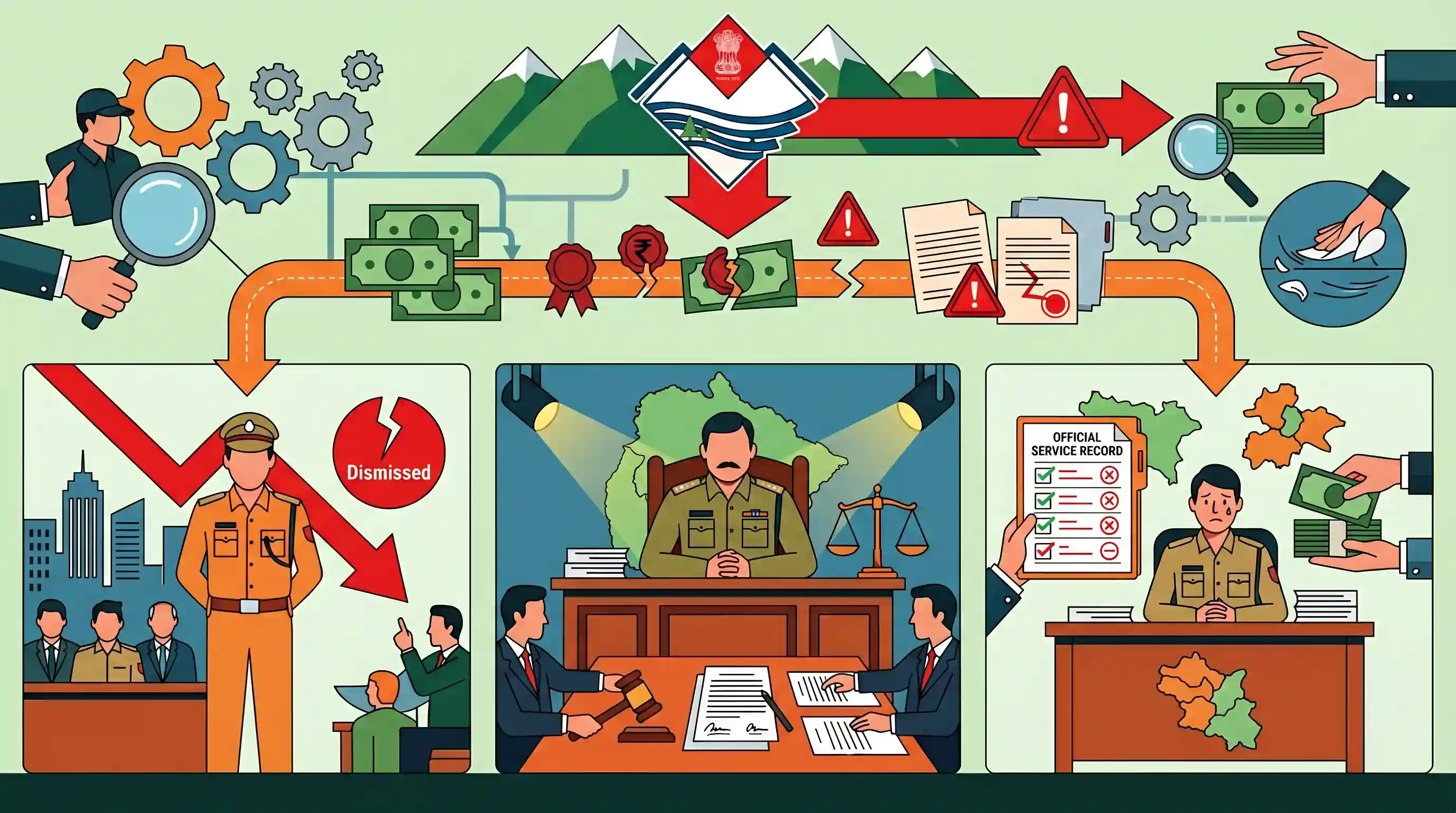
The Uttarakhand state government has recommended severe disciplinary actions, including the immediate dismissal of the then-municipal commissioner Varun Chaudhary, major penalty proceedings against then-DM Karmendra Singh, and adverse service entries alongside the withholding of increments for then-SDM Ajayveer Singh over serious irregularities in the Haridwar land purchase case.
Key Points
- The Uttarakhand government recommended the immediate dismissal of the then-municipal commissioner of Haridwar, Varun Chaudhary, due to irregularities in the Haridwar Municipal Corporation land purchase case.
- Major penalty proceedings have been initiated against the then-District Magistrate (DM) of Haridwar, Karmendra Singh, on charges of serious negligence in discharging his official duties.
- Directions were issued to record an adverse entry in the service record of the then-Sub-Divisional Magistrate (SDM), Ajayveer Singh, and to withhold his next three annual increments.
- Chief Minister Pushkar Singh Dhami reaffirmed the state government's zero-tolerance stance on administrative corruption, asserting that strict measures against compromised officials would continue.
Important Terms
Haridwar Municipal Corporation

An urban local body responsible for the civic administration, infrastructure development, and public service delivery in the holy city of Haridwar, Uttarakhand.
UPSC context
GS Paper II: Local self-government, Urban Local Bodies, and the 74th Constitutional Amendment Act.
Municipal Commissioner
The executive head of a municipal corporation, usually an IAS officer appointed by the state government, responsible for implementing council decisions and administering urban services.
UPSC context
GS Paper II: Urban local bodies, administrative reforms, and state-bureaucracy dynamics.
Department of Personnel and Training (DoPT)
The nodal department of the Government of India responsible for formulating personnel policies, managing cadre controls for the IAS, and overseeing training and disciplinary actions.
UPSC context
GS Paper II: Governance, executive accountability, and central administration of civil services.
District Magistrate (DM)
A senior IAS officer responsible for law and order, land revenue administration, and the execution of developmental policies at the district level.
UPSC context
GS Paper II: Role of civil services in a democracy, district administration, and governance.
Major Penalty Proceedings
Formal disciplinary actions initiated against a civil servant for serious misconduct, potentially resulting in dismissal, removal from service, compulsory retirement, or reduction in rank.
UPSC context
GS Paper II & IV: Administrative accountability, CCS (CCA) Rules, and civil service ethics.
Prelims Trap
State governments hold the ultimate power to dismiss or remove an All India Services (IAS) officer serving in their state cadre.
While states can suspend and recommend penalties, the final power of dismissal or removal rests solely with the Central Government (President of India) as the appointing authority.
Static Concepts Connected
What protections are guaranteed to civil servants under Article 311?
- No Subordinate Dismissal: A civil servant cannot be dismissed or removed by an authority subordinate to their appointing authority.
- Inquiry Requirement: No major penalty can be imposed without conducting a formal inquiry and giving the officer a reasonable opportunity of being heard.
- Inquiry Exceptions: Inquiry can be bypassed under three conditions: criminal conviction, physical impracticality, or national security interests.
How is disciplinary authority split for All India Services (AIS)?
- State Government Limits: State governments can suspend an AIS officer or impose minor penalties like censure or withholding increments.
- Central Government Supremacy: Major penalties like dismissal, removal, or compulsory retirement can only be executed by the President of India (Central Government).
- UPSC Consultation: Under Article 320, consulting the Union Public Service Commission is mandatory before imposing any major disciplinary penalty.
Cross-Topic Patterns
Executive control vs administrative autonomy
Article 311 acts as a federal safety valve, protecting civil servants from arbitrary politically motivated dismissals by state executives.
Decentralization and municipal auditing gaps
Urban local body land scams highlight structural weaknesses in financial devolution and the absence of robust independent municipal auditing mechanisms.

UPSC may test the constitutional limits of state executive control over All India Services and Article 311 inquiry exceptions in 2026.
Linked PYQs · 2
Linked PYQs · 2
- 2024UKPSC_PRELIMSGS1
The Chairman of Union Public Service Commission can be removed from his Post by
- 2025UKPSC_PRELIMSGS1
Consider the following statements with reference to Uttarakhand and choose the correct answer: 1. The executive of Uttarakhand includes Governor as the head of the state. 2. It also includes the Chief Minister and his/her council of ministers.
