Uttarakhand Forest Diversion Raises Ecological Concerns
Source:himbumail ↗
Why It Matters
Combines important state-specific cultural facts (Harela festival) with critical environmental data (forest diversion statistics) and disaster management concepts, all of which are frequently tested in UKPSC PCS Prelims.
Summary
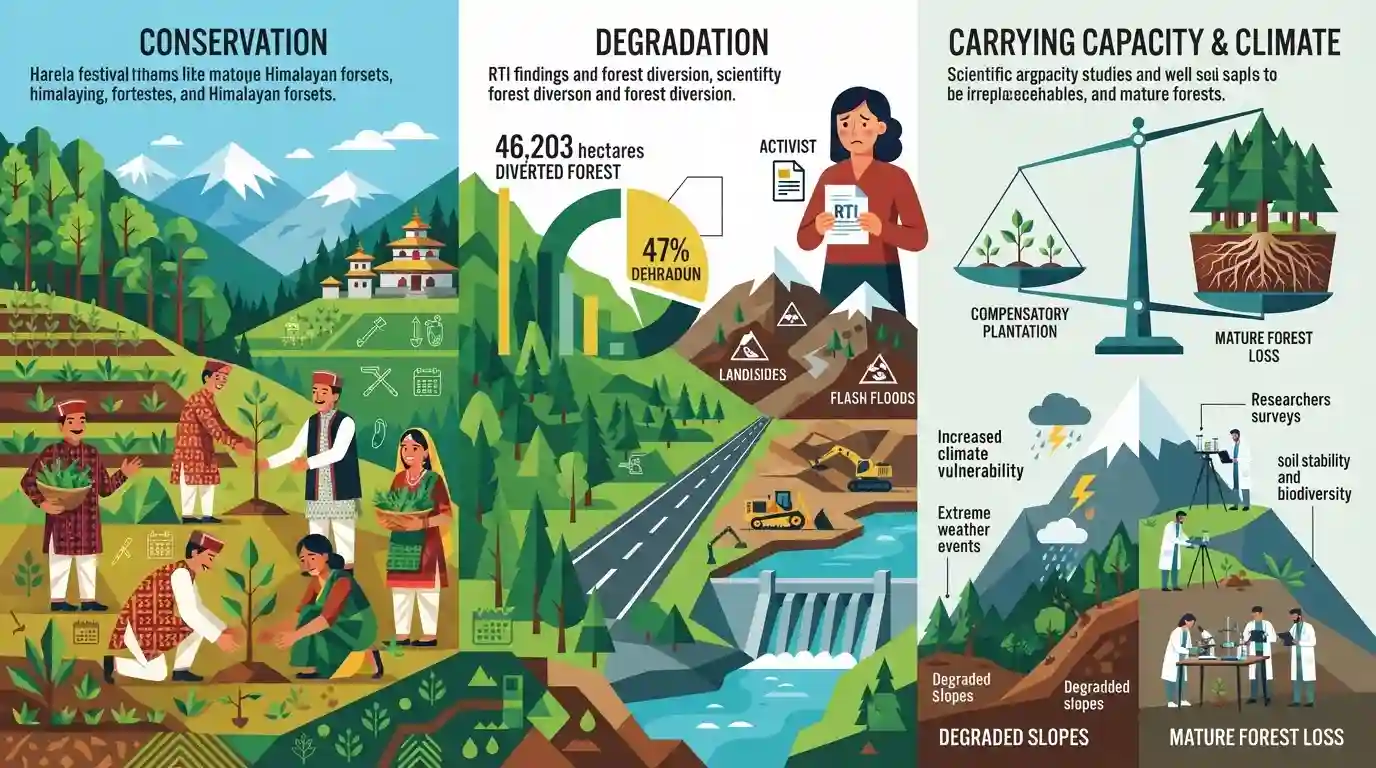
During the celebration of Uttarakhand's traditional green festival, Harela, activists highlighted a severe ecological concern: an RTI query revealed that 46,203 hectares of forest land have been diverted for infrastructure, mining, and power projects since the state's formation in 2000. Dehradun alone accounts for nearly 47% of this forest loss. Activists like Anoop Nautiyal warn that unchecked developmental activities—such as the Rishikesh–Bhaniyawala highway—are exacerbating the region's vulnerability to climate change, flash floods, and landslides. They emphasize the need for scientific carrying-capacity studies and argue that compensatory plantation drives cannot adequately substitute the loss of mature Himalayan forests.
Key Points
- Uttarakhand's traditional green festival, Harela, focuses on plantation and environmental conservation.
- An RTI reply revealed that 46,203 hectares of forest land in Uttarakhand have been diverted for development and infrastructure projects since the state's formation in 2000.
- Dehradun is the most affected district, accounting for 21,618 hectares (nearly 47%) of the total diverted forest land.
- Environmentalists are opposing large-scale tree felling for projects like the Rishikesh–Bhaniyawala four-lane highway, citing the state\'s ecological fragility.
- Activists are calling for scientific carrying-capacity studies, cumulative impact assessments, and strict environmental compliance, arguing that compensatory afforestation cannot replace mature Himalayan forests.
Important Terms
Right to Information (RTI) Act

A landmark 2005 Indian legislation that empowers citizens to request information from public authorities, securing transparency, accountability, and active public participation in governance while combating institutional corruption.
UPSC context
GS Paper II (Governance). Relevant for topics on transparency, accountability, citizen charters, and institutional checks and balances.
State Government of Uttarakhand
The sub-national governing authority established under the Constitution of India, responsible for executive and legislative administration, sustainable development, and ecological preservation in Uttarakhand.
UPSC context
GS Paper II (Governance). Relates to federalism, state-level environmental policy execution, and regional development in fragile ecosystems.
SDC Foundation
A Dehradun-based environmental action and advocacy group focused on climate resilience, waste management, sustainable urbanization, and disaster analysis (UDAAI) in Uttarakhand and the wider Himalayan region.
UPSC context
GS Paper III (Environment). Tests the role of civil society and NGOs in regional ecological conservation and disaster mitigation.
Ramboll
A global engineering, architecture, and consultancy company that partners with grassroots organizations, like the SDC Foundation, to support climate education and leadership initiatives such as Project PAHAL 2.0.
UPSC context
GS Paper III (Environment). Illustrates the role of corporate partnerships and CSR in localized climate action and capacity building.
Prelims Trap
"Barahnaza is a traditional shifting cultivation practice prevalent in the Northeast Indian states."
Barahnaza (twelve grains) is a traditional multi-cropping system of the Garhwal Himalayas linked to the Harela festival, not a slash-and-burn practice.
Static Concepts Connected
How does Compensatory Afforestation function under Indian environmental law?
- Legal Mandate: Governed by the Forest (Conservation) Act, 1980 and the Compensatory Afforestation Fund (CAF) Act, 2016.
- Land & Funds: Requires non-forest land equal to the diverted area (or double degraded forest land) plus the payment of Net Present Value (NPV).
- Ecological Deficit: Critics note that planted saplings fail to replicate the complex biodiversity and ecosystem services of old-growth, mature forests.
What is the National Mission for Sustaining the Himalayan Ecosystem (NMSHE)?
- Core Objective: One of the 8 NAPCC missions, focused on assessing vulnerability and safeguarding Himalayan glaciers and mountain ecosystems.
- Geographic Coverage: Spans 13 administrative units (11 States and 2 UTs) in the Indian Himalayan Region.
- Implementation: Coordinated by the Department of Science and Technology (DST) with support from various scientific institutions.
Cross-Topic Patterns
Harela & Barahnaza traditional cropping
Links regional monsoon festivals with climate-resilient agricultural practices like Garhwal's 12-crop system (Barahnaza), reflecting indigenous knowledge for soil fertility and drought resistance.
Infrastructure vs. Himalayan carrying capacity
Forest diversions for highway projects directly connect to phenomena like Joshimath land subsidence, triggering Supreme Court mandates for carrying-capacity assessments across 13 Himalayan units.

Expect a 2026 Prelims pairing of regional festivals (Harela) with indigenous climate-resilient farming (Barahnaza) or Himalayan NMSHE.
Linked PYQs · 3
Linked PYQs · 3
- 2016UKPSC_PRELIMSGS1
'HARELA' festival of Uttarakhand is related to:
- 2025UKPSC_PRELIMSGS1
Consider the following statements and select the correct answer from the options given below : Statement 1 : Uttarakhand is highly vulnerable to climate change. Statement 2 : Climate change is causing water stress and depleting biodiversity in Uttarakhand.
- 2024UKPSC_PRELIMSGS1
The Geographical regions which are particularly rich in endemic, rare and threatened species, found relatively in small areas and facing significant habitat loss are referred to as
