Harela Festival Celebrates Himalayan Nature and Traditional Farming
Source:ians ↗
Why It Matters
Harela is a vital state-specific festival of Uttarakhand that represents the state's cultural identity and environmental heritage. UKPSC frequently asks direct questions on Harela and related traditional crafts/practices (e.g., Ringal bamboo crafts marketed under 'Himadri' brand).
Summary
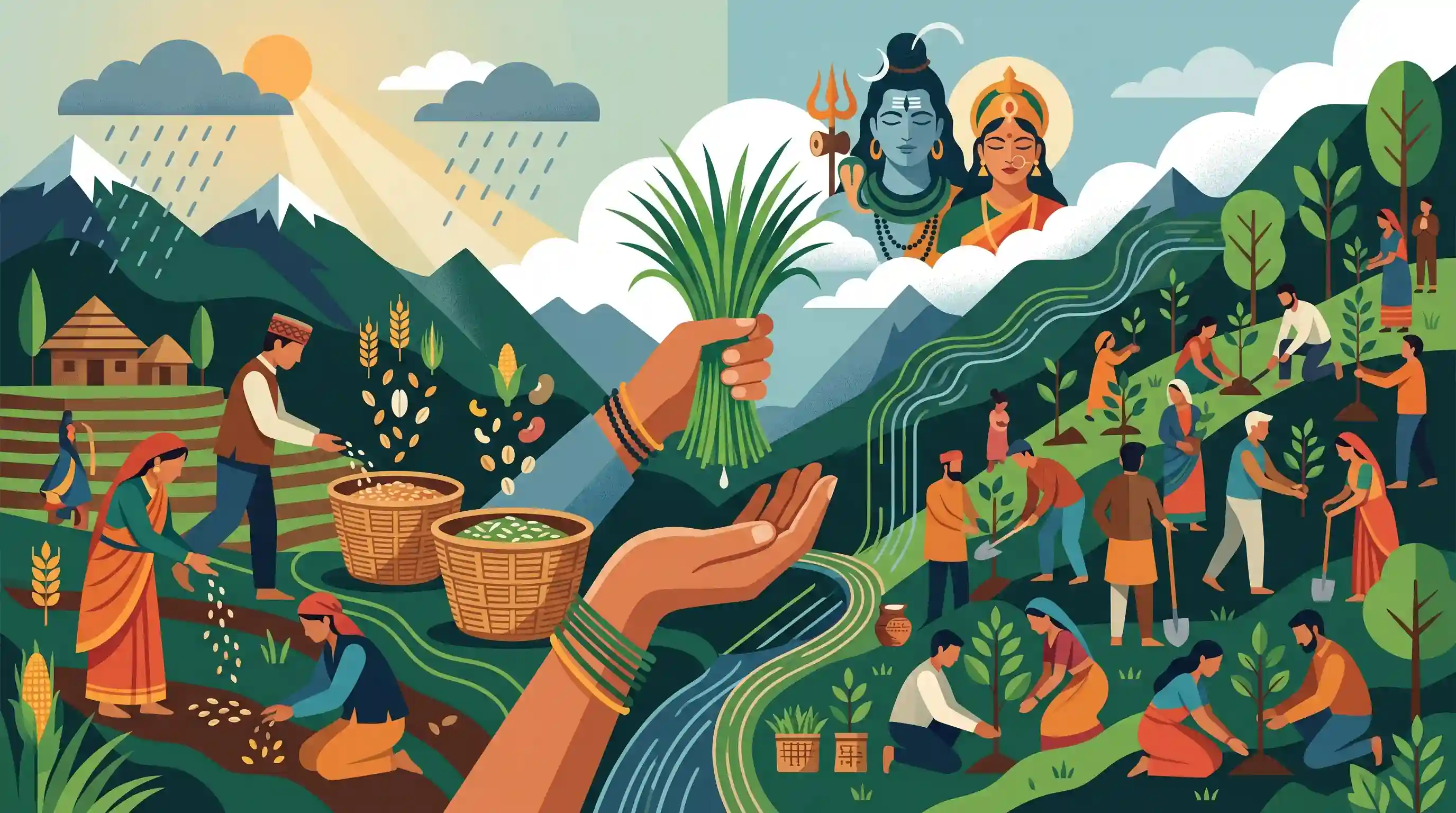
The Harela festival of Uttarakhand, celebrated in mid-July marking the onset of the month of Sawan, is a traditional celebration of agriculture, environment, and prosperity in the Kumaon region. Dedicated to Lord Shiva and Goddess Parvati, the festival involves sowing five to seven types of grains in traditional Ringal bamboo baskets, harvesting the lush green shoots as a symbol of prosperity, and carrying out mass tree plantation drives. It serves as an indicator of upcoming crop prospects and highlights the deep connection of Himalayan communities with nature.
Key Points
- Harela is a prominent traditional folk festival celebrated primarily in the Kumaon region of Uttarakhand at the onset of the Hindu holy month of Sawan (around mid-July).
- The festival is dedicated to Lord Shiva and Goddess Parvati, representing environmental conservation, greenery, and the arrival of the new agricultural season.
- Preparations begin 9 to 10 days before Sawan by sowing seeds in traditional 'Ringal' (local bamboo) baskets or earthen pots lined with Timil and Malu leaves.
- A blend of five or seven traditional grains is sown, typically including barley, wheat, paddy, maize, Gahat (horse gram), mustard, Urad (black gram), and Bhatt (black soybean).
- The germinated green shoots (Harela) are harvested on the first day of Sawan, first offered to the family deity (Isht Devta), and then placed behind the ears of family members by elders during traditional blessings.
- The traditional Kumaoni blessing given by elders references local flora: 'May your roots be as deep as the Dubak grass, your leaves as abundant as the Paul plant...'
- The health, height, and color of the germinated Harela shoots are traditionally observed by farming communities as indicators of soil health and upcoming crop prospects.
- A vital custom associated with Harela is the mass plantation of fruit-bearing and shade-giving saplings, reinforcing modern ecological conservation.
Important Terms
Harela Festival

An agricultural and environmental Hindu festival celebrated primarily in Uttarakhand's Kumaon region, marking the monsoon's arrival, the crop sowing cycle, and showcasing nature-society harmony.
UPSC context
GS Paper I: Art & Culture (Indian festivals) and GS Paper III: Environment (traditional conservation practices and climate resilience).
Ringal Bamboo Craft
A traditional Himalayan bamboo-weaving craft of Uttarakhand using flexible dwarf bamboo (Ringal). It holds a Geographical Indication (GI) tag, reflecting sustainable livelihood and eco-friendly design.
UPSC context
GS Paper I: Art & Culture (traditional crafts) and GS Paper III: Economy (Intellectual Property Rights and GI tags).
Kumaon Region
A mountainous region in eastern Uttarakhand, known for its distinct cultural identity, traditional festivals like Harela, indigenous agricultural systems, and unique Himalayan biodiversity.
UPSC context
GS Paper I: Geography (physical and human geography of India) and Art & Culture (regional diversity).
DSB College, Nainital
A premier constituent college of Kumaun University in Nainital, Uttarakhand, recognized for its botanical research and active role in promoting regional environmental conservation and forestry studies.
UPSC context
GS Paper I/III: Educational institutions contributing to the preservation of indigenous environmental knowledge and regional biodiversity.
Prelims Trap
Harela is the state-celebrated agricultural festival of Chhattisgarh, marked by worship of farm equipment and green clay art.
UPSC frequently exploits phonetic similarities. Harela is celebrated in Uttarakhand (Kumaon), while Hareli is the corresponding agricultural festival of Chhattisgarh.
Static Concepts Connected
What is the traditional 'Barahnaza' agricultural system of the Western Himalayas?
- Biodiverse Cropping: An indigenous system of cultivating 12 companion crops simultaneously in a single terrace field.
- Soil Health: Integrates nitrogen-fixing legumes (Gahat, Bhatt) with millets, naturally sustaining soil fertility without synthetic inputs.
- Climate Resilience: Reduces risk of crop failure against erratic weather, ensuring year-round food security for mountain communities.
What is the ecological and economic significance of Himalayan Ringal Bamboo?
- Dwarf Bamboo Habitat: Belonging to dwarf bamboo genera, it thrives naturally in the understory of temperate Himalayan forests.
- Geographical Indication: Awarded a GI tag to Uttarakhand in 2021, securing traditional basketry and weaving livelihoods.
- Disaster Mitigation: Its dense root network acts as an effective soil binder on steep, landslide-prone slopes of the Western Himalayas.
Cross-Topic Patterns
Indigenous agro-ecology vs. modern monoculture
Traditional multi-cropping like Barahnaza serves as a blueprint for climate-resilient farming under India's National Mission for Sustainable Agriculture.
Folk traditions as conservation tools
Harela's ritualistic tree planting aligns with Mission LiFE, demonstrating how community-led, culture-driven climate action bypasses bureaucratic friction.

Traditional agro-forestry systems (like Barahnaza) and related GI crafts (Ringal) are highly likely to feature in eco-cultural questions.
Linked PYQs · 2
Linked PYQs · 2
- 2016UKPSC_PRELIMSGS1
'HARELA' festival of Uttarakhand is related to:
- 2025UKPSC_PRELIMSGS1
The craft products of the Uttarakhand state are sold by which brand name?
