Uttarakhand celebrates traditional Harela festival with state holiday
Source:uttarakhandtribune ↗
Why It Matters
Harela is a prominent local festival frequently featured in state-level examinations (UKPSC). It represents a critical intersection between the state's cultural heritage, agricultural cycles, and modern ecological conservation policies.
Summary
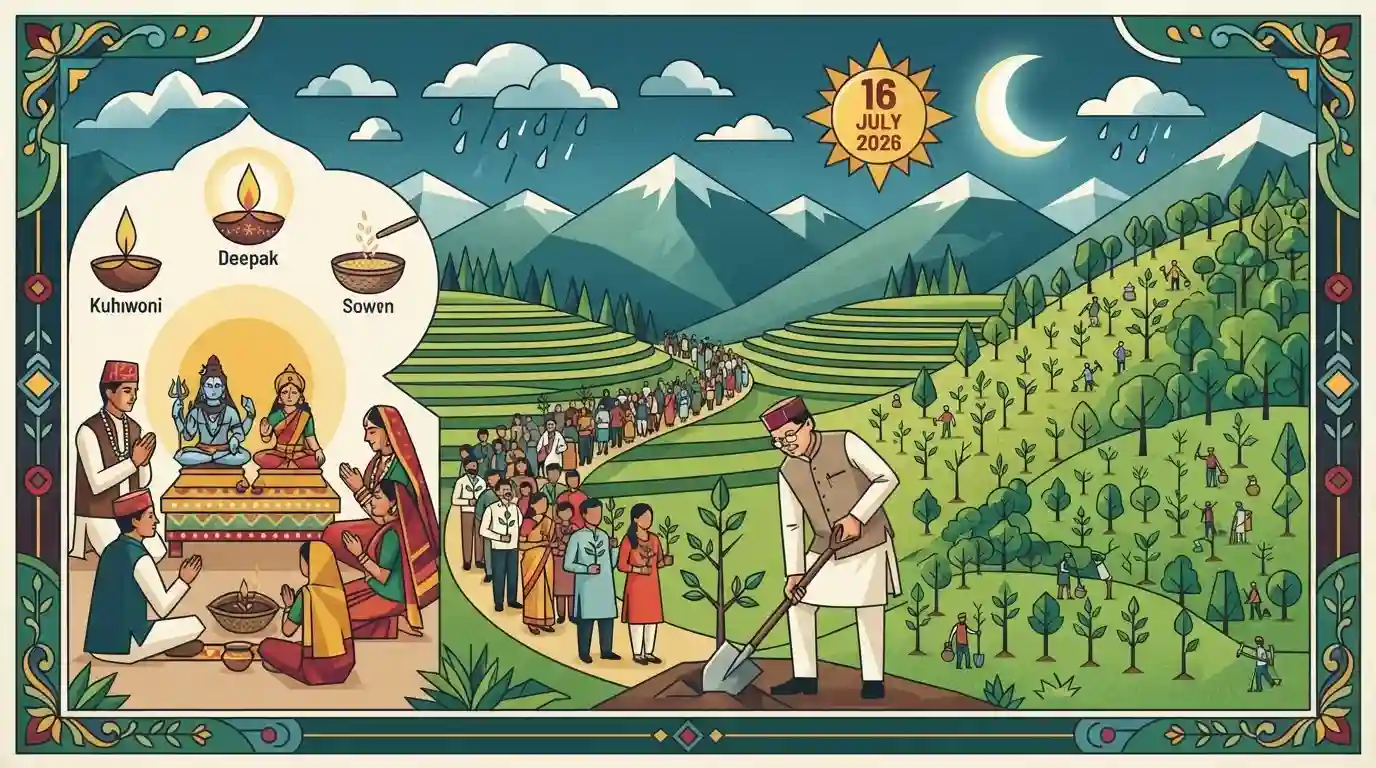
The Harela festival, deeply rooted in the agrarian culture of Uttarakhand, was celebrated on July 16, 2026, with a state holiday and massive environmental campaigns. Serving as a welcome to the monsoon season and the Shravan month, Harela integrates age-old rituals such as worshiping clay idols of Shiva and Parvati ('Dikare') and sowing grains with modern ecological efforts, notably large-scale tree plantation drives led by Chief Minister Pushkar Singh Dhami.
Key Points
- Uttarakhand celebrated the traditional Harela Festival on July 16, 2026, to mark the arrival of the monsoon and the auspicious Shravan month.
- The festival, known as 'Green Day', holds significant agrarian and socio-cultural value, signaling the start of the seasonal sowing cycle in the Kumaon and Garhwal regions.
- Cultural rituals include the creation of 'Dikare' (clay idols of Lord Shiva and Goddess Parvati) and the sowing of 5-7 types of grain, whose young shoots ('Harelu') are considered blessings.
- Chief Minister Pushkar Singh Dhami led a large-scale plantation drive in Malagram, Pauri Garhwal, reinforcing the festival's deep connection to environmental conservation and afforestation.
Important Terms
Harela Festival

A traditional monsoon and agrarian festival of Uttarakhand, translating to "Day of Green." It marks the onset of the sowing cycle, blending cultural rituals like sprouting seeds with large-scale environmental tree-plantation drives.
UPSC context
GS Paper 1 (Culture) & GS 3 (Environment). Tests regional harvest festivals and traditional ecological conservation practices.
Dikare
Handcrafted clay idols of deities—typically Lord Shiva and Goddess Parvati—worshiped during Uttarakhand's Harela festival. They symbolize divine marriage, fertility, and cultural continuity within Himalayan agrarian communities.
UPSC context
GS Paper 1 (Art and Culture). Important for questions on regional folk arts, traditional crafts, and religious symbolism.
Shravan Month
The fifth month in the Hindu lunar calendar, coinciding with the arrival of the southwest monsoon. It initiates crucial agrarian sowing cycles and is considered highly auspicious for nature worship.
UPSC context
GS Paper 1 (Art and Culture). Tests knowledge of the Hindu Luni-Solar calendar, seasonal changes, and associated regional harvest festivals.
Prelims Trap
Harela is a post-monsoon harvest festival celebrated predominantly by the tribal communities of Central India.
Aspirants often confuse Harela (Uttarakhand) with Hareli (Chhattisgarh). Furthermore, Harela marks the onset of the monsoon and the sowing cycle, not a harvest.
Static Concepts Connected
What is the 'Barahnaza' system of traditional farming?
- Core meaning: Literally translating to "12 grains", it is a traditional mixed-farming system practiced in the Garhwal Himalayas of Uttarakhand.
- Crop diversity: Farmers intercrop cereals, lentils, vegetables, creepers, and root crops in the same field to ensure year-round food security.
- Ecological benefits: It naturally maintains soil fertility, prevents total crop failure during erratic monsoons, and reduces the spread of pests.
How do Indian agrarian festivals align with the monsoon cycle?
- Sowing festivals: Festivals like Harela (Uttarakhand), Hareli (Chhattisgarh), and Raja Parba (Odisha) celebrate the arrival of the monsoon and the beginning of the sowing season.
- Harvest festivals: Festivals like Pongal, Bihu, Lohri, and Makar Sankranti celebrate the culmination of the agricultural cycle and the gathering of crops.
- Cultural ecology: Many monsoon festivals involve soil worship, seed exchange, and a temporary halt on tilling to allow the earth to regenerate.
Cross-Topic Patterns
Agrarian festivals and ecological conservation
UPSC increasingly links cultural practices with environmental protection. Harela's integration of ritualistic seed sowing and modern state-sponsored afforestation reflects the utility of Traditional Ecological Knowledge (TEK) in climate resilience.
Hyper-local ritualistic crafts (Dikare)
The creation of 'Dikare' clay idols reflects UPSC's ongoing trend of shifting away from mainstream classical arts toward specific, hyper-local ritualistic crafts and folk traditions in Prelims.

Expect a 'pairs' question matching agrarian festivals (Harela, Hareli, Raja Parba) to their respective states and sowing/harvest contexts.
Linked PYQs · 2
Linked PYQs · 2
- 2016UKPSC_PRELIMSGS1
'HARELA' festival of Uttarakhand is related to:
- 2024UKPSC_PRELIMSGS1
Which of the following folk dances/celebrations of Uttarakhand is included in the intangible heritage list of UNESCO ?
