Jammu and Kashmir Assembly raises concern over harassment of locals
Source:The Hindu ↗
Why It Matters
Highlighting the vulnerability of specific communities outside their home states raises critical questions regarding federalism, law and order, and the constitutional mandate of the Centre and States to protect citizens from identity-based hate crimes and discrimination.
Summary
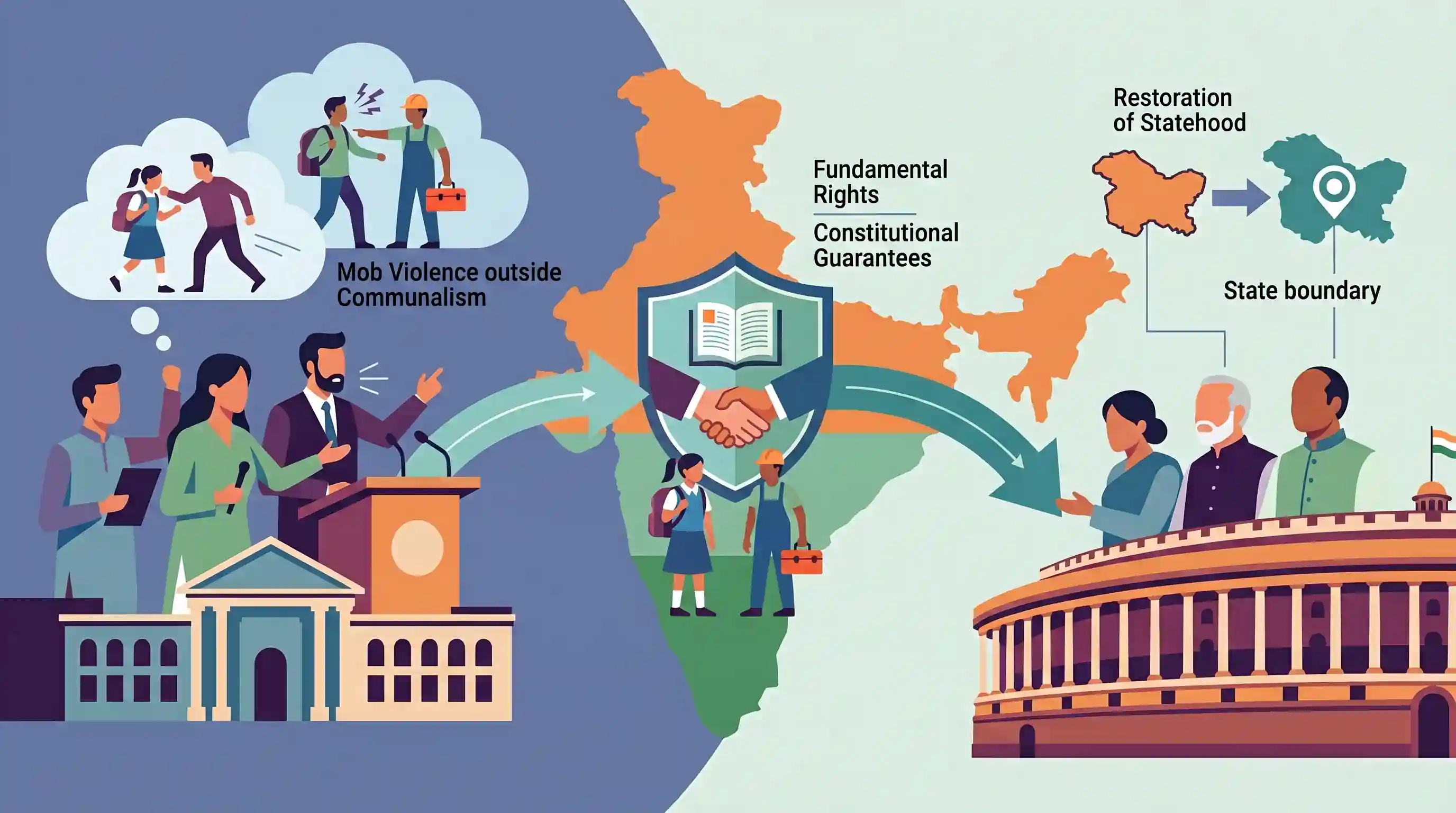
Growing cases of harassment, violence, and hate crimes against Kashmiris residing outside Jammu and Kashmir were raised in the J&K Assembly. Lawmakers from the PDP and NC sought urgent intervention from the Centre, demanding concrete steps against identity-based discrimination, constitutional guarantees, and the restoration of statehood to ensure the safety of Kashmiri students and workers.
Key Points
- Lawmakers from the PDP and NC highlighted a surge in hate crimes and physical assaults against Kashmiri students and workers in states like Himachal Pradesh and Uttarakhand.
- PDP MLA Waheed Ur Rehman Para moved an adjournment motion to discuss the safety of Kashmiris, urging state and central leaders to address identity-based discrimination.
- NC MLAs staged a sit-in demanding the restoration of J&K's Statehood and strong constitutional guarantees to prevent further marginalization.
- Former J&K Chief Minister Mehbooba Mufti accused state governments of offering silent patronage to mob violence and using hatred as a political tool.
Important Terms
Jammu & Kashmir Legislative Assembly

The representative legislative body for the Union Territory of Jammu and Kashmir, reconstituted after the 2024 elections. It has powers over State List subjects, excluding 'Public Order' and 'Police'.
UPSC context
GS II (Polity/Governance); tests understanding of UT governance models, Article 239A, and the legislative limits of the J&K Reorganisation Act.
Restoration of Statehood
The political and constitutional process of returning Jammu and Kashmir to the status of a full State, a transition mandated for the future by the Supreme Court in December 2023.
UPSC context
GS II (Federalism); tests knowledge of Article 3, the federal structure as a 'Basic Structure' element, and judicial directives on state reorganisation.
Jammu & Kashmir Reorganisation Act, 2019
The landmark Parliamentary Act that bifurcated the State of Jammu and Kashmir into two Union Territories (J&K and Ladakh) and nullified its special status under Article 370.
UPSC context
GS II (Constitution); tests knowledge of Article 370, parliamentary powers to alter state boundaries, and the legal framework of modern J&K.
Jammu & Kashmir National Conference (JKNC)
A major regional political party in Jammu and Kashmir, currently the ruling party. It historically advocates for the region's autonomy and the restoration of statehood.
UPSC context
GS II (Regionalism); tests the role of regional parties in federal politics and the socio-political evolution of Jammu and Kashmir.
Jammu & Kashmir Peoples Democratic Party (JKPDP)
A significant regional political party in J&K, currently in opposition. It focuses on regional identity, constitutional guarantees, and often raises issues of human rights and discrimination.
UPSC context
GS II (Polity); tests the dynamics of multi-party systems in sensitive border regions and the impact of local opposition on national policy.
Adjournment Motion
A procedural tool used in legislatures to suspend regular business to discuss a specific matter of 'urgent public importance,' requiring the Speaker's consent.
UPSC context
GS II (Parliamentary Procedures); tests knowledge of legislative devices used to hold the executive accountable and raise issues of national security or human rights.
Prelims Trap
The Union Government has direct enforcement powers to maintain public order and protect inter-state migrants in any state under Article 355.
'Public Order' and 'Police' are State subjects. Article 355 imposes a duty to protect against internal disturbance, but it does not grant the Centre routine policing powers over states.
Static Concepts Connected
Which Fundamental Rights protect citizens moving or settling outside their home state?
- Article 15(1): Prohibits the State from discriminating against any citizen on grounds solely of religion, race, caste, sex, or place of birth.
- Article 19(1)(d) & (e): Guarantees all citizens the right to move freely throughout the territory of India and to reside and settle in any part of it.
- Article 19(5) restrictions: These movement/residence rights can only be restricted in the interests of the general public or for the protection of Scheduled Tribes.
What are the core characteristics of an Adjournment Motion in Indian legislatures?
- Urgent public importance: It must be introduced to discuss a definite, factual, and highly urgent matter of public importance.
- Element of censure: It involves an element of censure against the government, and therefore is not permitted in the Upper House (Rajya Sabha/Legislative Councils).
- Interrupts normal business: Its adoption requires setting aside the normal business of the House, typically requiring the support of a minimum number of members (e.g., 50 in Lok Sabha).
Cross-Topic Patterns
Alienation and Internal Security linkages
Harassment of regional minorities acts as a catalyst for alienation, feeding directly into the radicalization narratives exploited by non-state actors in border regions.
J&K's Article 239A UT Framework
Demands for statehood highlight the limitations of the UT framework under Article 239A, where elected assemblies lack full legislative control compared to full states.

Expect a 2026 Mains question linking Article 15/19 inter-state migrant protections to the federal limitations of Article 355 & State List.
Linked PYQs · 3
Linked PYQs · 3
- 2025MainsGS2
Discuss the nature of Jammu and Kashmir Legislative Assembly after the Jammu and Kashmir Reorganization Act, 2019. Briefly describe the powers and functions of the Assembly of the Union Territory of Jammu and Kashmir.
- 2017MainsGS3
Mob violence is emerging as a serious law and order problem in India. By giving suitable examples, analyze the causes and consequences of such violence.
- 2023MainsGS1
Discuss the impact of post-liberal economy on ethnic identity and communalism.
