Zoonotic Disease Risks and Climate Change Linkages
Source:Indian Express ↗
Why It Matters
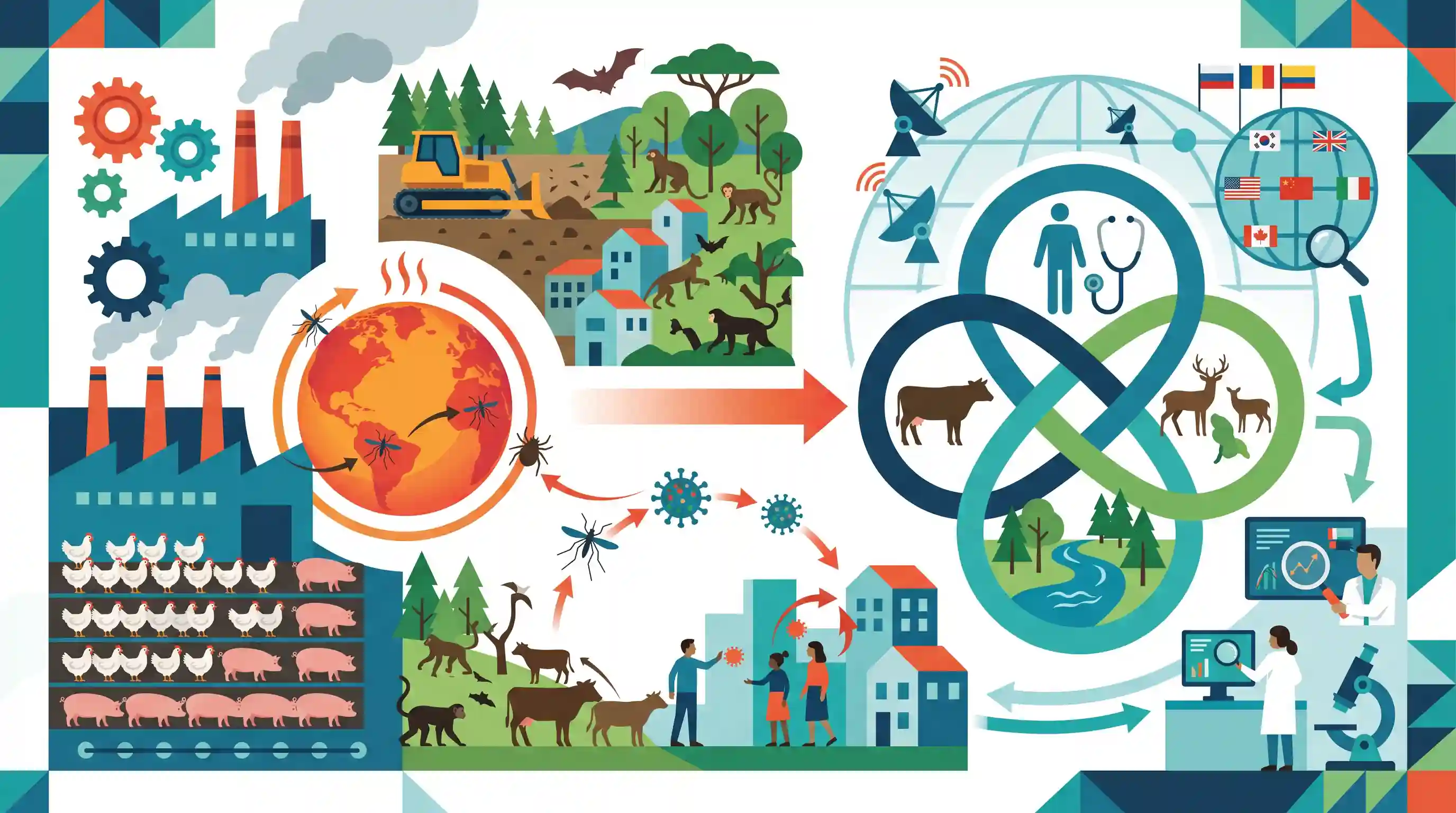
Zoonotic diseases (such as Nipah, COVID-19, and Hantavirus) have severe public health and economic repercussions. Understanding the environmental and anthropogenic drivers of these diseases—like deforestation, industrial farming, and climate change—is crucial for addressing topics in GS3 (Environment, Science & Tech) and GS2 (Public Health Governance).
Summary
The article features insights from Dr. Gagandeep Kang on the rising threat of zoonotic spillovers, highlighted by cases like Hantavirus. Ecological destruction, agricultural encroachment, and industrial livestock farming are identified as primary drivers creating breeding grounds for pathogens to jump from animals to humans. Additionally, climate change is altering the geographical distribution of disease vectors, such as mosquitoes and ticks, exposing new populations to risks. To mitigate these threats, the implementation of a robust 'One Health' approach is advocated to monitor the human-animal-environment interface. The ongoing global Pandemic Accord negotiations are underscored as a vital mechanism for ensuring early reporting and preparedness for future outbreaks.
Key Points
- Zoonotic spillover of diseases like Hantavirus is becoming increasingly inevitable due to ecological imbalances, deforestation, and climate change.
- Industrial livestock farming with genetically uniform animals acts as an amplifier, increasing the risk of virus mutation and subsequent transmission to humans.
- Climate change is shifting the geographical habitats of disease vectors; for instance, mosquitoes transmitting viral diseases are now establishing themselves at higher altitudes.
- Dr. Gagandeep Kang emphasizes the critical need for a 'One Health' approach that integrates human, animal, and environmental monitoring to preempt outbreaks.
- Ongoing global Pandemic Accord negotiations present a crucial opportunity to enforce better surveillance, compliance, and early reporting protocols globally.
Important Terms
One Health approach

An integrated strategy recognizing that human, animal, and environmental health are interdependent, used to address zoonoses, antimicrobial resistance, and ecosystem health holistically.
UPSC context
GS2 (Health) & GS3 (Environment); tests understanding of holistic health governance and inter-sectoral coordination for epidemic prevention.
Pandemic Accord
A legally binding international treaty (negotiated by WHO members) aimed at ensuring equitable global prevention, preparedness, and response to future pandemics.
UPSC context
GS2 (International Institutions); tests knowledge of global health legal frameworks and equity in vaccine/technology access.
Zoonotic Spillover
The process where a pathogen jumps from its natural vertebrate animal host into a human population, often triggered by habitat loss or wildlife trade.
UPSC context
GS3 (Science/Environment); tests understanding of disease emergence mechanisms and the impact of ecological degradation on public health.
Hantavirus
A family of viruses primarily spread by rodents that causes severe respiratory (HPS) or renal (HFRS) illnesses in humans through aerosolized waste inhalation.
UPSC context
GS3 (Science & Tech/Health); tests knowledge of specific infectious diseases, reservoir hosts, and transmission pathways.
Vector-borne Diseases
Illnesses caused by pathogens transmitted to humans by organisms like mosquitoes, ticks, or fleas, whose distribution is significantly influenced by climate change.
UPSC context
GS3 (Science & Tech/Environment); tests comprehension of climate change’s impact on health and challenges in controlling environmental disease vectors.
Prelims Trap
Hantavirus is transmitted by mosquitoes whose geographical habitats are shifting to higher altitudes due to climate change.
While the article discusses mosquitoes shifting to higher altitudes, Hantavirus is specifically transmitted via aerosolized rodent excreta. UPSC frequently tricks aspirants by swapping disease vectors.
Static Concepts Connected
What is the 'One Health' approach and why is it critical?
- Core principle: Recognizes that human, animal, and ecosystem health are inextricably linked, requiring multi-sectoral, coordinated surveillance.
- Zoonotic focus: It is essential for preempting zoonotic spillovers, which constitute approximately 60% of all emerging infectious diseases globally.
- Systemic monitoring: Addresses compounding risks from industrial farming, ecological degradation, and wildlife trafficking at the human-animal interface.
How does climate change directly impact the epidemiology of infectious diseases?
- Altitudinal shifts: Warming temperatures allow disease vectors like mosquitoes and ticks to survive and breed at higher elevations previously too cold for them.
- Latitudinal expansion: Tropical vector-borne diseases (like dengue and malaria) are increasingly expanding their geographic range into temperate latitudes.
- Habitat overlap: Climate-induced ecological degradation and deforestation force wildlife into closer proximity with human settlements, increasing spillover risks.
Cross-Topic Patterns
One Health & Antimicrobial Resistance (AMR)
The One Health framework is also the primary strategy for tackling AMR, as antibiotic misuse in industrial livestock farming leaches into ecosystems and transfers resistant pathogens to humans.
Pandemic Accord vs. TRIPS Intellectual Property
Negotiations for the WHO Pandemic Accord frequently clash with WTO's TRIPS agreement over compulsory licensing, technology transfer, and equitable sharing of genomic data versus pharmaceutical patents.

Expect a 2026 multi-statement question combining Hantavirus transmission (rodents), One Health principles, and WHO Pandemic Accord status.
Linked PYQs · 4
Linked PYQs · 4
- 2023PrelimsGS1
'Wolbachia method' is sometimes talked about with reference to which one of the following?
- 2021PrelimsGS1
The term 'ACE2' is talked about in the context of
- 2018PrelimsGS1
The term "sixth mass extinction/sixth extinction" is often mentioned in the news in the context of the discussion of
- 2020MainsGS2
Critically examine the role of WHO in providing global health security during the Covid-19 pandemic.
