WHO Assesses Public Health Risk as Low Following Hantavirus Outbreak
Source:The Hindu ↗
Why It Matters
Understanding zoonotic diseases, their modes of transmission, and the WHO's risk-assessment protocols is crucial for both Prelims (General Science) and Mains (GS2 Health, GS3 Science & Technology). It underscores the mechanisms of global health governance during localized outbreaks.
Summary
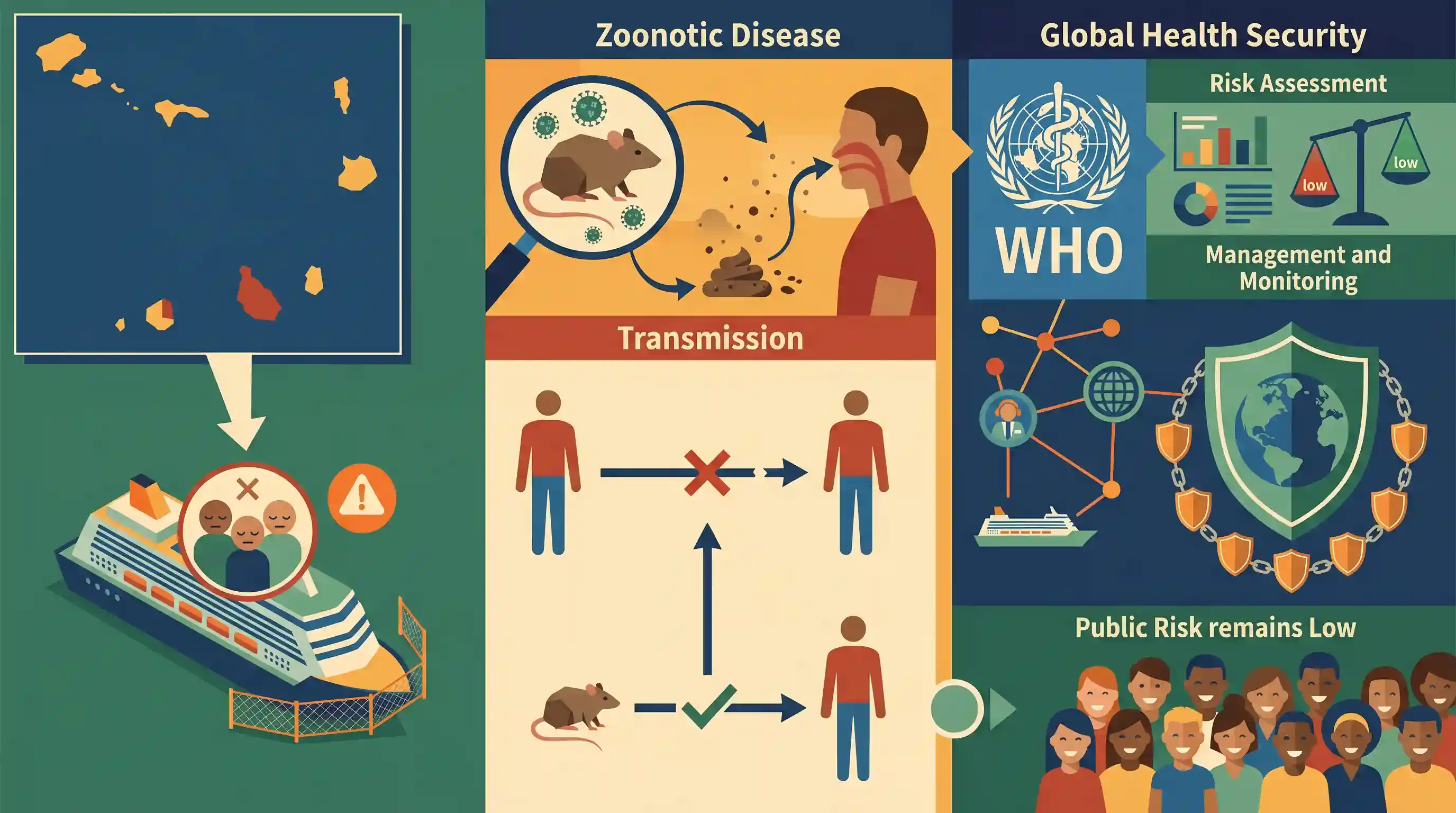
A suspected hantavirus outbreak on a cruise ship off the coast of Cape Verde has left three people dead. Despite the fatalities, the World Health Organization (WHO) has stated that the risk to the general public remains low. Hantavirus is a zoonotic infection primarily carried by rodents, and unlike many other respiratory viruses, it is rarely transmitted from person to person. The WHO continues to monitor the situation, highlighting its mandate in assessing and managing global health security risks.
Key Points
- A suspected hantavirus outbreak on the cruise ship MV Hondius near Cape Verde resulted in three fatalities and three other illnesses among passengers.
- Hantavirus is a zoonotic disease typically transmitted to humans through direct contact with the urine, feces, or saliva of infected rodents.
- The World Health Organization (WHO) assessed the public health risk as low because human-to-human transmission of hantaviruses is extremely rare.
- The incident emphasizes the WHO's critical role in monitoring international health emergencies, assessing epidemiological risks, and preventing unwarranted global panic.
Important Terms
World Health Organization (WHO)

A specialized UN agency established in 1948, headquartered in Geneva, responsible for coordinating international public health, setting global health standards, and monitoring disease outbreaks.
UPSC context
GS Paper-II: Important International Institutions; tests understanding of global health governance and response mechanisms during pandemics.
Hantavirus
A family of viruses primarily carried by rodents; human infection occurs through contact with infected rodent waste, causing severe respiratory or renal syndromes. Person-to-person transmission is extremely rare.
UPSC context
GS Paper-III: Science and Technology; tests knowledge of viral transmission, public health threats, and disease management strategies.
Zoonotic Diseases
Infectious diseases that naturally spread between vertebrate animals and humans, caused by various pathogens like viruses (e.g., Nipah), bacteria (e.g., Anthrax), or parasites.
UPSC context
GS Paper-III: Environment and Science & Tech; evaluates awareness of emerging health risks at the human-animal interface.
Global Health Security
A proactive and reactive framework designed to minimize the impact of acute public health events that cross international boundaries and threaten global population health.
UPSC context
GS Paper-II/III: International Relations/Health; examines collective international action and preparedness for transnational health emergencies.
International Health Regulations (IHR)
A legally binding international agreement (2005) requiring 196 countries to report and respond to public health risks that could spread globally.
UPSC context
GS Paper-II: International Agreements; tests knowledge of the legal obligations of states in managing global health risks.
One Health approach
An integrated, unifying approach that aims to sustainably balance the health of people, animals, and ecosystems by recognizing their close interdependence.
UPSC context
GS Paper-III: Environment/S&T; key strategy for addressing zoonoses and antimicrobial resistance through cross-sectoral collaboration.
Prelims Trap
"Hantavirus is a highly contagious disease transmitted rapidly from person to person."
Hantavirus is zoonotic and primarily contracted by inhaling aerosolized rodent excrement. Human-to-human transmission is extremely rare, unlike COVID-19 or the flu.
Static Concepts Connected
What are the primary transmission pathways and impacts of Hantaviruses?
- Rodent carriers: They are primarily transmitted by infected rodents through their urine, droppings, and saliva.
- Aerosolization: Humans usually contract the virus by breathing in virus-contaminated aerosolized particles stirred up from rodent habitats.
- Severe clinical outcomes: The infection can lead to severe conditions like Hantavirus Pulmonary Syndrome (HPS) and Hemorrhagic Fever with Renal Syndrome (HFRS).
What triggers a Public Health Emergency of International Concern (PHEIC)?
- Legal framework: It is a formal declaration by the WHO under the legally binding International Health Regulations (IHR, 2005).
- Declaration criteria: It must be an extraordinary event that poses a public health risk to other States through the international spread of disease.
- Global coordination: It mandates a coordinated international response. The WHO tracks local outbreaks precisely to prevent them from reaching this threshold.
Cross-Topic Patterns
Maritime Law + Global Health
Cruise ship outbreaks test the intersection of UNCLOS (jurisdiction over vessels) and the IHR 2005 (quarantine and disease reporting obligations of port States), a recurring theme since the COVID-19 pandemic.
African Island Nations Mapping
Cape Verde’s location off West Africa connects to physical geography themes like the Macaronesia ecoregion, the cold Canary Current, and volcanic archipelagos in the Atlantic.

Expect a match-the-following Prelims question pairing emerging viruses (Hantavirus, Nipah, Zika) with their specific primary vectors.
Linked PYQs · 3
Linked PYQs · 3
- 2020MainsGS2
Critically examine the role of WHO in providing global health security during the Covid-19 pandemic.
- 2023PrelimsGS1
'Wolbachia method' is sometimes talked about with reference to which one of the following?
- 2019PrelimsGS1
Which one of the following statements is not correct?
