Global Trade Wars Escalate as United States Imposes Tariffs
Source:The Hindu ↗
Why It Matters
A dramatic shift toward aggressive protectionism by the world's largest economy destabilizes multilateral trade and global supply chains. For UPSC aspirants, understanding the economic fallout (inflation, recession risks) and geopolitical consequences (WTO disputes, bilateral retaliation) is essential for analyzing the future of globalization and its direct impact on emerging economies like India.
Summary
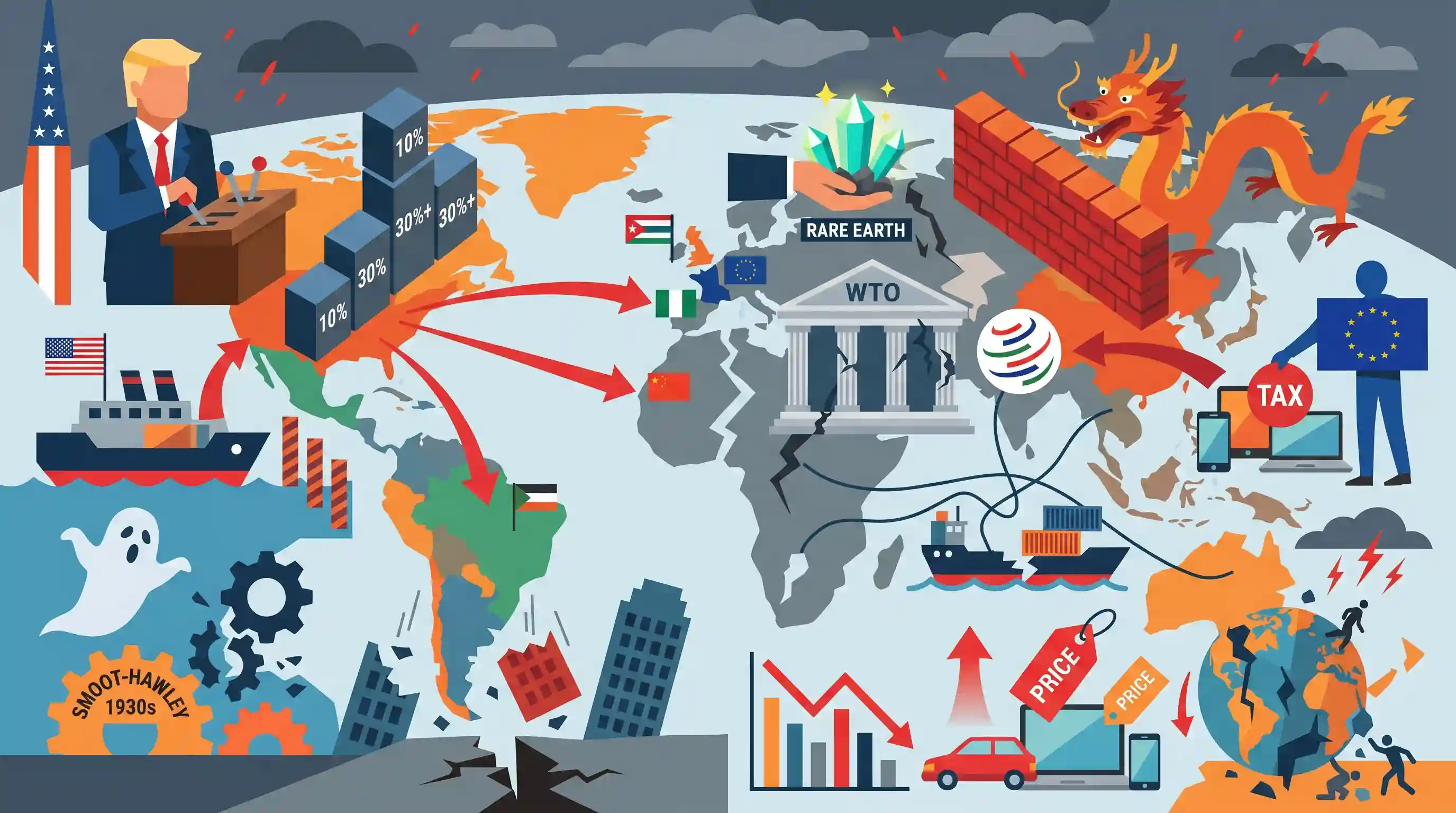
U.S. President Donald Trump has aggressively escalated global protectionism by implementing sweeping tariffs on countries worldwide, imposing a baseline 10% duty on most imports and significantly higher rates on key partners like China, Japan, and the EU. In retaliation, China has matched the 34% tariffs, threatened WTO action, and restricted rare earth exports, while the EU considers taxing U.S. tech companies. Economists warn the tariffs, mirroring the catastrophic Smoot-Hawley Tariff Act of the 1930s, risk triggering retaliatory trade wars, inflating prices, and plunging the global economy into a recession, as evidenced by a steep drop in international markets.
Key Points
- U.S. President Donald Trump implemented a sweeping 10% baseline tariff on most imports, invoking emergency economic powers to address perceived trade deficits and lack of reciprocity.
- Approximately 60 trading partners, including the EU, Japan, and China, face elevated tariff rates, with China facing a 34% levy and retaliating with reciprocal tariffs, restrictions on rare earth exports, and a WTO lawsuit.
- Temporary exemptions have been provided for Canada and Mexico (due to existing agreements) and for critical goods like copper, pharmaceuticals, and critical minerals, though investigations into these sectors are ongoing.
- The EU, facing a 20% tariff, and other partners like Japan are planning measured responses, with France and Germany considering taxes on U.S. technology companies.
- Global financial markets fell sharply over fears that the tariffs—averaging an effective rate of 24%, higher than the 1930 Smoot-Hawley Tariff Act—could disrupt global supply chains, dampen growth, and fuel inflation or a recession.
Important Terms
World Trade Organization (WTO)

Global body regulating international trade rules between nations, established in 1995. It oversees trade negotiations, resolves disputes, and monitors member-state trade policies to ensure fairness.
UPSC context
GS Paper 2/3: International institutions and their impact on India’s interests and global economic stability.
Smoot-Hawley Tariff Act
1930 US law that raised import duties on over 20,000 goods. It triggered global retaliatory tariffs, severely disrupting international trade and deepening the Great Depression.
UPSC context
GS Paper 3/World History: Historical precedent for protectionism and its catastrophic effects on the global economy.
European Union (EU)
A political and economic union of 27 European states with a standardized system of laws and a single market. It acts as a collective trade negotiator.
UPSC context
GS Paper 2: Regional groupings and bilateral trade relations (e.g., India-EU BTIA negotiations).
North America trade agreement (USMCA)
A trade pact between the US, Mexico, and Canada that replaced NAFTA in 2020. It updated rules on labor, automotive manufacturing, and digital trade.
UPSC context
GS Paper 2: International agreements involving major world powers and their effect on global trade.
Center for Strategic and International Studies (CSIS)
A prominent Washington-based non-partisan think tank that conducts research on geopolitical, economic, and security issues to influence global policy.
UPSC context
GS Paper 2: Role of non-state actors and think tanks in shaping international relations and policy discourse.
Prelims Trap
Rare Earth Elements (REEs) are classified as 'rare' because of their absolute geological scarcity in the Earth's crust.
They are actually relatively abundant in the earth's crust. They are called 'rare' because finding them in economically viable, concentrated ore deposits is highly unusual, making extraction difficult.
Static Concepts Connected
How does the WTO Dispute Settlement Mechanism function?
- Consultation phase: Complaining and responding parties must first attempt to resolve disputes bilaterally within 60 days.
- Panel adjudication: If unresolved, a specialized Panel adjudicates the dispute and issues a report which becomes binding unless appealed.
- Appellate Body: The highest forum for trade disputes. It is currently paralyzed because the US has blocked the appointment of new judges.
What are Digital Services Taxes (DSTs)?
- Taxing digital value: Taxes levied on non-resident digital platforms (like tech giants) based on revenues generated from local users, bypassing traditional 'physical presence' tax rules.
- India's Equalisation Levy: India introduced this in 2016 to tax digital advertising and e-commerce revenues of foreign companies, operating as a unilateral DST.
- OECD BEPS Link: The OECD's Base Erosion and Profit Shifting (BEPS) Pillar One aims to replace these unilateral DSTs with a unified global tax framework.
Cross-Topic Patterns
Trade wars and competitive devaluation
Prolonged tariff wars often push targeted nations to intentionally depreciate their currencies to maintain export competitiveness, risking global currency wars and macroeconomic instability.
Rare earths and minilateral supply chain groupings
China’s weaponization of rare earth exports directly accelerates minilateral initiatives like the Minerals Security Partnership and Quad’s critical technology supply chain resilience goals.
Retaliatory tech taxes and BEPS framework
The EU's threat to tax US tech links directly to the delayed OECD Two-Pillar framework and India's own Equalisation Levy on digital giants.

Expect a 2026 Prelims multi-statement question linking unilateral trade tariffs, WTO Appellate Body paralysis, and rare earth definitions.
Linked PYQs · 4
Linked PYQs · 4
- 2025MainsGS3
What are the challenges before the Indian economy when the world is moving away from free trade and multilateralism to protectionism and bilateralism? How can these challenges be met?
- 2018MainsGS3
How would the recent phenomena of protectionism and currency manipulations in world trade affect macroeconomic stability of India?
- 2018MainsGS2
What are the key areas of reform if the WTO has to survive in the present context of "Trade War', especially keeping in mind the interest of India?
- 2013MainsGS1
What policy instruments were deployed to contain the Great Economic Depression?
