Hamas Refuses Immediate Disarmament and Retains Gaza Security Control
Source:Indian Express ↗
Why It Matters
The ongoing Israel-Hamas conflict significantly impacts global geopolitics, regional stability in the Middle East, and global energy markets. For UPSC aspirants, understanding the foundational demands of the involved actors (like the 1967 borders and the two-state solution) is critical for analyzing international peace initiatives and India's diplomatic balancing act in West Asia.
Summary
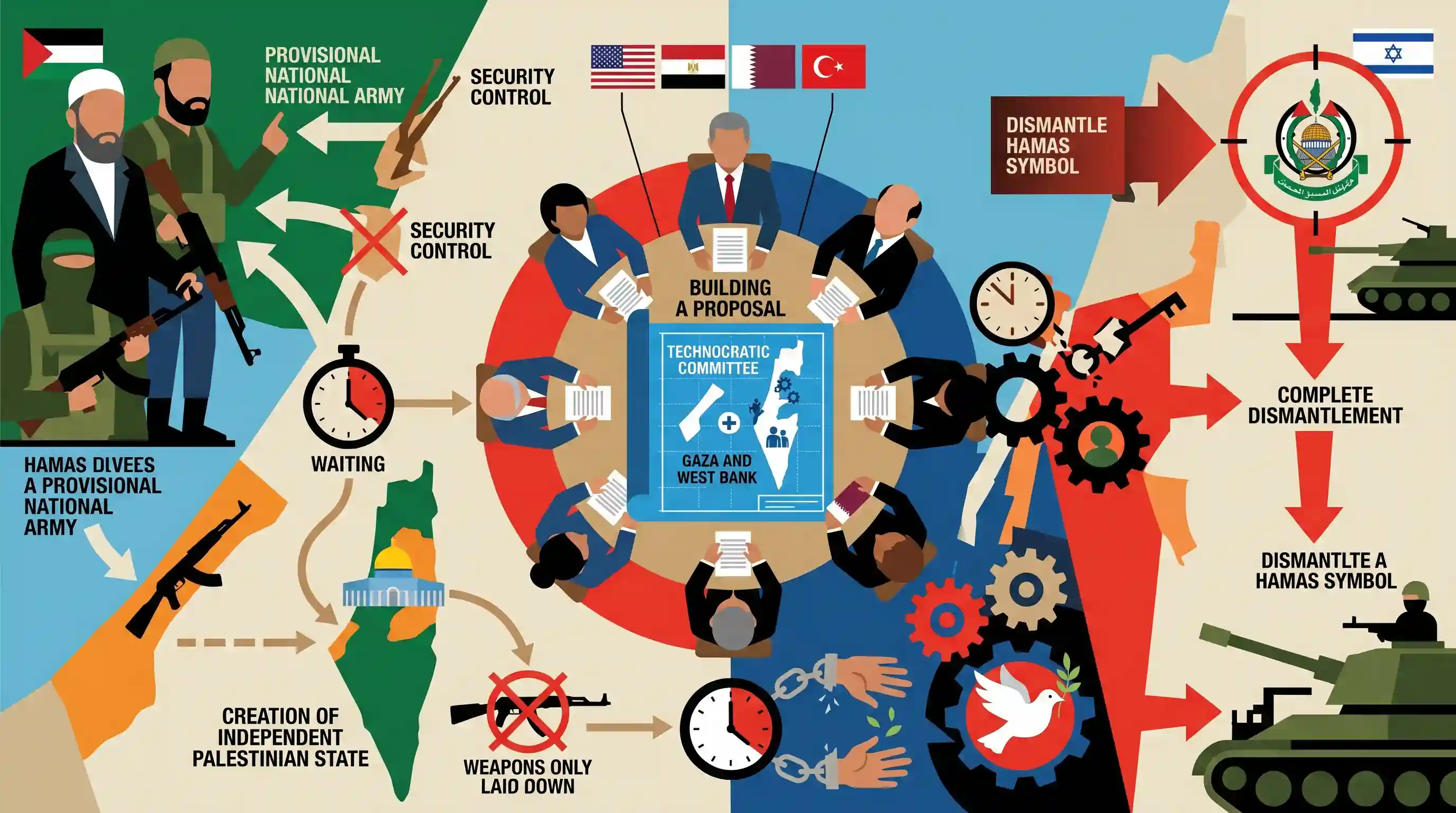
Hamas has stated it will not commit to immediate disarmament and insists on retaining control of security in the Gaza Strip during any transitional phase. Senior Hamas official Basem Naim asserted that the group's armed wing functions as a provisional national army, and disarmament can only occur after the establishment of an independent Palestinian state based on 1967 borders with East Jerusalem as its capital. While international mediators from the US, Egypt, Qatar, and Turkey are discussing the formation of a technocratic committee to govern Gaza and the West Bank, Hamas's refusal to disarm directly conflicts with Israel’s primary war objective of completely dismantling the group. This fundamental disagreement continues to stall ceasefire efforts and hostage release deals.
Key Points
- Hamas refuses to disarm immediately, insisting that an independent Palestinian state along the 1967 borders must be established first.
- The militant group demands to retain control over Gaza's security apparatus during any transitional period, viewing its armed wing as a provisional national defense force.
- International mediators (US, Egypt, Qatar, Turkey) are proposing a 'technocratic committee' to administer Gaza, manage borders, and oversee reconstruction.
- Israel demands the complete dismantlement of Hamas's military and governing capabilities, leading to a persistent deadlock in ceasefire and hostage-release negotiations.
Important Terms
Two-state solution

A proposed framework for the Israel-Palestine conflict envisioning two independent states—Israel and Palestine—coexisting side-by-side to ensure self-determination and regional security.
UPSC context
GS Paper II: International Relations. India's official stance supporting a negotiated solution for enduring peace in West Asia.
1967 borders
Also known as the Green Line; the 1949 Armistice lines that define the territory (West Bank, Gaza, East Jerusalem) occupied by Israel after the Six-Day War.
UPSC context
GS Paper II: International Relations. Key territorial benchmark for Palestinian statehood and international law (UN Resolution 242).
Hamas
An Islamist organization governing Gaza since 2007; classified as a terrorist group by many, it views itself as a national liberation movement and provisional army.
UPSC context
GS Paper II: Effect of policies and politics on India's interests; tests understanding of non-state actors in West Asia.
Fatah
A secular Palestinian nationalist party and the largest faction of the PLO; it governs the West Bank and favors a diplomatic, negotiated path to statehood.
UPSC context
GS Paper II: International Relations. Understanding internal Palestinian dynamics and the Palestinian Authority’s role in peace negotiations.
Technocratic committee proposal
A proposed 15-member interim governance body of independent Palestinian experts intended to manage Gaza’s public services and reconstruction during a post-conflict transitional phase.
UPSC context
GS Paper II: International Relations. Contemporary proposals for post-war reconstruction and the role of international mediators (US, Egypt, Qatar).
Prelims Trap
"The '1967 borders' refer to the new territorial boundaries established after the 1967 Six-Day War."
The '1967 borders' actually refer to the 1949 Armistice lines (Green Line) that existed BEFORE the 1967 Six-Day War altered territorial control.
Static Concepts Connected
What are the geographical boundaries and key crossings of the Gaza Strip?
- Bordering Entities: It shares land borders with Israel (north, east) and Egypt (southwest), with the Mediterranean Sea forming its western coastline.
- Rafah Crossing: The sole crossing point between Gaza and Egypt, serving as a critical lifeline that bypasses direct Israeli mainland control.
- Kerem Shalom: A major commercial goods border crossing situated at the strategic junction of the Gaza Strip, Israel, and Egypt.
What does the Two-State Solution based on '1967 borders' entail?
- The Green Line: It refers to the pre-1967 armistice lines (the Green Line), before Israel captured the West Bank, East Jerusalem, and Gaza.
- Core Territories: It envisions an independent Palestinian state encompassing the West Bank and Gaza Strip, with East Jerusalem as its capital.
- UN Resolutions: The framework is backed by UN Security Council Resolutions 242 and 338, which call for Israeli withdrawal from territories occupied in 1967.
Cross-Topic Patterns
Abraham Accords vs. Arab Peace Initiative
The 2002 Arab Peace Initiative conditioned normalization on a Palestinian state (1967 borders). The recent Abraham Accords bypassed this, reshaping Middle East geopolitics but leaving the core territorial conflict unresolved.
Engaging non-state armed actors in diplomacy
Qatar and Turkey mediating with Hamas mirrors past diplomatic efforts like the Doha Agreement with the Taliban, highlighting the complex integration of non-state armed actors into formal geopolitical negotiations.

Expect map-based Prelims questions on Gaza crossings (Rafah, Kerem Shalom) or chronological statements on Middle East peace agreements.
Linked PYQs · 3
Linked PYQs · 3
- 2023PrelimsGS1
Consider the following statements: Statement-I: Israel has established diplomatic relations with some Arab States. Statement-II: The 'Arab Peace Initiative' mediated by Saudi Arabia was signed by Israel and Arab League. Which one of the following is correct in respect of the above statements?
- 2022PrelimsGS1
The term "Levant" often heard in the news roughly corresponds to which of the following regions?
- 2021MainsGS3
Analyse the complexity and intensity of terrorism, its causes, linkages and obnoxious nexus. Also suggest measures required to be taken to eradicate the menace of terrorism.
