Hamas Demands Halt to Israeli Aggression for Gaza Reconstruction
Source:The Hindu ↗
Why It Matters
The evolving security architecture in Gaza, particularly the introduction of a US-led international peacekeeping force with contributions from Muslim-majority nations, reflects a major shift in Middle Eastern geopolitics. It raises important governance and security questions for UPSC candidates regarding international conflict resolution, the role of non-state actors, and UN Security Council mandates.
Summary
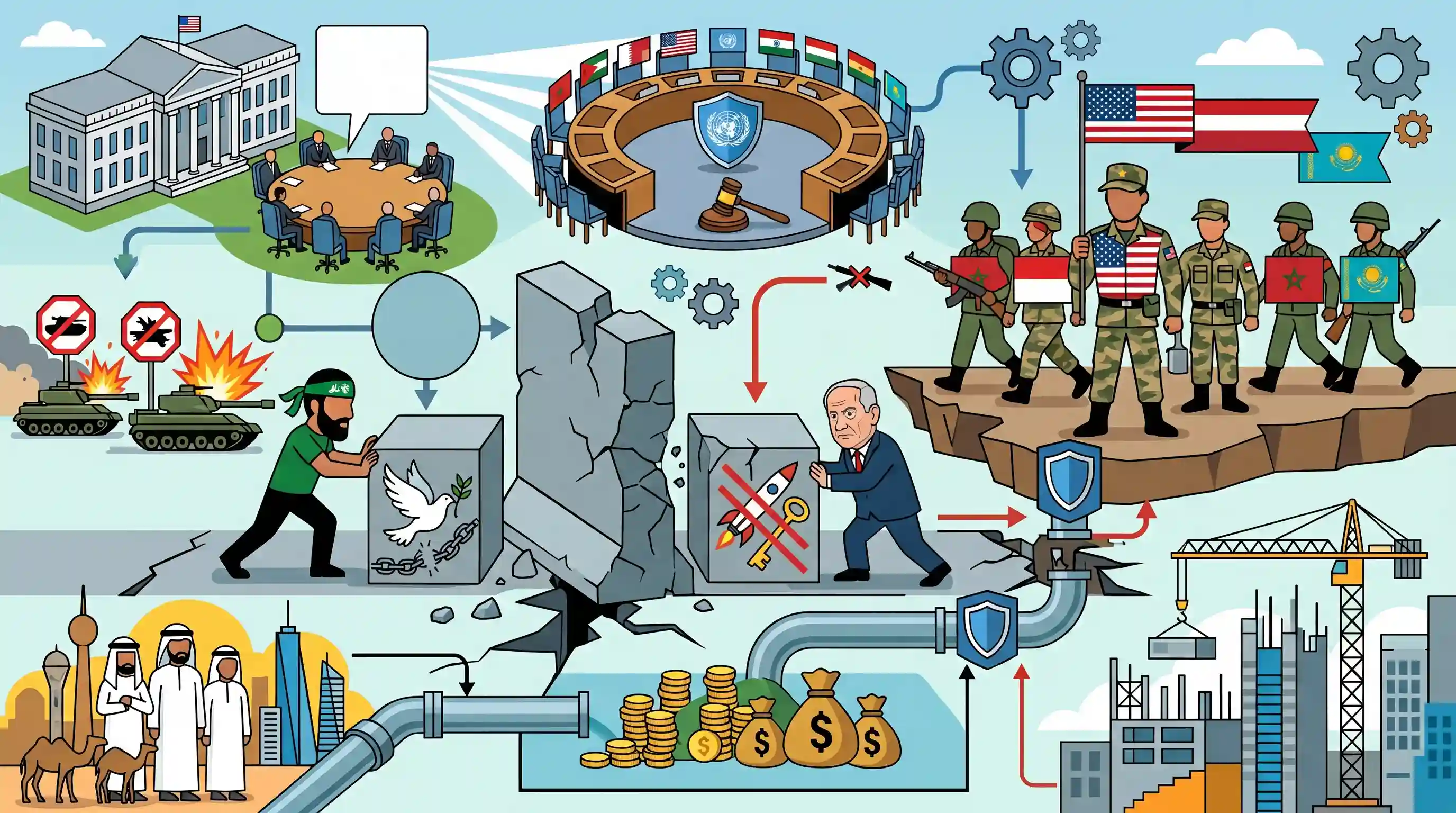
Hamas has stated that the path to rebuilding Gaza must begin with an end to Israeli aggression, highlighting the stark divisions that remain despite international efforts. A recent 'Board of Peace' meeting convened by US President Donald Trump in Washington discussed the deployment of an International Stabilisation Force. The force, endorsed by the UN Security Council, will be commanded by the US and include troops from nations like Indonesia (serving as deputy commander), Morocco, and Kazakhstan. While Gulf countries have pledged over $7 billion for Gaza's reconstruction, Israeli Prime Minister Benjamin Netanyahu continues to insist on the complete disarmament of Hamas before any rebuilding can commence.
Key Points
- Hamas declared that any roadmap for Gaza's future must start with a complete halt to Israeli aggression.
- US President Donald Trump hosted a 'Board of Peace' meeting in Washington regarding the region.
- A US-led International Stabilisation Force, commanded by American Maj Gen Jasper Jeffers, is planned for Gaza, with Muslim-majority Indonesia taking a deputy commander role.
- Over $7 billion has been pledged, primarily by Gulf states, for the reconstruction of Gaza.
- Israeli PM Benjamin Netanyahu demands the total disarmament of Hamas prior to any reconstruction efforts.
Important Terms
Hamas

A Palestinian militant and political organization that governed Gaza. In the 2026 peace framework, its disarmament remains a primary obstacle to US-brokered reconstruction and transition efforts.
UPSC context
GS-II (West Asia Geopolitics); vital for understanding non-state actors in conflict resolution and the complexities of regional security.
International Stabilisation Force (ISF)
A 20,000-strong multinational peacekeeping force mandated by UNSC Resolution 2803 to oversee Gaza's demilitarization. Commanded by the US with Indonesia as deputy, it includes troops from Morocco and Kazakhstan.
UPSC context
GS-II (IR) and GS-III (Security); examines new multilateral security models and the role of non-traditional peacekeeping contributors.
Board of Peace
A US-led international body established in 2026 to oversee Gaza’s post-war transition. Chaired by Donald Trump, it manages reconstruction funds and coordinates governance alongside the UN-mandated ISF.
UPSC context
GS-II (Global Groupings); tests knowledge of ad-hoc international administrations and US-led alternatives to traditional UN humanitarian frameworks.
UN Security Council (UNSC)
The UN organ responsible for international security. In 2025, it authorized the Board of Peace and ISF via Resolution 2803, providing the legal framework for Gaza’s stabilization.
UPSC context
GS-II (International Institutions); evaluates the Council's role in legitimizing multinational forces and the influence of major powers on its mandates.
Prelims Trap
The International Stabilisation Force deployed in Gaza is a traditional UN Peacekeeping Mission.
The force is merely endorsed by the UN Security Council but is actively commanded by the US, making it a multinational coalition rather than UN 'Blue Helmets'.
Static Concepts Connected
How do UN Peacekeeping Missions differ from UN-authorized Multinational Forces?
- Command Structure: UN Peacekeeping is under direct UN command, whereas Multinational Forces are commanded by a designated lead nation (e.g., the US) or an alliance.
- Funding Mechanism: UN missions rely on mandatory assessed contributions from member states, while multinational forces are primarily funded by participating troop-contributing countries.
- Operational Scope: Multinational forces often handle robust peace-enforcement tasks under UN Charter Chapter VII that exceed the capacity of traditional, lightly armed blue helmets.
What is the Gulf Cooperation Council (GCC)?
- Membership: A political and economic alliance formed in 1981 comprising Bahrain, Kuwait, Oman, Qatar, Saudi Arabia, and the UAE.
- Checkbook Diplomacy: GCC states frequently leverage immense financial resources and sovereign wealth to drive post-conflict reconstruction and regional stabilization efforts.
Cross-Topic Patterns
Abraham Accords and active stabilization
The participation of Morocco reflects a geopolitical shift where Abraham Accords signatories move beyond diplomatic normalization to active security burden-sharing in the Israeli-Palestinian arena.
UNSC delegation of peace enforcement
Similar to ISAF in Afghanistan, this highlights a trend where the UNSC authorizes a major power to lead stabilization instead of deploying UN peacekeepers, reflecting limits in UN operational capacity.

UN Peacekeeping vs UNSC-authorized multinational forces (like the new Gaza mission) is highly likely to be tested in 2026 Prelims.
Linked PYQs · 3
Linked PYQs · 3
- 2023PrelimsGS1
Consider the following statements: Statement-I: Israel has established diplomatic relations with some Arab States. Statement-II: The 'Arab Peace Initiative' mediated by Saudi Arabia was signed by Israel and Arab League. Which one of the following is correct in respect of the above statements?
- 2024MainsGS2
‘Terrorism has become a significant threat to global peace and security.’ Evaluate the effectiveness of the United Nations Security Council's Counter Terrorism Committee (CTC) and its associated bodies in addressing and mitigating this threat at the international level.
- 2018MainsGS2
“India’s relations with Israel have, of late, acquired a depth and diversity, which cannot be rolled back.” Discuss.
