Gaza military conflict and international humanitarian law challenges
Source:Indian Express ↗
Why It Matters
The Israel-Gaza conflict is a foundational topic for UPSC GS2 (International Relations) and GS4 (Ethics in IR). It touches upon global geopolitical alignments, India's balancing act in the Middle East, and the ethical considerations of modern warfare and human rights.
Summary
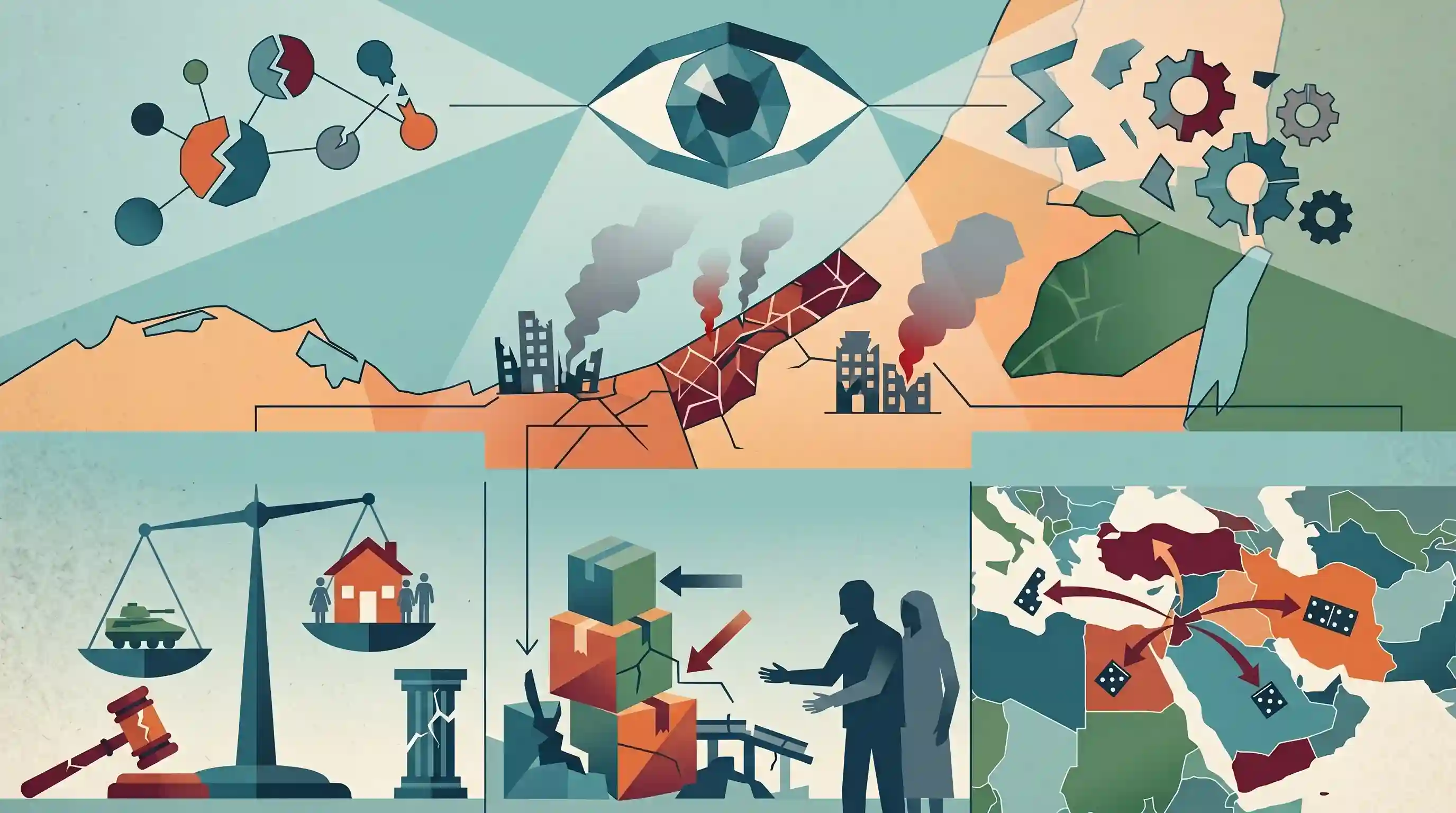
The escalation of the Israel-Hamas conflict into a prolonged war in Gaza has triggered an immense humanitarian crisis. As the devastation deepens, the international community is increasingly scrutinizing the moral legitimacy of Israel's military response. The high toll on civilians has begun to fracture the international consensus supporting Israel, bringing to the forefront the ethical dilemmas of disproportionate warfare, adherence to international humanitarian law, and the broader geopolitical instability in West Asia.
Key Points
- The prolonged Israeli military campaign in Gaza has resulted in severe infrastructural devastation and an unprecedented humanitarian crisis.
- Global perception is shifting, with the moral and ethical foundations of international support for Israel increasingly being questioned due to high civilian casualties.
- The conflict highlights the profound tension in international law between a state's right to self-defense and the principles of proportionality and civilian protection.
- The war has significantly impacted West Asian geopolitics, complicating normalization efforts like the Abraham Accords and heightening regional instability.
Important Terms
International Humanitarian Law

A branch of international law (Geneva and Hague Conventions) designed to limit the effects of armed conflict by protecting non-combatants and regulating the means of warfare.
UPSC context
Relevant for GS Paper 2 (International Relations) regarding global governance, human rights, and adherence to international treaties during conflicts.
West Asian Geopolitics
The strategic and political landscape of Western Asia, critical to India's energy security, trade routes (Strait of Hormuz), and the welfare of its massive diaspora.
UPSC context
Core topic for GS Paper 2 (India and its Neighborhood) and GS Paper 3 (Strategic Security) regarding regional stability.
Ethics in International Relations
The application of moral principles to global politics, focusing on the tension between national interest (Realism) and humanitarian obligations (Idealism).
UPSC context
Specifically tested in GS Paper 4 (Ethics, Integrity, and Aptitude) regarding the moral legitimacy of state actions and global justice.
Hamas
A Palestinian Islamist political and militant organization that has governed the Gaza Strip since 2007, following its victory in the 2006 parliamentary elections.
UPSC context
Important for GS Paper 2 (International Relations) as a non-state actor and GS Paper 3 regarding internal security and terrorism.
United Nations
The primary global organization for peace and security, established in 1945, whose resolutions and agencies (like UNRWA) are central to the Israel-Palestine narrative.
UPSC context
Critical for GS Paper 2 (International Institutions) and their effectiveness in maintaining global peace and enforcing humanitarian law.
Two-State Solution
A proposed diplomatic framework for resolving the Israel-Palestine conflict by establishing an independent Palestinian state alongside the State of Israel.
UPSC context
Frequently discussed in GS Paper 2 as the widely recognized international benchmark for achieving lasting peace in the Middle East.
Prelims Trap
"Jus in bello dictates the justifiable reasons and legitimate authority for a state to declare war."
This describes "Jus ad bellum" (right to go to war). "Jus in bello" governs conduct *during* war, such as proportionality and civilian protection.
Static Concepts Connected
What are the core components of the Just War Theory?
- Jus ad bellum: The ethical conditions required for going to war, which include having a just cause, legitimate authority, and using war only as a last resort.
- Jus in bello: The ethical conduct during a war, strictly focusing on the use of proportional force and explicitly distinguishing between active combatants and non-combatant civilians.
- Jus post bellum: The principles of justice applied after a war concludes, ensuring fair peace treaties, accountability for war crimes, and equitable post-conflict reconstruction.
What are the primary protections under the Geneva Conventions of 1949?
- 1st & 2nd Conventions: These initial conventions mandate the protection of wounded, sick, and shipwrecked military personnel during conflicts on land and at sea.
- 3rd Convention: Establishes strict, comprehensive international rules for the humane treatment, rights, and protection of Prisoners of War (PoWs) held by an adversary.
- 4th Convention: Specifically protects civilians in armed conflicts and occupied territories, explicitly prohibiting the targeting of non-combatants and collective punishment.
Cross-Topic Patterns
Just War Theory + Realpolitik
The Gaza conflict merges GS4's "Ethics in IR" (proportionality, civilian harm) with stark GS2 realism, a frequent theme in Mains essays exploring the limits of global governance and human rights.
Levant mapping + Abraham Accords
Prelims map questions increasingly pair Mediterranean/Red Sea conflict zones (Gaza, Golan Heights, Houthis) with recent geopolitical and economic frameworks like the Abraham Accords, IMEC, or I2U2.
India's De-hyphenation Policy
The crisis tests India's contemporary Middle East diplomacy: navigating historical non-aligned solidarity for Palestine while sustaining deepening defense, tech, and agricultural ties to Israel.

Expect a 2026 Prelims map question matching Levant zones with bordering seas, or a Mains GS4 case study on 'Jus in bello' proportionality.
Linked PYQs · 4
Linked PYQs · 4
- 2018MainsGS2
“India’s relations with Israel have, of late, acquired a depth and diversity, which cannot be rolled back.” Discuss.
- 2022MainsGS4
Russia and Ukraine war has been going on for the last seven months. Different countries have taken independent stands and actions keeping in view their own national interests. We are all aware that war has its own impact on the different aspects of society, including human tragedy. What are those ethical issues that are crucial to be considered while launching the war and its continuation so far? Illustrate with justification the ethical issues involved in the given state of affair.
- 2023PrelimsGS1
Consider the following statements: Statement-I: Israel has established diplomatic relations with some Arab States. Statement-II: The 'Arab Peace Initiative' mediated by Saudi Arabia was signed by Israel and Arab League. Which one of the following is correct in respect of the above statements?
- 2022PrelimsGS1
The term "Levant" often heard in the news roughly corresponds to which of the following regions?
