Gaza governance transition and technocratic committee formation
Source:The Hindu ↗
Why It Matters
The transition of administrative power in Gaza from Hamas to a technocratic, externally-supported civilian committee represents a major structural shift in the Israeli-Palestinian peace process and governance in West Asia. India's strategic interests in the region—encompassing energy security, a massive diaspora, bilateral trade, and connectivity initiatives like the India-Middle East-Europe Economic Corridor (IMEC)—rely heavily on the stability and post-conflict resolution of the Levant.
Summary
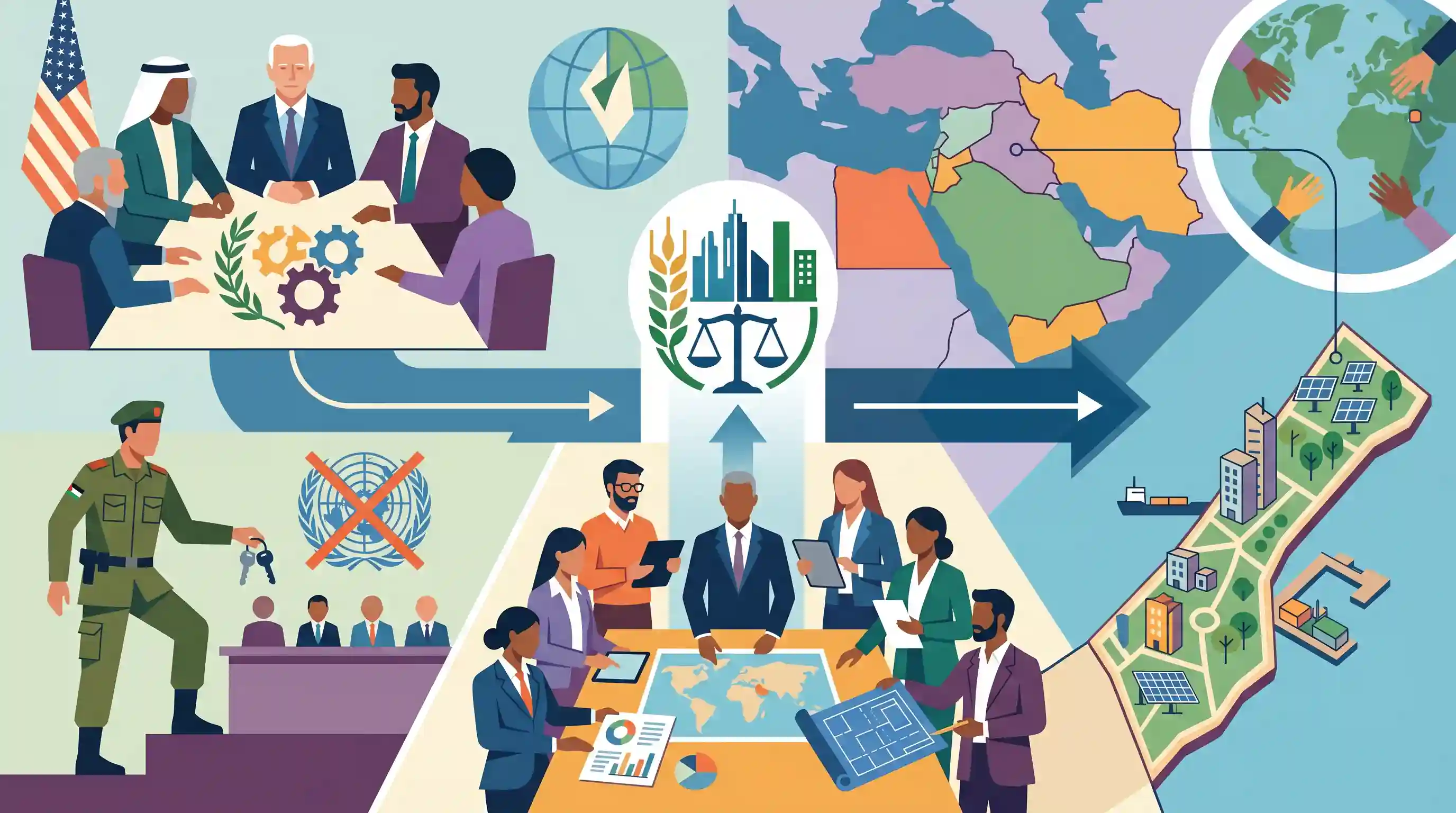
In July 2026, Hamas announced the dissolution of its long-standing emergency governing committee in the Gaza Strip to clear the path for a technocratic civilian administrative transition. Mohammed al-Farra, the head of the emergency committee, resigned to allow the National Committee for the Administration of Gaza (NCAG) to assume civilian governance. The NCAG was established by the 'Board of Peace' under a U.S.-brokered ceasefire agreement between Hamas and Israel in October 2025.
Key Points
- Dissolution of Hamas Rule: The Palestinian Islamist movement Hamas announced the official dissolution of the emergency committee that has governed the Gaza Strip for nearly two decades (since 2007).
- Transition to Civilian Rule: The dissolution clears the way for a technocratic committee, the National Committee for the Administration of Gaza (NCAG), to implement civilian administrative and governmental rule over the territory.
- Official Resignations: The head of the emergency committee, Mohammed al-Farra, submitted his resignation to facilitate a smooth transition, as confirmed by Ismail al-Thawabta, head of Hamas' government media office.
- U.S.-Brokered Peace Framework: The NCAG was created under the 'Board of Peace' framework, established during the October 2025 ceasefire brokered between Hamas and Israel by U.S. President Donald Trump.
Important Terms
National Committee for the Administration of Gaza (NCAG)

A transitional Palestinian technocratic committee established in January 2026 under UNSC Resolution 2803 to assume civilian governance, public services, and infrastructure rehabilitation in postwar Gaza.
UPSC context
GS Paper II (International Relations). Tests understanding of international peacebuilding mechanisms, post-conflict governance structures, and Middle East geopolitics.
Board of Peace
An international oversight body established by the United States to supervise the implementation of the Gaza ceasefire roadmap, manage reconstruction funding, and oversee transitional civilian governance.
UPSC context
GS Paper II (Global Institutions & Foreign Policies). Evaluates US-led multilateral diplomacy and strategic conflict resolution frameworks in West Asia.
October 2025 Ceasefire Agreement
A U.S.-brokered truce in the Gaza conflict, initiating a phased peace plan that includes hostage releases, military drawdowns, and transition of administrative power to a civilian-led technocratic committee.
UPSC context
GS Paper II (Bilateral & Regional Agreements). Examines foreign policy initiatives, international mediation, and peace treaties affecting global stability.
Hamas
A Palestinian Islamist militant and political organization that governed Gaza from 2007 until its July 2026 decision to dissolve its emergency governing body for a technocratic transition.
UPSC context
GS Paper II (West Asian Geopolitics). Assesses non-state armed groups, international security dynamics, and regional geopolitical conflicts.
Prelims Trap
India is a permanent, decision-making member of the Board of Peace (BoP) overseeing post-conflict Gaza.
India holds 'observer state' status among 21 nations, meaning it participates in discussions but lacks executive decision-making or voting veto power within the BoP framework.
Static Concepts Connected
What is India's 'De-hyphenation Policy' in West Asia?
- Definition: Treating relations with Israel and Palestine as independent bilateral tracks, rather than viewing them through the lens of mutual hostility.
- Historical Shift: Transitioned India away from a purely pro-Palestine stance to building deep security ties with Israel while maintaining support for Palestinian statehood.
What are transitional administrations in post-conflict zones?
- Mandate: UN-authorized bodies designed to temporarily manage civil services, restore law and order, and prepare a territory for self-governance.
- Key challenge: Resolving the disarmament-governance paradox where armed non-state actors resist laying down weapons during civil power transitions.
Cross-Topic Patterns
India's De-hyphenated West Asia Diplomacy
Balancing strategic defense ties with Israel while joining the Board of Peace as an observer to support Palestinian administrative transitions.
Security-Governance Paradox in State-Building
Transitioning civil power to technocratic bodies (NCAG) without immediate disarmament highlights the structural vulnerabilities of post-conflict peace agreements.

UNSCR 2803, the Gaza transitional administration (NCAG), and India's diplomatic balancing act as a BoP observer are prime GS-2 material.
Linked PYQs · 4
Linked PYQs · 4
- 2025MainsGS2
"Energy security constitutes the dominant kingpin of India's foreign policy, and is linked with India's overarching influence in Middle Eastern countries.” How would you integrate energy security with India's foreign policy trajectories in the coming years?
- 2018MainsGS2
“India’s relations with Israel have, of late, acquired a depth and diversity, which cannot be rolled back.” Discuss.
- 2015PrelimsGS1
The area known as 'Golan Heights' sometimes appears in the news in the context of the events related to
- 2022PrelimsGS1
The term "Levant" often heard in the news roughly corresponds to which of the following regions?
