Extreme heatwaves and climate change impacts on public health
Source:The Hindu ↗
Why It Matters
The escalating frequency and duration of extreme heatwaves present critical challenges for India's disaster management, public health, and agricultural sectors. Understanding the drivers of these events and formulating effective adaptation strategies, such as Heat Action Plans, is highly relevant for GS-1 (Geography/Urbanization) and GS-3 (Environment/Disaster Management).
Summary
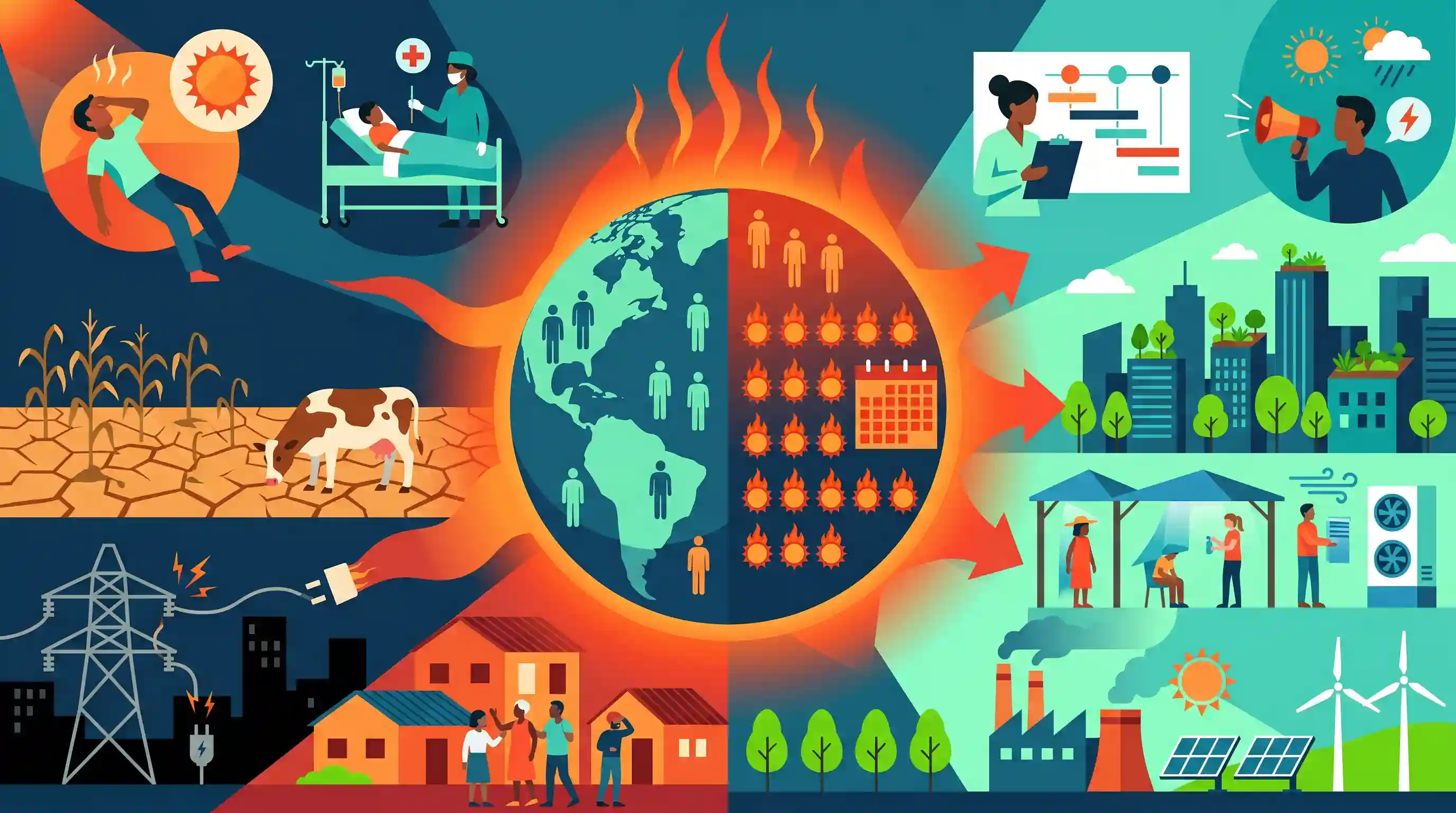
An analysis by World Weather Attribution, Climate Central, and the Red Cross reveals that human-caused climate change has subjected half the world's population to an additional month of extreme heat over the past year (May 2024–May 2025). This prolonged heat crisis acts as a "silent killer," resulting in widespread mortality, compromised food security due to crop and livestock losses, and severe strain on power grids and healthcare infrastructure. Vulnerable demographics, particularly low-income communities, face disproportionate impacts. Experts emphasize the urgent need for robust heat action plans, early warning systems, enhanced urban greening, and cooling infrastructure, alongside a rapid global phase-out of fossil fuels. In India, escalating heatwaves highlight the urgent need for comprehensive urban planning and climate adaptation strategies.
Key Points
- Over 4 billion people globally endured an extra month of extreme heat between May 2024 and May 2025 due to human-caused climate change.
- The heat crisis has severely strained energy and healthcare systems, led to significant crop and livestock losses, and increased mortality rates.
- Vulnerable populations, including low-income communities, children, and the elderly, are disproportionately affected by the 'silent killer' of extreme heat.
- In India, escalating heatwaves are precipitating public health emergencies and exacerbating water crises.
- Experts advocate for robust heat action plans, early warning systems, increased urban greening, cooling shelters, and updated building codes.
- A rapid phase-out of fossil fuels is essential to mitigate the increasing frequency and intensity of global heatwaves.
Important Terms
World Weather Attribution (WWA)

An international scientific collaboration that uses weather observations and climate models to quantify how human-caused climate change influences the intensity and likelihood of specific extreme weather events.
UPSC context
GS Paper 3: Environment. Relevant for understanding attribution science and assessing anthropogenic impacts on extreme weather events like heatwaves and floods.
Heat Action Plan (HAP)
A comprehensive policy framework providing early warnings, vulnerability mapping, and coordinated public health responses to mitigate mortality and health risks during periods of extreme heat.
UPSC context
GS Paper 3: Disaster Management. Essential for studying India’s institutional response to heatwaves and NDMA’s guidelines for state-level adaptation strategies.
Early Warning System (EWS)
An integrated system for hazard monitoring, forecasting, and communication that enables individuals and authorities to take timely action to reduce disaster risks before a hazard manifests.
UPSC context
GS Paper 3: Disaster Management. Key to the Sendai Framework (Target G) and India’s efforts in last-mile connectivity for multi-hazard warnings.
Red Cross Red Crescent Climate Centre
A specialist reference center of the International Federation of Red Cross and Red Crescent Societies (IFRC) that focuses on reducing climate-related disaster impacts on vulnerable populations.
UPSC context
GS Paper 3: Disaster Management. Highlights the role of international humanitarian organizations in climate-smart disaster risk reduction and community resilience.
Urban Greening
The strategic integration of vegetation, parks, and tree cover into urban landscapes to provide natural cooling, enhance biodiversity, and mitigate the Urban Heat Island effect.
UPSC context
GS Paper 1: Urbanization/Geography. Tests knowledge of nature-based solutions and sustainable urban planning to combat climate-induced temperature rises in cities.
Climate Central
A nonprofit organization consisting of scientists and communicators that researches and reports on climate change impacts, using data-driven visuals to bridge the gap between science and the public.
UPSC context
GS Paper 3: Environment. Useful for identifying key international bodies providing the scientific data and analytics used in global climate policy reporting.
Prelims Trap
Heatwaves are centrally notified national disasters under the Disaster Management Act, 2005.
Heatwaves are not officially notified national disasters for NDRF allocation. However, states can declare them 'local disasters' to use up to 10% of their State Disaster Response Fund (SDRF).
Static Concepts Connected
What causes the Urban Heat Island (UHI) effect?
- Surface materials: Concrete and asphalt have low albedo and high thermal capacity, absorbing and retaining more solar radiation than natural ground.
- Urban geometry: The urban "canyon effect" created by tall buildings blocks natural wind flow and traps long-wave radiation within city streets.
- Reduced vegetation: A lack of trees and green spaces drastically reduces natural ambient cooling derived from evapotranspiration and shade.
- Waste heat: Anthropogenic heat emissions from air conditioning exhaust, vehicle engines, and industrial facilities add direct thermal energy to cities.
What is the significance of the 35°C Wet-Bulb Temperature limit?
- Combined metric: It is a combined metric measuring ambient heat and humidity, representing the lowest temperature achievable through water evaporation.
- Sweat evaporation: High humidity prevents sweat from evaporating, which completely disables the human body's primary thermoregulatory cooling mechanism.
- Survivability threshold: At a wet-bulb temperature of 35°C, even healthy, resting adults can suffer fatal heatstroke within six hours.
Cross-Topic Patterns
Heatwaves + Food Inflation
Extreme heat causes terminal heat stress in Rabi crops like wheat, linking localized climate anomalies directly to agricultural output, CPI food inflation, and RBI monetary policy challenges.
Wet-bulb limits + Informal Economy
Fatal wet-bulb temperatures disproportionately threaten India's informal outdoor workforce (agriculture, construction), compounding job insecurity and severely risking GDP output and the demographic dividend.

Wet-bulb temperature physics, Urban Heat Island factors, and NDMA Heat Action Plan guidelines will likely fuse into a 2026 Prelims question.
Linked PYQs · 5
Linked PYQs · 5
- 2025PrelimsGS1
The World Bank warned that India could become one of the first places where wet-bulb temperatures routinely exceed 35 °C. Which of the following statements best reflect(s) the implication of the above-said report? I. Peninsular India will most likely suffer from flooding, tropical cyclones and droughts. II. The survival of animals including humans will be affected as shedding of their body heat through perspiration becomes difficult. Select the correct answer using the code given below.
- 2017MainsGS3
'Climate change' is a global problem. How India will be affected by climate change? How Himalayan and coastal states of India will be affected by climate change?
- 2022MainsGS3
Discuss global warming and mention its effects on the global climate. Explain the control measures to bring down the level of greenhouse gases which cause global warming, in the light of the Kyoto Protocol, 1997.
- 2013MainsGS1
Bring out the causes for the formation of heat islands in the urban habitat of the world.
- 2023MainsGS1
Discuss the consequences of climate change on the food security in tropical countries.
