Monsoon Deficit and Agricultural Sowing Impact in Andhra Pradesh
Source:deccan-chronicle ↗
ఇది ఎందుకు ముఖ్యం
This article highlights the direct correlation between global climatic phenomena (El Nino) and localized agricultural challenges (Kharif sowing deficits) in Andhra Pradesh. It is highly relevant for Geography (Climatology and Indian Monsoon) and Economy (Agriculture) sections in the Prelims, as candidates are often tested on rainfall distribution, monsoon patterns, and their socioeconomic impacts.
సారాంశం
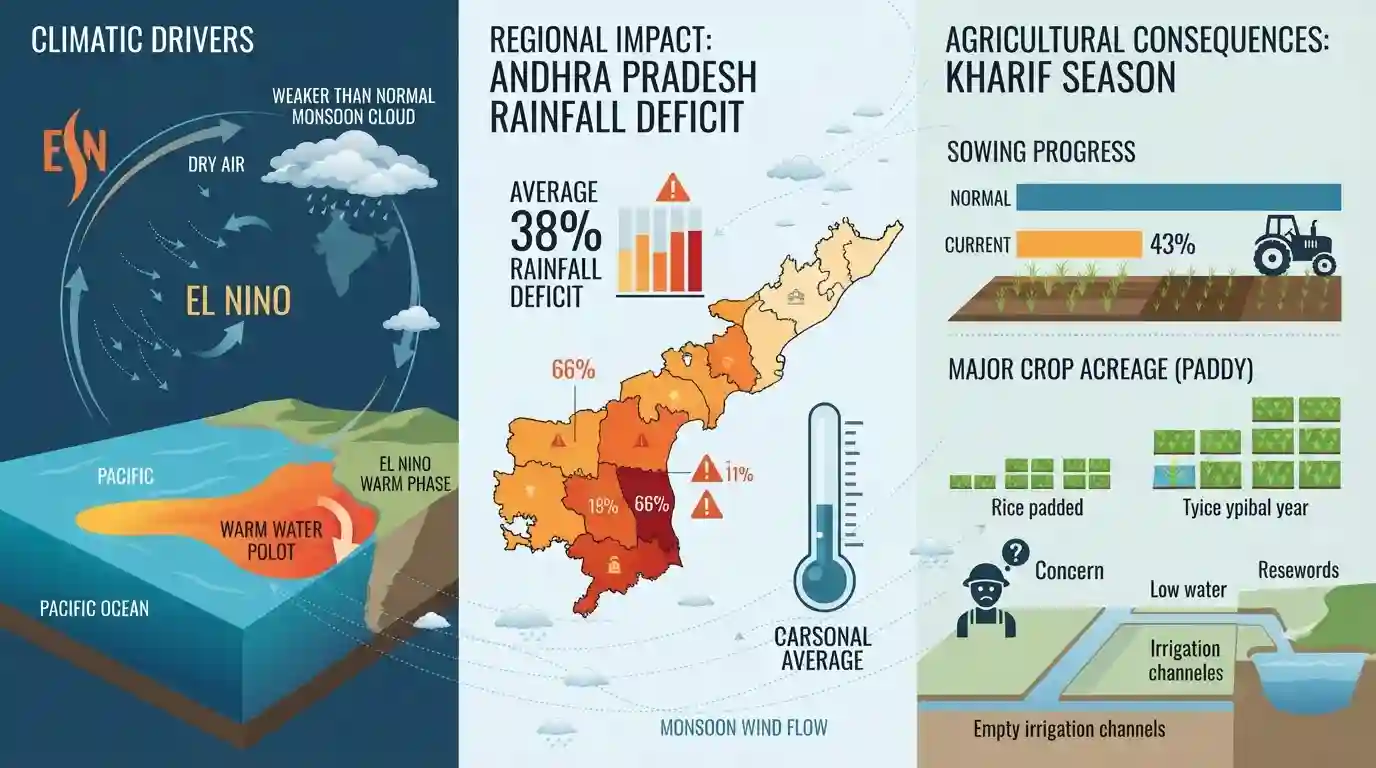
Midway through the southwest monsoon season, Andhra Pradesh is grappling with a severe 38% deficit in rainfall, heavily influenced by the emergence of El Nino conditions. The erratic weather has had a cascading effect on agriculture, particularly the Kharif season, where sowing operations have been completed in only 43% of the normal cultivated area. Crucial districts are facing localized deficits of up to 66%, and major crops like paddy are experiencing a drop in acreage. The India Meteorological Department (IMD) characterizes the monsoon as weak in the Rayalaseema region, raising significant concerns for the state's agricultural output and water security.
ముఖ్య అంశాలు
- Andhra Pradesh is experiencing a severe 38% deficit in rainfall midway through the southwest monsoon season, with July seeing a sharp decline compared to June.
- The erratic and deficient rainfall is largely attributed to the emergence of El Nino conditions, heavily impacting regional climatology.
- Kharif crop sowing has been severely delayed and reduced, with only 43% of the normal area (13.32 lakh hectares out of 30.84 lakh hectares) sown so far.
- Several districts, including Annamayya, West Godavari, and Bapatla, report extreme localized rainfall deficits exceeding 50%.
- Key food crops like paddy are seeing substantially lower acreage compared to the previous year, raising concerns about agricultural output.
- The India Meteorological Department (IMD) has classified the ongoing monsoon as weak over Rayalaseema and normal over Coastal AP and Yanam.
ముఖ్యమైన పదాలు
India Meteorological Department (IMD)

The principal government agency under the Ministry of Earth Sciences responsible for meteorological observations, weather forecasting, seismology, and early warnings of hazardous weather events in India.
UPSC context
GS Paper I (Geography) and GS III (Disaster Management); tests knowledge of key national scientific and forecasting institutions.
State Disaster Management Authority (SDMA)
The apex state-level statutory body constituted under the Disaster Management Act, 2005, headed by the Chief Minister, responsible for formulating disaster plans and coordinating mitigation measures.
UPSC context
GS Paper III (Disaster Management); tests understanding of the institutional framework for managing natural and man-made disasters.
Directorate of Agriculture
The administrative and executive state-level body responsible for implementing agrarian policies, disseminating technical knowledge, and monitoring crop sowing, seed distribution, and fertilizer availability.
UPSC context
GS Paper III (Agriculture); tests knowledge of state-level administrative bodies and their role in managing rural development.
Southwest Monsoon
The primary seasonal wind system that brings 70-80% of India's annual rainfall between June and September, crucial for the country's agricultural economy and water security.
UPSC context
GS Paper I (Physical Geography); tests understanding of monsoon mechanisms, wind reversal, and their socioeconomic impacts.
Kharif Season
The summer cropping season in India, lasting from June to October, where crops like paddy and maize are sown with the onset of the southwest monsoon.
UPSC context
GS Paper III (Agriculture) and GS Paper I (Geography); tests knowledge of cropping patterns and monsoon dependency.
El Niño
A periodic climate pattern involving abnormal warming of equatorial Pacific surface waters, which disrupts atmospheric circulation and often weakens the Indian southwest monsoon.
UPSC context
GS Paper I (Climatology); tests understanding of global ocean-atmospheric oscillations and their impact on Indian agriculture.
ప్రిలిమ్స్ ఉచ్చు
El Niño invariably leads to a drought year for the Indian Southwest Monsoon.
While El Niño strongly correlates with deficient rainfall, it does not always cause a drought. A positive Indian Ocean Dipole (IOD) can offset its effects.
అనుసంధానమైన స్థిర భావనలు
How does El Niño suppress the Indian Southwest Monsoon?
- Pacific Warming: Characterized by abnormal warming of sea-surface temperatures in the central and eastern equatorial Pacific.
- Walker Cell Disruption: This warming shifts the Walker Circulation eastward, altering global pressure systems and weakening the Mascarene High.
- Weakened Trade Winds: Consequently, the moisture-laden south-westerly trade winds blowing towards the Indian subcontinent are significantly weakened, reducing rainfall.
Why is the Rayalaseema region highly prone to chronic droughts?
- Rain Shadow Effect: It lies predominantly in the rain shadow zone of the Western Ghats, blocking moisture from the Arabian Sea branch.
- Climatic Zone: It is classified largely as semi-arid steppe, missing the bulk of both the Southwest monsoon and the coastal-focused Northeast monsoon.
- Extreme Aridity: Anantapur in Rayalaseema is recognized as the second-driest district in India after Jaisalmer in Rajasthan.
అంతర-అంశ నమూనాలు
El Nino's cascade to food inflation
Deficient monsoon rainfall reduces Kharif paddy acreage, tightening foodgrain supply. This structurally fuels cereal inflation, often prompting the RBI to maintain a hawkish monetary policy to anchor inflation expectations.
Tenant farmers and climate vulnerability
Tenant farmers often lack formal land titles, denying them access to institutional credit and PMFBY crop insurance. When droughts strike, these informal cultivators face severe debt traps from high-interest private loans.

Expect a combined Prelims question linking El Nino/IOD mechanics with specific regional climatic zones like Rayalaseema's rain shadow.
అనుసంధాన PYQలు · 2
అనుసంధాన PYQలు · 2
- 2019APPSC_PRELIMSGS1
El-Nino is a complex weather system that appears once every three to seven years. Consider the following statements in this regard : A. The appearance of warm currents off the Coast of Peru in the Eastern Pacific. B. The word El-Nino means 'Christ Child' because the current appears around Christmas in December. C. El-Nino was one of the reasons for the deficit rainfall in India (2014). Which of the statements given above is/are correct ?
- 2024APPSC_PRELIMSGS1
Match the following Climatic regions of India according to Koeppen's scheme: | List-I(Type of Climate) | List-II.(Areas) | |---|---| | A. Monsoon with short dry season | I. West coast of India, south of Goa | | B. Monsoon with dry summer | II. Coromandel coast of Tamil Nadu | | C. Monsoon with dry winter | III. Most of North-East India | | D. Semi-arid Steppe climate | IV. Northwestern Gujarat | Choose the correct answer using the codes given below: Code: A B C D
