Hair crested drongo sighted for first time in Madurai district
Source:The Hindu ↗
Why It Matters
UPSC frequently asks Prelims questions about specific flora and fauna, their habitats, physical characteristics, and migratory patterns. The preparation of local biodiversity registers and the sighting of migratory birds serve as critical indicators of ecosystem health, which are core themes in the Environment syllabus.
Summary
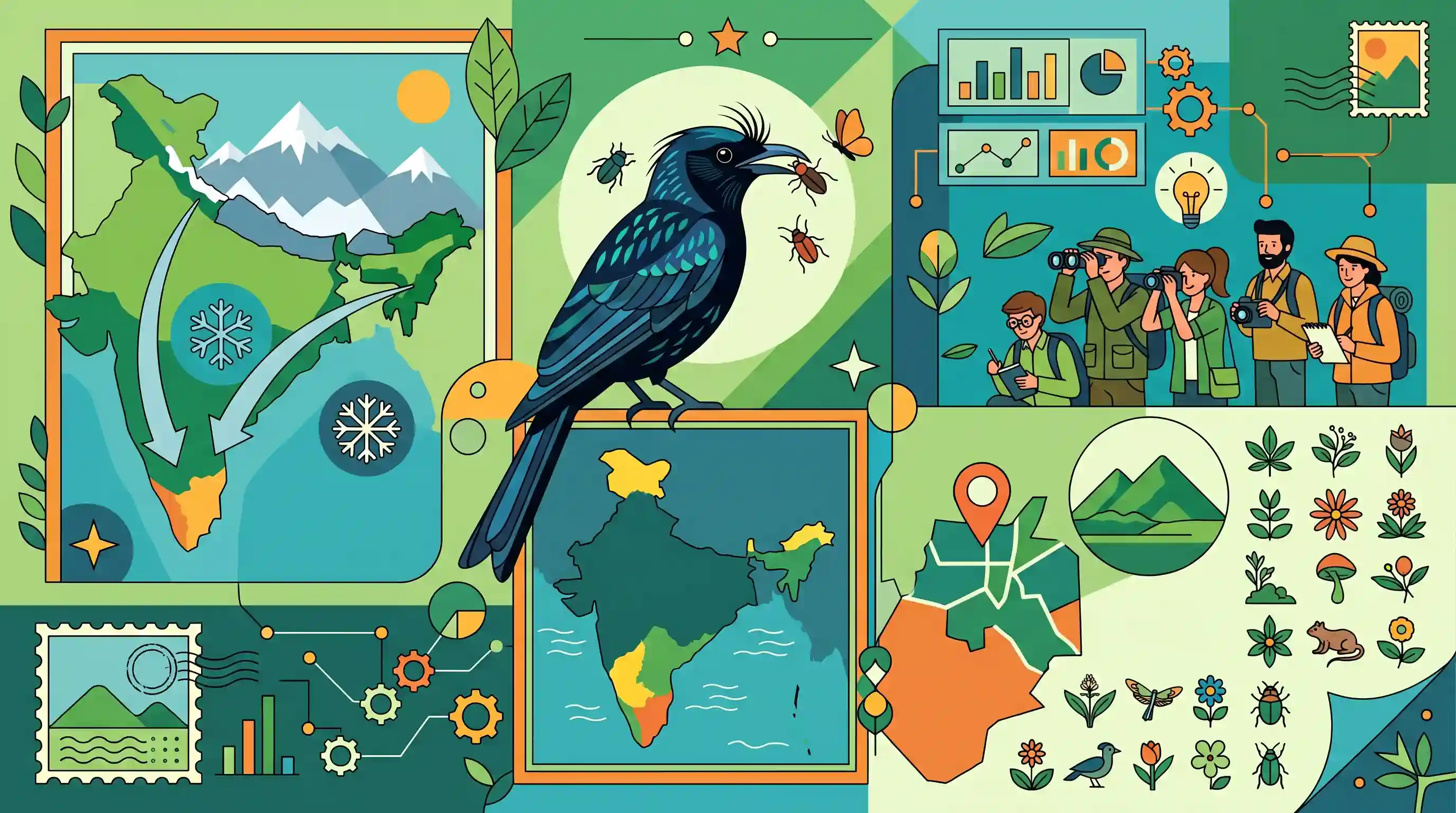
The Hair-crested Drongo (Dicrurus hottentottus) has been sighted for the first time in Madurai at the foothills of Manjamalai near Palamedu. The insectivorous bird, known for its distinct hair-like forehead feathers, typically migrates from the Himalayas and Northeast India to southern India during winter. It was recorded by the Madurai Nature Cultural Foundation during their ongoing effort to document the district's biodiversity. While the species had previously been recorded in nearby regions like Karandamalai in Dindigul, its presence in Madurai underscores the region's rich ecological diversity.
Key Points
- The Hair-crested Drongo (Dicrurus hottentottus) was sighted for the first time in Madurai district at the Manjamalai foothills.
- The bird is insectivorous and characterized by a glossy black body, deeply forked tail, and hair-like feathers on its forehead.
- It is a migratory species that travels from the Himalayan region and North East India to southern India during the winter months.
- The sighting was documented by the Madurai Nature Cultural Foundation while they were compiling a biodiversity register for the district.
- The IUCN conservation status of the Hair-crested Drongo is 'Least Concern'.
Important Terms
Hair-crested Drongo

An insectivorous Asian bird (Dicrurus hottentottus) with distinctive hair-like forehead feathers and a lyre-shaped tail. It migrates from the Himalayas to southern India during winter.
UPSC context
Prelims: Species in News; GS III: Biodiversity. Tests knowledge of migratory patterns and conservation status of Indian avifauna.
IUCN Red List
The world's most comprehensive inventory of the global conservation status of biological species, categorizing them from 'Least Concern' to 'Extinct' based on extinction risk.
UPSC context
GS III: Environment. Essential for understanding international conservation benchmarks for species appearing in news.
Wildlife (Protection) Act, 1972
An Indian law providing a legal framework for the protection of various species of wild animals and plants, management of their habitats, and regulation of trade.
UPSC context
GS III: Environmental Legislation. Tests awareness of legal protection categories (Schedules) for specific species in India.
Biological Diversity Act, 2002
A 2002 Indian law enacted to preserve biological diversity, ensure sustainable use of its components, and facilitate fair sharing of benefits from biological resources.
UPSC context
GS III: Biodiversity. Crucial for questions on India's 3-tier institutional structure (NBA, SBB, BMC) and BHS notifications.
Biodiversity Heritage Site (BHS)
Unique, ecologically fragile ecosystems notified by State Governments under the Biological Diversity Act, 2002, to protect species richness and areas of evolutionary or cultural significance.
UPSC context
GS III: Conservation. Important for regional ecology questions; Madurai’s Arittapatti was Tamil Nadu's first notified BHS.
Madurai Nature Cultural Foundation
A Madurai-based non-governmental organization dedicated to documenting regional biodiversity and heritage, instrumental in the notification of Arittapatti as a Biodiversity Heritage Site.
UPSC context
GS III: Biodiversity Conservation. Represents civil society's role in local conservation and implementing the Biological Diversity Act.
Prelims Trap
The Hair-crested Drongo is a Critically Endangered trans-continental migratory bird.
UPSC often pairs "first-time sightings" with extreme threat categories. The Drongo is merely 'Least Concern' and a regional migrant within India, not a trans-continental one.
Static Concepts Connected
What is a People's Biodiversity Register (PBR)?
- Statutory Mandate: Mandated under the Biological Diversity Act, 2002 to comprehensively record local flora, fauna, and associated traditional ecological knowledge.
- Authority: Prepared by local Biodiversity Management Committees (BMCs) in consultation with gram sabhas, panchayats, and local communities.
What is regional or altitudinal avian migration in India?
- Definition: Seasonal movement of birds from high-altitude breeding grounds (Himalayas/Northeast) to warmer lower altitudes or Peninsular India during winter.
- Ecological Driver: Primarily driven by the scarcity of food resources (like insects and nectar) and harsh weather conditions in higher altitudes during winter months.
Cross-Topic Patterns
PBRs aiding citizen science
The Biological Diversity Act mandates local BMCs to prepare PBRs. Local citizen-led documentation like this is increasingly capturing rare regional migratory events and species range extensions.
Avian ecosystem services
Insectivorous and nectar-feeding birds like the Drongo act as natural biological pest controllers and pollinators, linking species conservation directly to sustainable agriculture and food security topics.

Expect a match-the-pair question linking regional Indian migratory birds with their wintering habitats, IUCN status, or ecological roles.
Linked PYQs · 4
Linked PYQs · 4
- 2024PrelimsGS1
The organisms “Cicada, Froghopper and Pond skater" are:
- 2020PrelimsGS1
With reference to India's biodiversity, Ceylon frogmouth, Coppersmith barbet, Gray-chinned minivet and White-throated redstart are
- 2014PrelimsGS1
The most important strategy for the conservation of biodiversity together with traditional human life is the establishment of
- 2013PrelimsGS1
With reference to food chains in ecosystems, consider the following statements : 1. A food chain illustrates the order in which a chain of organisms feed upon each other. 2. Food chains are found within the populations of a species. 3. A food chain illustrates the numbers of each organism which are eaten by others. Which of the statements given above is/are correct?
