Velampeta Slum Redevelopment and TDR Housing Model in Visakhapatnam
Source:deccan-chronicle ↗
Why It Matters
The initiative serves as a crucial case study in state-level urban governance and public policy, illustrating how local civic bodies use mechanisms like DBFT models and Transferable Development Rights (TDR) to address the complex challenges of urban slum upgradation, a key function under the 12th Schedule.
Summary
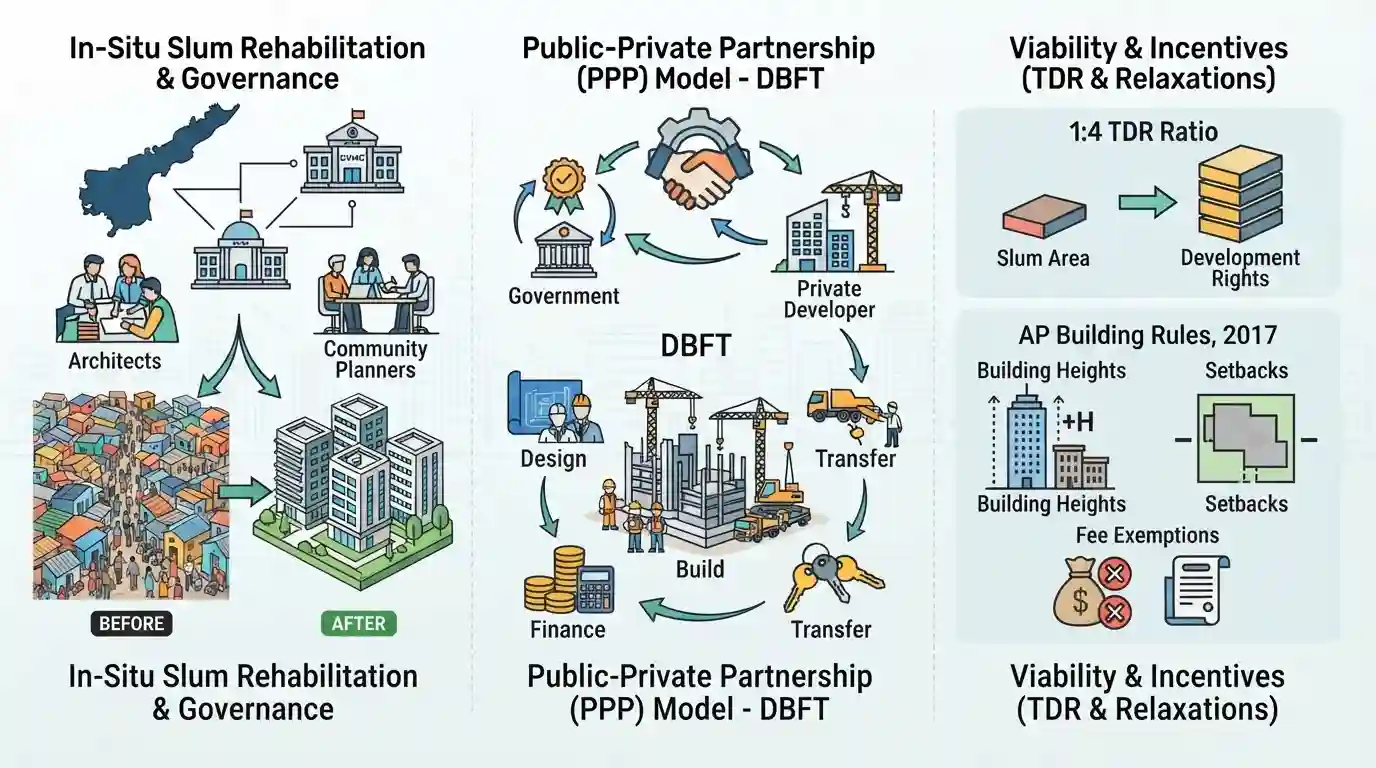
The Andhra Pradesh government has authorized the Greater Visakhapatnam Municipal Corporation (GVMC) to launch the Velampeta Slum Redevelopment Project, an in-situ initiative under the Visakhapatnam Economic Region (VER) Programme. Envisaged to create 177 housing units, the project will be executed using the Design-Build-Finance-Transfer (DBFT) model. To ensure financial viability for private developers, the state has offered a 1:4 Transferable Development Rights (TDR) ratio and granted critical relaxations under the AP Building Rules, 2017, covering building heights, setbacks, and fee exemptions.
Key Points
- The Greater Visakhapatnam Municipal Corporation (GVMC) will execute an in-situ pilot slum redevelopment project in Velampeta to construct 177 high-rise housing units.
- The project operates under the Design-Build-Finance-Transfer (DBFT) public-private partnership model and falls under the Visakhapatnam Economic Region (VER) Programme.
- To incentivize developers, the government is providing a Transferable Development Rights (TDR) ratio of 1:4.
- The project benefits from specific exemptions under the Andhra Pradesh Building Rules, 2017, including waivers for setback norms, parking requirements, and various municipal fees.
Important Terms
Velampeta Slum Redevelopment Project

A pilot in-situ urban housing initiative in Visakhapatnam, Andhra Pradesh, designed to construct 177 permanent high-rise homes for EWS families, utilizing a non-cash, TDR-backed development model.
UPSC context
GS Paper I (Urbanization) and GS II (Welfare schemes). Tests policy solutions for slum rehabilitation and urban poor housing.
Visakhapatnam Economic Region (VER) Programme
An ambitious regional development initiative by Andhra Pradesh targeting over ₹9 lakh crore in investments across eight districts to develop key sectors like AI, clean energy, and port manufacturing.
UPSC context
GS Paper III (Planning and Economic Development). Tests planning of regional industrial corridors and mobilizing public-private investments.
Transferable Development Rights (TDR)
An urban planning tool where developers receive certificates permitting additional built-up area in other zones as compensation for surrendering land or building public infrastructure like affordable housing.
UPSC context
GS Paper III (Land Reforms and Infrastructure). Tests innovative municipal financing models and non-cash compensation strategies.
Design-Build-Finance-Transfer (DBFT)
A Public-Private Partnership model where a single private contractor is responsible for the design, construction, and financing of a public infrastructure project, eventually transferring ownership back to the government.
UPSC context
GS Paper III (Investment Models). Tests comprehension of infrastructure procurement, risk allocation, and private sector participation.
Greater Visakhapatnam Municipal Corporation (GVMC)
The local urban self-government body administering Visakhapatnam, responsible for civic infrastructure, public health, and executing municipal housing reforms like slum redevelopment.
UPSC context
GS Paper II (Local Governance). Tests devolution of powers, urban governance, and challenges faced by municipal bodies.
Andhra Pradesh Building Rules, 2017
State-level regulatory guidelines aligned with the Model Building Bye-Laws that govern construction parameters, setbacks, building heights, open spaces, and TDR implementation across municipal jurisdictions.
UPSC context
GS Paper II (Urban Governance) and GS Paper III (Infrastructure). Tests regulatory frameworks governing planned, resilient urban planning.
Prelims Trap
Transferable Development Rights (TDR) can only be utilized to reconstruct buildings on the exact land parcel where they were generated.
TDR is specifically designed to be transferable; the certificates can be sold and utilized in designated 'receiving zones' elsewhere in the city, not restricted to the slum site itself.
Static Concepts Connected
How do Transferable Development Rights (TDR) function in Indian urban planning?
- Core Definition: Decouples development potential (Floor Space Index) from physical land, converting it into tradeable certificates for use elsewhere.
- Mechanism: Generated at "sending zones" (such as slums or heritage sites) and sold to developers to exceed building limits in designated "receiving zones".
- Policy Benefit: Provides non-cash compensation to landowners, drastically reducing direct fiscal acquisition costs for resource-constrained municipal corporations.
What are the core pillars of the In-Situ Slum Redevelopment (ISSR) approach?
- In-Situ Philosophy: Rehabilitates slum dwellers in their current physical locations using land as a resource, preserving local socio-economic networks and livelihood access.
- Cross-Subsidization: A private developer builds free housing for eligible slum dwellers and recovers costs by commercially developing a portion of the same land.
- PPP Execution: Typically executed via DBFT (Design-Build-Finance-Transfer) models, shifting construction, design, and financing risks entirely to the private partner.
Cross-Topic Patterns
Urban Land Monetization + Slum Welfare
Leverages high-value urban land to cross-subsidize affordable housing, linking GS-1 urbanization challenges with GS-3 infrastructure financing and land resource mobilization.
ULB Financial Autonomy + Land Regulations
Examines how Urban Local Bodies utilize regulatory tools like building rule relaxations and TDR as non-fiscal incentives, bypassing direct state budgetary constraints.

Mechanisms of Transferable Development Rights (TDR) and land-pooling models are highly likely to be tested under urban infrastructure in 2026.
Linked PYQs · 3
Linked PYQs · 3
- 2023APPSC_PRELIMSGS1
Which of the following subjects are listed in the 11th Schedule? I. Women and Child Development II. Public Distribution System III. Libraries IV. Slum Improvement and Upgradation V. Markets and Fairs Choose the correct answer using the codes given below:
- 2024APPSC_PRELIMSGS1
The strategic objective of Asset Monetization Programme may be explained as :
- 2024APPSC_PRELIMSGS1
In connection with the Urban Infrastructure Development Fund (UIDF), which of the following statement/statements is/are valid? I. The fund will be established through reserved bonds taken from the G-Sec market. II. The fund is to be exclusively availed by private agencies to create urban infrastructure in Tier 2 and Tier 3 cities. III. Eligible activities for UIDF shall be connected to the Missions and Programmes of the Ministry of Housing | Urban Affairs (MoHUA). IV. The fund will be collectively managed by a cluster of Municipal Cooperative Banks. Select the correct answer using the codes given below:
