GUVNL floats tender for battery energy storage systems
Source:renewable-watch ↗
Why It Matters
Large-scale Battery Energy Storage Systems (BESS) are essential to mitigate the intermittency of renewable energy sources like solar and wind. By floating massive tenders, state entities like GUVNL lead the push toward a modernized, stable grid infrastructure capable of sustaining high renewable integration.
Summary
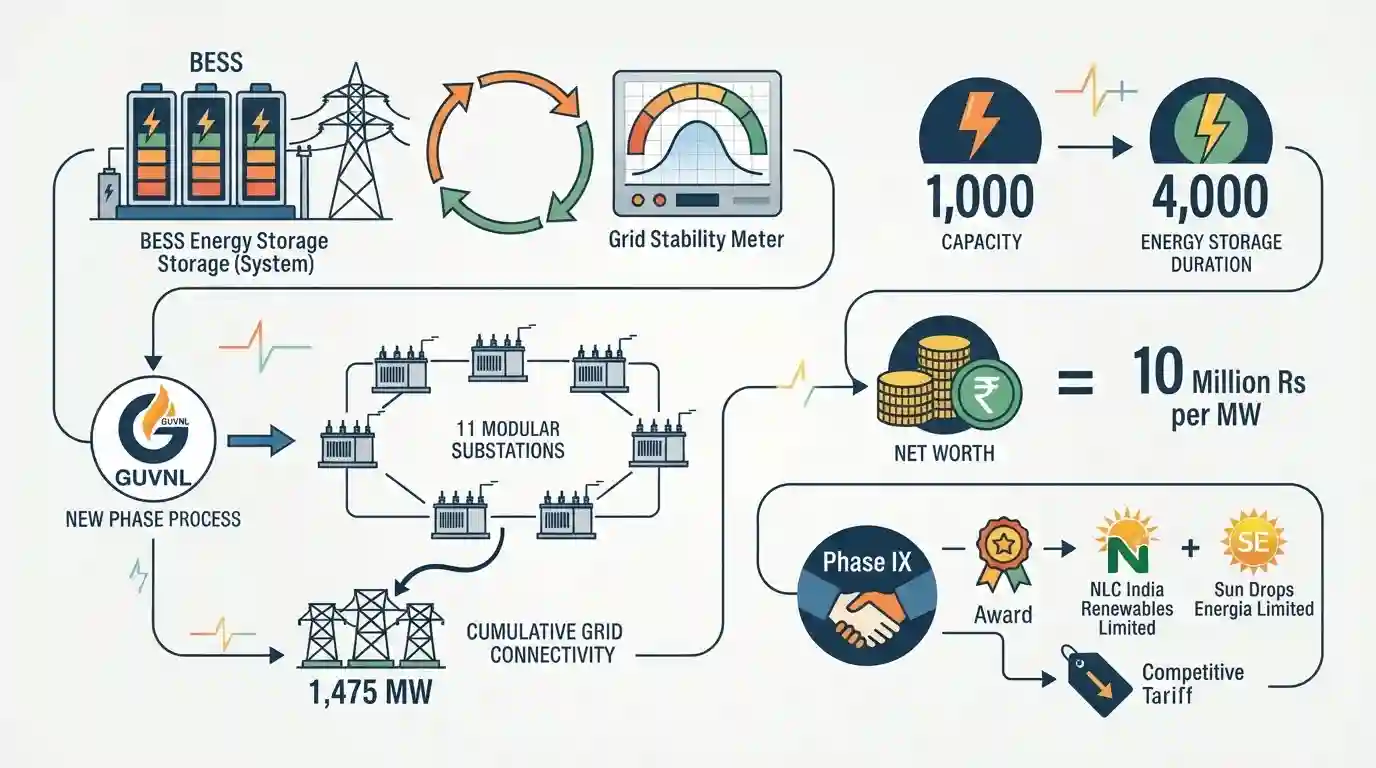
Gujarat Urja Vikas Nigam Limited (GUVNL) has invited bids for 1,000 MW (4,000 MWh) of standalone battery energy storage system (BESS) capacity under the Phase-X tariff-based competitive bidding process. The projects are intended to be set up near 11 designated substations connected to Gujarat's State Transmission Utility network, which collectively provide 1,475 MW of grid connectivity. Bidders are required to possess a minimum net worth of Rs 10 million per MW of the quoted capacity. This follows the recent conclusion of the Phase IX tender, where GUVNL awarded 450 MW of BESS capacity to NLC India Renewables Limited and Sun Drops Energia Limited at competitive tariffs.
Key Points
- GUVNL has floated a tender for 1,000 MW/4,000 MWh of standalone Battery Energy Storage System (BESS) capacity under Phase-X of its competitive bidding.
- The projects will be connected to the State Transmission Utility network across 11 designated substations, which offer a combined connectivity of 1,475 MW.
- Participating bidders must have a minimum net worth of Rs 10 million per MW of quoted capacity.
- Earlier, under Phase IX, GUVNL awarded a combined 450 MW/900 MWh standalone BESS capacity to NLC India Renewables Limited and Sun Drops Energia Limited.
Important Terms
Tariff-Based Competitive Bidding (TBCB)

A transparent procurement mechanism under the Electricity Act 2003 where power and transmission projects are awarded to developers offering the lowest tariff. It promotes private sector participation and reduces energy costs for consumers.
UPSC context
Crucial for GS Paper 3 (Energy/Infrastructure), it tests knowledge of power sector reforms and cost-efficient renewable energy deployment.
State Transmission Utility (STU)
A state-government-designated entity under the Electricity Act 2003 tasked with planning, operating, and ensuring an efficient intra-state electricity transmission system. To prevent conflicts of interest, STUs are barred from electricity trading.
UPSC context
Features in GS Paper 3 (Infrastructure) and GS Paper 2 (Governance), testing the unbundling of power sectors and statutory regulatory frameworks.
Gujarat Urja Vikas Nigam Limited (GUVNL)
The state-owned electrical services umbrella company in Gujarat. It acts as the bulk purchaser of power and coordinates the state's transmission and distribution networks to ensure reliable energy supply.
UPSC context
Useful as a GS Paper 3 (State Discoms) case study, testing state-level power procurement models and regional renewable energy integration.
NLC India Renewables Limited
A subsidiary of the Navratna CPSE NLC India Limited, established to execute clean energy projects. It develops solar, wind, and battery storage capacities, reflecting the pivot of traditional fossil-fuel companies towards renewables.
UPSC context
Relevant to GS Paper 3 (Energy Transition, PSUs), highlighting how traditional public sector enterprises are diversifying to meet national climate goals.
Prelims Trap
Battery Energy Storage Systems (BESS) must be co-located with renewable power plants and cannot operate independently on the transmission grid.
Standalone BESS connects directly to the transmission grid (substations) to provide ancillary services like peak shifting, completely independent of generation sites.
Static Concepts Connected
How does Grid Frequency regulation work in India?
- Synchronous Grid: India operates as a synchronously connected 'One Nation - One Grid - One Frequency' system.
- Mandated Band: National grid frequency must be maintained strictly between the 49.90 Hz and 50.05 Hz band to avoid blackouts.
- Role of BESS: BESS provides essential ancillary services via rapid charging and discharging, mitigating supply intermittency to keep frequency stable.
What is Viability Gap Funding (VGF) for BESS infrastructure?
- Financial Grant: Provides financial support covering up to 40% of capital costs as a grant to make long-gestation infrastructure commercially viable.
- BESS Target: The government has approved a Rs 3,760 crore scheme to develop 4,000 MWh of BESS projects by 2030-31.
- Disbursement Mechanism: Disbursed in tranches linked to project milestones, aimed at lowering the Levelized Cost of Storage (LCoS).
Cross-Topic Patterns
BESS + Critical Minerals Diplomacy
The surge in massive BESS tenders directly heightens India's import dependence on Lithium and Cobalt, explicitly linking domestic grid stability to bilateral critical mineral diplomacy with countries like Argentina and Australia.
Renewable Intermittency + Grid Stability
As India nears its 500 GW non-fossil capacity target, the UPSC focus shifts from pure renewable generation to grid integration. Large-scale energy storage is the critical bridge for managing supply intermittency.

Expect a multi-statement question contrasting Standalone BESS vs Pumped Hydro Storage regarding geographical constraints and grid response.
Linked PYQs · 2
Linked PYQs · 2
- 2026GPSC_PRELIMSGS1
Which of the following statement/s is/are correct regarding Renewable Energy Installed Capacity in India? 1. Wind energy is second only to solar energy in the Indian renewable sector. 2. Biomass power capacity accounts for around 30% of India's total renewable energy. 3. India ranks among the top three countries in the world in Hydropower Installed Capacity. Choose the correct option from the following.
- 2025GPSC_PRELIMSGS1
A key technical feature of the "One Nation - One Grid - One Frequency" system in India is
