GUVNL Battery Energy Storage Auction Accelerates Grid Stabilization
Source:powerline ↗
Why It Matters
Utility-scale battery energy storage is essential for managing the intermittency of renewable energy sources like solar and wind. The provision of Viability Gap Funding (VGF) via the Power System Development Fund highlights the targeted public finance interventions needed to overcome the high initial capital costs of emerging grid stabilization technologies.
Summary
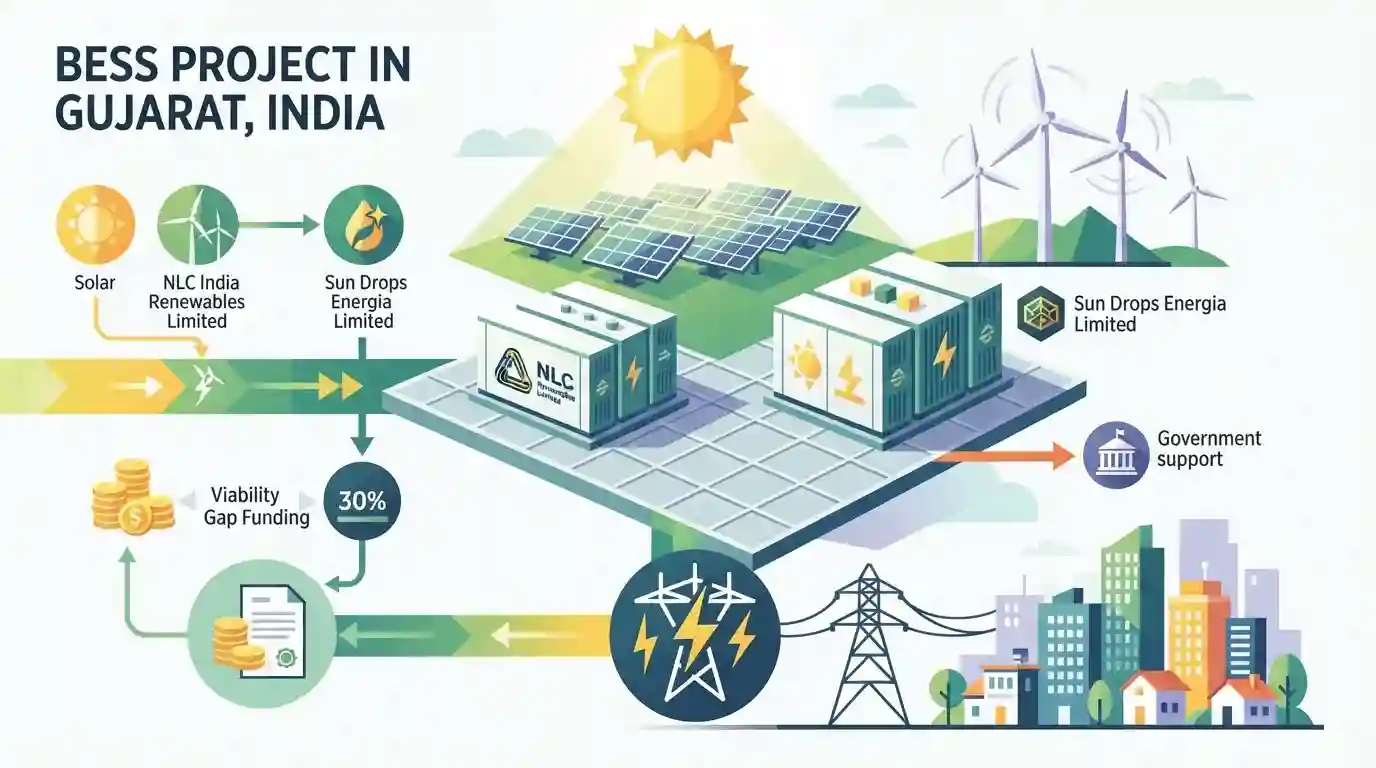
Gujarat Urja Vikas Nigam Limited (GUVNL) has finalized the results for its Phase IX tender for 450 MW/900 MWh of standalone Battery Energy Storage Systems (BESS) in Gujarat. NLC India Renewables Limited and Sun Drops Energia Limited were declared the successful bidders, tasked with setting up 250 MW and 200 MW of capacity, respectively, under a build-own-operate framework. These utility-scale storage systems will supply on-demand dispatchable energy to GUVNL, assisting with grid balancing and renewable energy integration. Notably, the projects qualify for Viability Gap Funding (VGF) of up to 30% of their capital costs under the central Power System Development Fund (PSDF) scheme, underscoring government support to commercialize grid-scale energy storage.
Key Points
- Gujarat Urja Vikas Nigam Limited (GUVNL) announced the successful bidders for its 450 MW/900 MWh standalone Battery Energy Storage System (BESS) Phase IX tender.
- NLC India Renewables Limited won 250 MW (500 MWh) and Sun Drops Energia Limited won 200 MW (400 MWh) of capacity.
- The BESS projects will be developed under a Build-Own-Operate (BOO) model and will provide on-demand energy dispatch services.
- Projects are eligible for financial support covering up to 30% of the capital cost via Viability Gap Funding (VGF) under the Power System Development Fund scheme.
Important Terms
Viability Gap Funding (VGF)

A central capital grant scheme supporting economically justified but commercially unviable infrastructure projects, especially Public-Private Partnerships. It covers up to 30% of capital costs for these grid-scale BESS projects.
UPSC context
GS Paper 3 (Infrastructure). Tests knowledge of PPP financing models and government interventions for commercializing renewable technology.
Power System Development Fund (PSDF)
A central fund utilized for strategic projects to relieve transmission congestion, modernize the electrical grid, and financially back renewable energy integration schemes, such as the BESS VGF mechanism.
UPSC context
GS Paper 3 (Energy). Highlights mechanisms for financing grid modernization, reducing transmission deficits, and supporting renewable capacity building.
Battery Energy Storage System (BESS)
Electrochemical storage devices, like lithium-ion batteries, that store surplus electrical energy. They provide on-demand dispatchable energy, ensuring grid stability and seamless integration of intermittent renewable sources like solar.
UPSC context
GS Paper 3 (Energy/Environment). Crucial for questions on the clean energy transition, peak load management, and India's net-zero targets.
Gujarat Urja Vikas Nigam Limited (GUVNL)
The state-owned electricity holding and procurement utility of Gujarat. It manages bulk power purchases and floats large-scale tenders, like the 450 MW standalone BESS auction, ensuring regional grid stability.
UPSC context
GS Paper 3 (Energy). Relevant as a practical case study for state-level energy procurement and proactive integration of renewable storage.
NLC India Renewables Limited
The green energy subsidiary of NLC India (a central PSU). It recently emerged as the lowest bidder to build, own, and operate 275 MW of standalone BESS capacity in Gujarat.
UPSC context
GS Paper 3 (Economy). Demonstrates the strategic diversification of traditional public sector undertakings into the clean energy and storage sector.
Prelims Trap
"The Viability Gap Funding (VGF) scheme covers 100% of the capital cost for utility-scale Battery Energy Storage Systems."
The central scheme limits VGF to a maximum of 40% of the capital cost for BESS projects to reduce the Levelized Cost of Storage while retaining private sector investment.
Static Concepts Connected
What is Viability Gap Funding (VGF) in Public-Private Partnerships?
- Core Purpose: A one-time government capital grant to make economically essential but commercially unviable infrastructure projects financially feasible for private developers.
- BESS Application: In the context of BESS, VGF reduces the Levelized Cost of Storage (LCoS), making battery-stored renewable power competitive with conventional grid power.
- BOO vs BOT: In a BOO (Build-Own-Operate) framework, the private developer retains indefinite ownership of the asset, unlike BOT where it reverts to the state.
How does the Power System Development Fund (PSDF) support the national grid?
- Fund Utilization: It is utilized to finance strategic transmission systems, relieve grid congestion, and install modernization equipment like BESS and FACTS (Flexible AC Transmission Systems).
- Ancillary Services: Under CERC regulations, BESS provides ancillary services like real-time frequency control and voltage support, critical for integrating intermittent renewable energy like solar and wind.
Cross-Topic Patterns
BESS scaling + Critical Mineral Security
Scaling grid-level storage links directly to India's import dependence on Lithium, connecting domestic energy policy with KABIL's overseas asset acquisitions and the Quad's critical mineral supply chain mapping.
BESS + Harmonised Master List
Adding Energy Storage Systems to the Harmonised Master List of Infrastructure enables easier access to long-tenor, lower-cost institutional credit, removing a major hurdle for capital-intensive BOO (Build-Own-Operate) projects.

A 2026 prelims question will likely blend BESS's inclusion in the Infrastructure Master List with VGF caps (40%) and ancillary grid roles.
Linked PYQs · 2
Linked PYQs · 2
- 2026GPSC_PRELIMSGS1
Which of the following statement/s is/are correct regarding Renewable Energy Installed Capacity in India? 1. Wind energy is second only to solar energy in the Indian renewable sector. 2. Biomass power capacity accounts for around 30% of India's total renewable energy. 3. India ranks among the top three countries in the world in Hydropower Installed Capacity. Choose the correct option from the following.
- 2025GPSC_PRELIMSGS1
Under the Green Open Access Rules, 2022, the minimum size of the renewable energy project eligible for open access is
