Haryana stilt four building policy halted over urban capacity limits
Source:Indian Express ↗
Why It Matters
It serves as a critical case study on the carrying capacity of rapidly expanding urban centers (like Gurugram) and the crucial role of the judiciary in halting state policies that ignore infrastructural and environmental limits in favor of revenue.
Summary
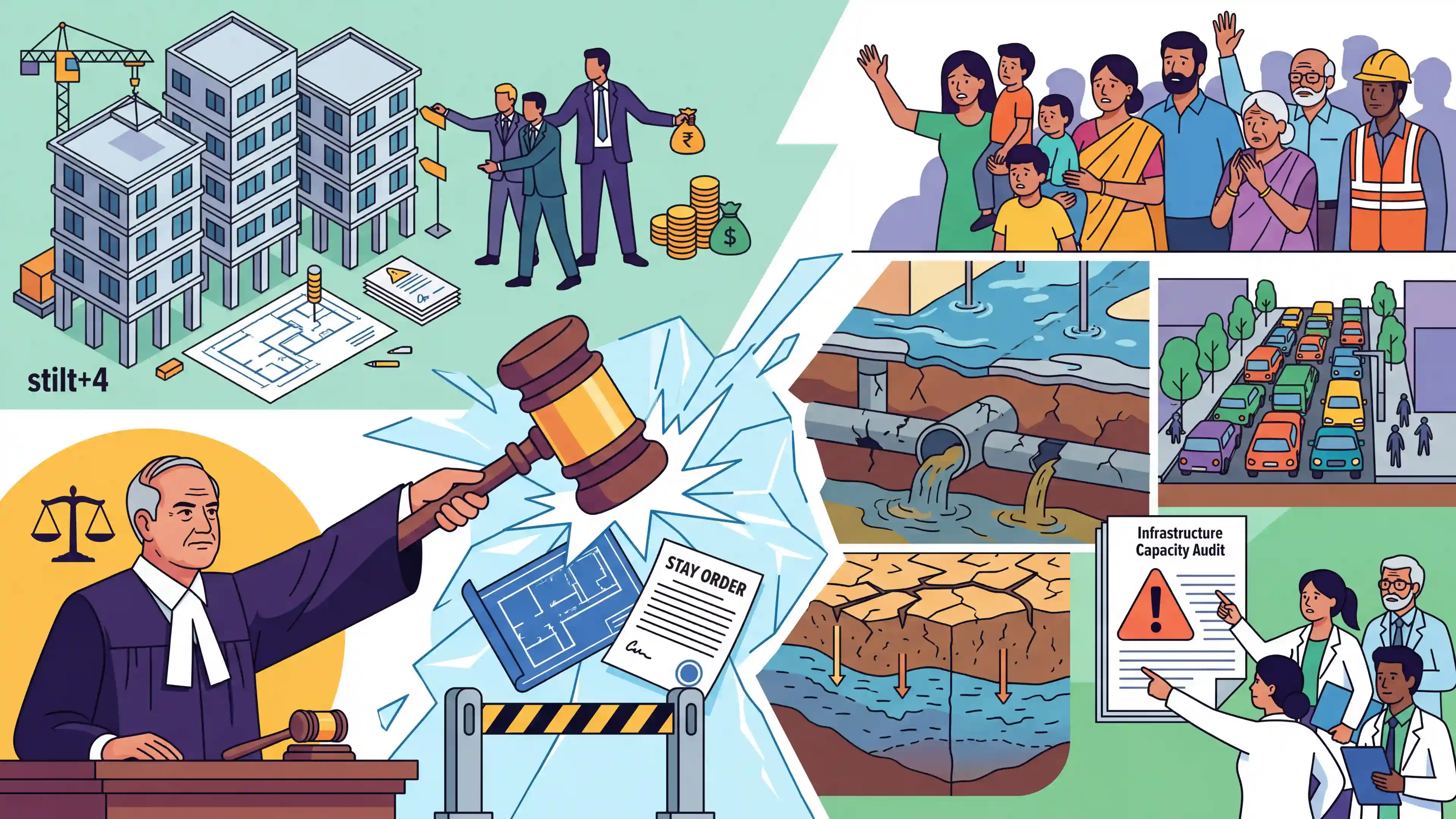
The Punjab and Haryana High Court has ordered an interim stay on the Haryana government's "stilt+4" building policy in Gurugram, effectively freezing new approvals and occupancy certificates. The judiciary cited acute infrastructure deficits—such as poor sewerage, drainage, narrowed roads, and groundwater depletion—and accused the state government of sacrificing public safety and its constitutional duties for revenue generation. The ruling echoed the concerns of a state-appointed Expert Committee chaired by P. Raghavendra Rao, which had warned against blanket implementation without conducting an 'Infrastructure Capacity Audit'.
Key Points
- The Punjab and Haryana High Court stayed the Haryana government's July 2024 policy permitting stilt+4 floor residential constructions in Gurugram, halting new approvals and occupancy certificates.
- The court highlighted severe civic infrastructure deficits, including shrinking roads, inadequate sanitation, defective town planning, and blocked aquifers preventing groundwater recharge.
- The state government was heavily criticized for prioritizing revenue generation over its constitutional duty to ensure a clean and healthy urban environment for citizens.
- An Expert Committee led by P. Raghavendra Rao previously advised against a blanket policy, recommending an 'Infrastructure Capacity Audit' before implementation, which was bypassed by the state.
Important Terms
Stilt+4 Policy

A housing policy allowing four residential floors above a ground-level stilt parking area, increasing plot density and floor area ratio (FAR) beyond traditional limits.
UPSC context
GS Paper 1 (Urbanization) and GS Paper 3 (Infrastructure). Tests understanding of urban density vs. sustainable civic planning.
Carrying Capacity
The maximum population and development level an area's infrastructure (sewerage, water, roads) can sustain without environmental or service degradation.
UPSC context
GS Paper 3 (Environment/Disaster Management). Essential for sustainable urban growth and environmental impact assessments.
P. Raghavendra Rao Committee
A state-appointed expert body that recommended conducting 'Infrastructure Capacity Audits' and imposing road-width riders before implementing denser residential building policies.
UPSC context
GS Paper 2 (Governance). Relevant for examining executive decision-making and the role of expert committees in public policy.
Floor Area Ratio (FAR)
The ratio of a building's total floor area to the size of the piece of land upon which it is built; used to regulate urban density.
UPSC context
GS Paper 1 (Urbanization). A fundamental concept in urban planning and municipal governance.
Haryana Building Code 2017
The regulatory framework in Haryana governing building design and safety, which was amended to permit the fourth floor in residential plots.
UPSC context
GS Paper 2 (Statutory rules/Governance). Tests knowledge of state-level administrative laws and building regulations.
Article 21
The fundamental right to life, which the judiciary interprets to include the right to a clean environment, public safety, and adequate civic infrastructure.
UPSC context
GS Paper 2 (Polity). Crucial for understanding judicial activism and the expansion of fundamental rights in urban contexts.
Prelims Trap
Carrying Capacity audits are exclusively mandated for hill stations and ecologically sensitive zones under environmental laws.
Aspirants assume 'carrying capacity' applies only to eco-sensitive zones (e.g., Himalayas). Courts are now actively enforcing Urban Carrying Capacity (UCC) on tier-1 cities to halt unchecked real estate densification.
Static Concepts Connected
What comprises 'Urban Carrying Capacity' in town planning?
- Definition: The maximum population or density a given urban area's environmental and infrastructural resources can sustain without irreversible degradation.
- Core Components: Water availability, drainage/sewerage load limits, traffic carrying capacity of roads, and solid waste management capabilities.
- Legal Backing: Often invoked by courts under Article 21 (right to a healthy environment) when executive master-planning ignores infrastructure deficits.
How does the Constitution distribute urban planning responsibilities?
- 74th Amendment: Added Part IX-A, formally recognizing Municipalities as the third tier of local self-government.
- 12th Schedule: Contains 18 functional items for Urban Local Bodies (ULBs), explicitly including urban planning, regulation of land use, and construction of buildings.
- Parastatal Bypass: State governments frequently bypass elected ULBs by creating non-elected 'Development Authorities', diluting local accountability and capacity.
Cross-Topic Patterns
Judicial Activism in Urban Governance
Courts are increasingly treating urban infrastructure collapse (Bengaluru lakes, Gurugram density) as an Article 21 violation, stepping in where state-appointed parastatal bodies fail to regulate land use.
Urban Flooding & Aquifer Blockage
The article explicitly links high-density real estate and indiscriminate concrete paving to the dual urban crises of our times: severe monsoon urban flooding and blocked groundwater recharge aquifers.

Urban Carrying Capacity + Article 21 + Municipal governance failures likely to form a high-weightage GS1 or GS2 Mains question in 2026.
Linked PYQs · 3
Linked PYQs · 3
- 2017MainsGS1
"The growth of cities as I.T. hubs has opened up new avenues of employment, but has also created new problems." Substantiate this statement with examples.
- 2024MainsGS3
Flooding in urban areas is an emerging climate-induced disaster. Discuss the causes of this disaster. Mention the features of two such major floods in the last two decades in India. Describe the policies and frameworks in India that aim at tackling such floods.
- 2022MainsGS2
“The most significant achievement of modern law in India is the constitutionalization of environmental problems by the Supreme Court.” Discuss this statement with the help of relevant case laws.
