Phage Therapy Success Against Drug-Resistant Bacterial Infections
Source:The Hindu ↗
Why It Matters
Antimicrobial Resistance (AMR) is a major public health crisis. Reporting successful alternatives like phage therapy provides crucial insights into addressing drug-resistant infections, aligning directly with UPSC GS3 syllabus requirements on biotechnology applications and health issues.
Summary
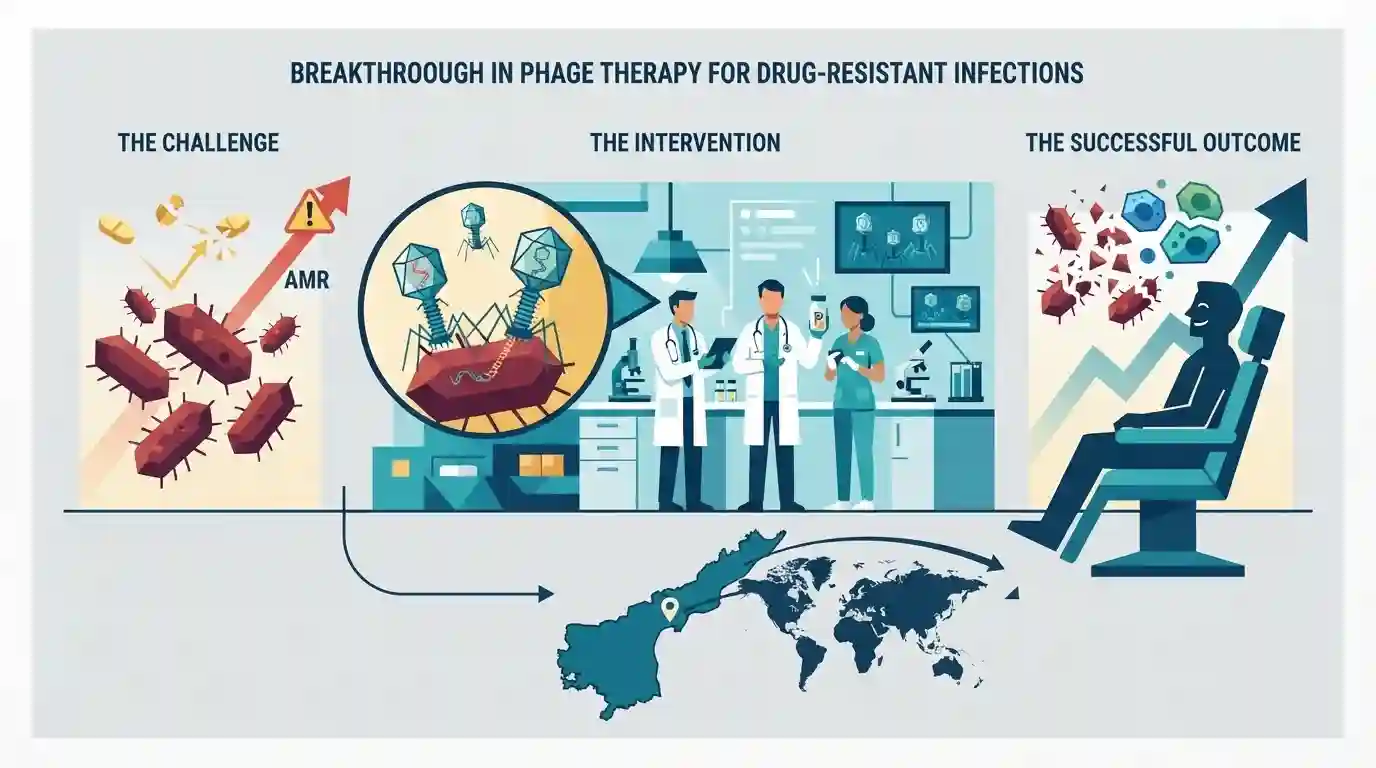
A medical team in Guntur, Andhra Pradesh, has reported successful clinical outcomes using phage therapy to treat drug-resistant bacterial infections. This breakthrough offers a viable alternative to conventional antibiotics amidst the escalating global threat of Antimicrobial Resistance (AMR), highlighting the potential of bacteriophages in targeting superbugs.
Key Points
- A medical research team in Guntur, Andhra Pradesh, successfully utilized phage therapy to treat drug-resistant bacterial infections, offering a promising alternative as conventional antibiotics fail.
- Phage therapy uses bacteriophages (viruses that specifically target and kill bacteria) to combat multidrug-resistant (MDR) pathogens without harming human cells or beneficial microbiota.
- This development addresses the global and national public health threat of Antimicrobial Resistance (AMR), often called the 'silent pandemic'.
- It highlights the need for institutional support, clinical trials, and regulatory frameworks to mainstream alternative therapies against superbugs.
Important Terms
National Action Plan on Antimicrobial Resistance (NAP-AMR)

India's comprehensive multi-sectoral roadmap aligned with the WHO Global Action Plan, utilizing a One Health approach to curb the escalating public health threat of drug-resistant pathogens.
UPSC context
UPSC Mains GS Paper II (Health) and GS Paper III (Science & Tech); tests policy frameworks tackling public health emergencies.
Guntur medical team
A medical research group in Andhra Pradesh that successfully utilized bacteriophage therapy to treat patients with persistent, multidrug-resistant bacterial infections.
UPSC context
UPSC Prelims/Mains Current Affairs; highlights indigenous clinical breakthroughs against antimicrobial resistance.
Prelims Trap
Bacteriophages are broad-spectrum antiviral agents that indiscriminately destroy human commensal microbiota alongside pathogenic bacteria.
Aspirants often assume bacteriophages kill human cells or beneficial flora, but their defining feature is high specificity for bacterial hosts, sparing host cells and commensal microbiota.
Static Concepts Connected
What are the core objectives and focus areas of India's National Action Plan on Antimicrobial Resistance (NAP-AMR)?
- Strategic alignment: Adopted in 2017 to align with WHO Global Action Plan, aiming to combat the silent pandemic of drug resistance through a One Health approach.
- Core pillars: Focuses on six key pillars: awareness, surveillance, infection prevention, research and development, and collaborative intersectoral governance.
- One Health scope: Addresses antibiotic overuse across human health, animal husbandry, poultry, and environmental waste management to curb resistance.
Cross-Topic Patterns
AMR containment and One Health integration
AMR containment strategies intersect with One Health frameworks, uniting human clinical protocols, animal husbandry antibiotic stewardship, and environmental effluent regulations under a single policy umbrella.
Biotech innovation vs. static drug regulations
The commercialization of self-replicating therapeutics like phages challenges conventional Drug Controller General of India (DCGI) approval pathways built for static chemical molecules.

AMR + Phage therapy + NAP-AMR targets are prime candidates for a multi-statement Prelims question or an ethics case study on public health.
Linked PYQs · 1
Linked PYQs · 1
- 2014MainsGS3
Can overuse and free availability of antibiotics without Doctor's prescription, be contributors to the emergence of drug-resistant diseases in India? What are the available mechanisms for monitoring and control? Critically discuss the various issues involved.
