Hyderabad Fire Tragedy Exposes Urban Planning and Safety Lapses
Source:The Hindu ↗
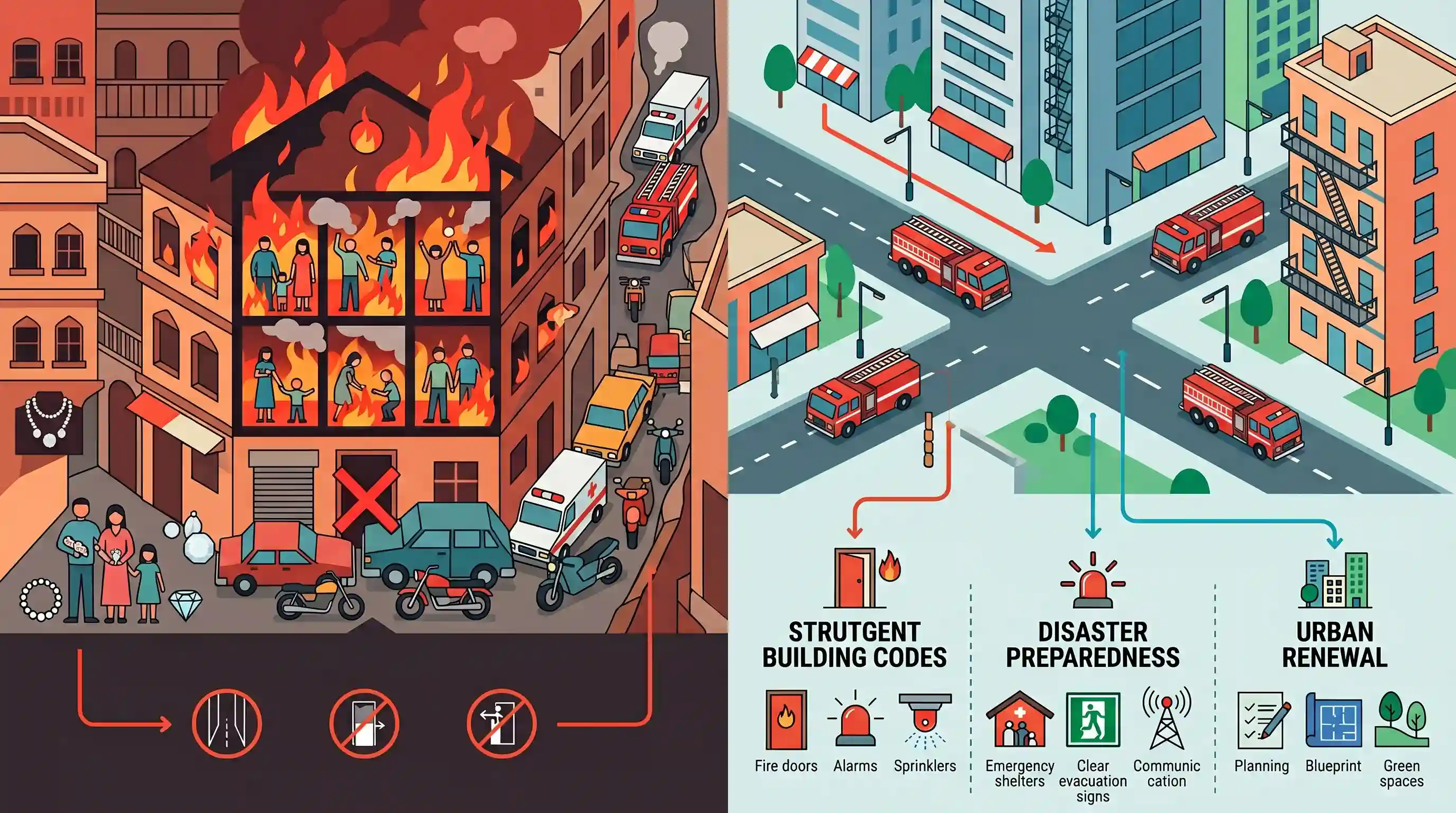
Why It Matters
The incident highlights the pressing need to address fire safety and disaster preparedness in congested and historically significant urban areas. It demonstrates the practical implications of poor urban planning and the lack of adherence to building safety codes.
Summary
A tragic fire in Hyderabad's historic Gulzar Houz area resulted in the deaths of 17 members of the Modi family, a prominent clan of pearl traders. The incident exposes the severe vulnerabilities of old, congested urban neighborhoods characterized by narrow lanes, lack of alternative escape routes, and poor adherence to fire safety protocols. The parking of vehicles at the only exit worsened the disaster, underscoring the pressing need for urban renewal and stringent disaster preparedness measures in heritage city zones.
Key Points
- A devastating fire in Gulzar Houz, Hyderabad claimed the lives of 17 members from three generations of the Modi family, renowned pearl traders in the region.
- The incident occurred in a century-old, congested two-storey building situated in a narrow, dimly lit lane near Mitti-ka-Sher.
- The severity of the tragedy was compounded by the presence of two-wheelers parked at the sole entrance, which caught fire and blocked the only escape route.
- This disaster brings to the forefront the critical issues of inadequate fire safety norms, poor urban planning, and the vulnerabilities of densely populated old city settlements.
Prelims Trap
"Fire services fall under the Concurrent List to enable NDMA oversight."
Fire services are exclusively a State subject and function as a municipal responsibility under the 12th Schedule (Article 243W). NDMA only provides guidelines.
Static Concepts Connected
How are Fire Services governed under the Indian Constitution?
- 12th Schedule: "Fire services" is a municipal function listed under the 12th Schedule, added by the 74th Constitutional Amendment Act.
- Article 243W: Under Article 243W, state legislatures endow municipalities with the power to manage fire services, making it a decentralized State subject.
- NDMA Role: The NDMA formulates national guidelines for fire safety, but execution and enforcement remain strictly a local/state mandate.
What is the legal status of the National Building Code (NBC) 2016?
- Recommendatory nature: Published by the Bureau of Indian Standards (BIS), it is a recommendatory model code, not a binding central law.
- State Adoption: It becomes legally enforceable only when explicitly integrated into State or Municipal building bylaws.
- Fire Safety Focus: Part 4 of the NBC specifically details Fire and Life Safety norms, including mandatory alternative escape routes.
Cross-Topic Patterns
Heritage conservation vs. Disaster resilience
The tension between preserving heritage zones (like the Charminar precinct) and implementing modern infrastructure for disaster resilience is a recurring GS1/GS3 urbanization theme.
Toxic fumes and building design norms
Recurring urban fire tragedies highlight that asphyxiation—not direct burns—is the primary cause of death, emphasizing the critical failure to maintain dual unblocked egress routes.

Mains 2026: "Evaluate disaster resilience in India's pre-independence heritage zones, analyzing regulatory gaps in municipal fire safety."
Linked PYQs · 3
Linked PYQs · 3
- 2019MainsGS3
Disaster preparedness is the first step in any disaster management process. Explain how hazard zonation mapping will help disaster mitigation in the case of landslides.
- 2013MainsGS1
Discuss the various social problems which originated out of the speedy process of urbanization in India.
- 2024MainsGS3
What is disaster resilience? How is it determined? Describe various elements of a resilience framework. Also mention the global targets of Sendai Framework for Disaster Risk Reduction (2015–2030).
