Gujarat NFSU sends forensic team to Nepal for flood victim ID
Source:social-news-xyz ↗
Why It Matters
This article highlights the direct application of biotechnology and DNA forensics in humanitarian disasters, emphasizing Gujarat's premier institute, NFSU (an Institution of National Importance), and India's soft power diplomacy through HADR in neighboring nations like Nepal.
Summary
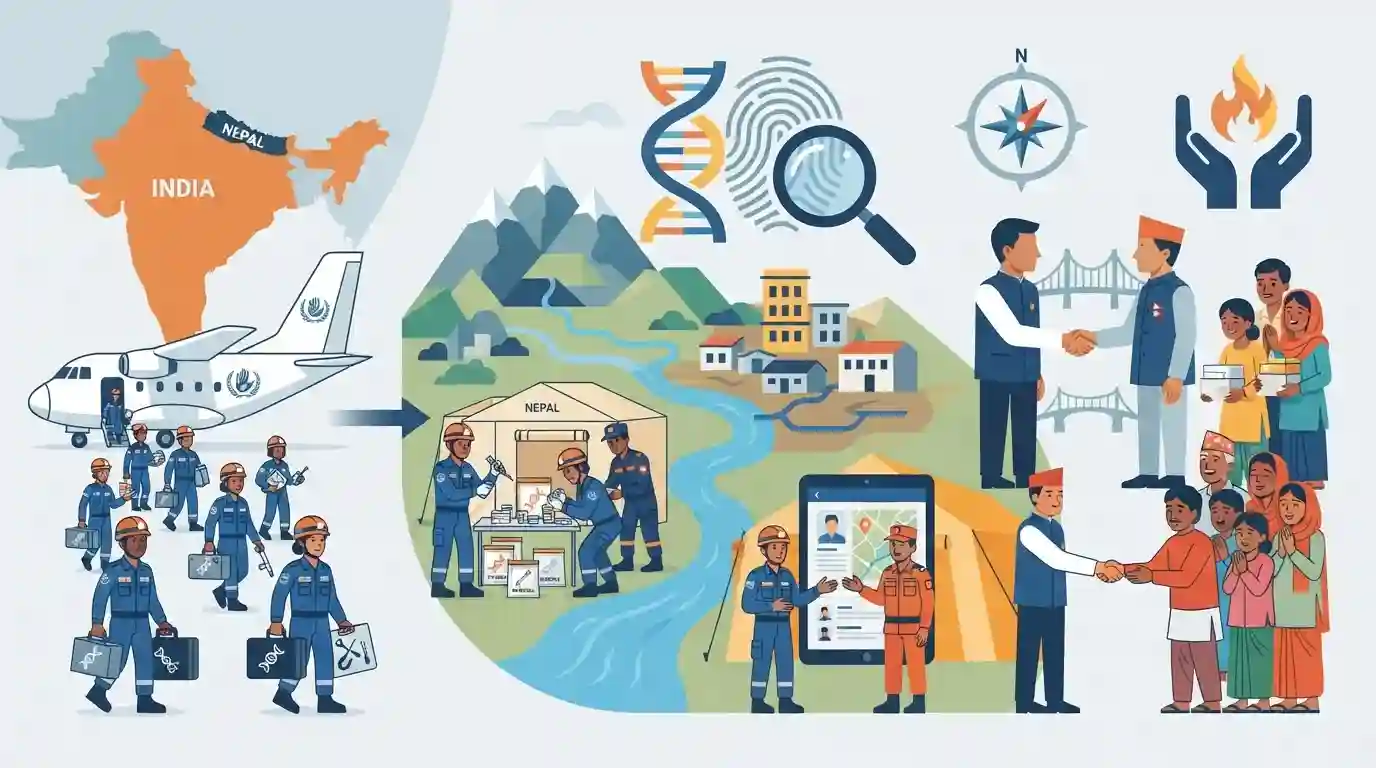
Gujarat-headquartered National Forensic Sciences University (NFSU) sent a 10-member specialist forensic team to Nepal, led by Bhargav Patel, to assist in DNA profiling and Disaster Victim Identification (DVI) following devastating flash floods in central Nepal. Operating under the joint supervision of India's MEA and MHA, this mission highlights India's regional disaster response capacities and the specialized expertise of NFSU in DNA forensics.
Key Points
- A 10-member forensic expert team from the National Forensic Sciences University (NFSU), Gandhinagar, was deployed to Nepal to assist in Disaster Victim Identification (DVI) and DNA sample matching.
- The mission is in response to the devastating flash floods on August 26, 2026, which struck central Nepal and the Nepal-Tibet border region, claiming at least 669 lives and leaving nearly 2,000 missing (including 25 individuals linked to Gujarat).
- The team is led by Bhargav Patel, Head of NFSU's Centre of Excellence in DNA Forensics, and operates under the joint supervision of India's Ministry of External Affairs (MEA) and Ministry of Home Affairs (MHA).
- NFSU's specialized expertise includes previous DVI tasks, such as resolving the identification of victims from the AI-171 aircraft crash (June 2025) within 10 days and collaborating with the US Department of Defense to identify remains of WWII-era American soldiers in India.
- This operation reflects India's proactive role in regional Humanitarian Assistance and Disaster Relief (HADR) and showcases the practical utility of DNA profiling technology in large-scale disaster management.
Important Terms
National Forensic Sciences University (NFSU)

An Institution of National Importance, headquartered in Gandhinagar, Gujarat, dedicated exclusively to forensic and investigative sciences, providing advanced academic, training, and disaster response support.
UPSC context
GS Paper-III (S&T, Disaster Management). Tests awareness of key scientific bodies and regional disaster relief efforts.
Disaster Victim Identification (DVI)
A scientific, multi-stage protocol used to identify deceased individuals in mass casualty events using primary identifiers (DNA, fingerprints, dental records) to ensure dignified handover to families.
UPSC context
GS Paper-III (Disaster Management). Tests knowledge of international guidelines and NDMA standard operating procedures during disasters.
Centre of Excellence in DNA Forensics (NFSU)
A highly specialized facility within NFSU focused on DNA profiling, forensic data analytics, and matching biological samples to aid human identification in disasters and crime.
UPSC context
GS Paper-III (S&T). Tests comprehension of specialized biotechnology facilities and practical applications of DNA profiling in India.
Union Ministry of External Affairs (MEA)
The government ministry responsible for conducting India's foreign relations, coordinating international assistance, and managing consular services for stranded Indian citizens abroad.
UPSC context
GS Paper-II (International Relations). Tests understanding of administrative machinery in diplomatic relations and neighborhood disaster relief.
Ministry of Home Affairs (MHA)
The central ministry responsible for domestic security, central police forces, and overall disaster management coordination within India and supervising specialized central forensic institutions.
UPSC context
GS Paper-II & III (Governance, Disaster Management). Tests understanding of executive ministries directing disaster response and domestic agencies.
Prelims Trap
The National Forensic Sciences University (NFSU) operates under the Union Ministry of Education as an Institution of National Importance.
NFSU actually operates under the administrative control of the Ministry of Home Affairs (MHA), not the Ministry of Education, despite its academic designation.
Static Concepts Connected
What is the statutory and administrative framework of the NFSU?
- Statutory Status: Upgraded to an Institution of National Importance under the National Forensic Sciences University Act, 2020.
- Nodal Ministry: Operates under the administrative control of the Union Ministry of Home Affairs (MHA), not Education.
- Global Expansion: Headquartered in Gandhinagar, Gujarat, with its first international campus established in Jinja, Uganda in 2023.
What is NDMA's 4-stage Disaster Victim Identification workflow?
- Recovery & PM: Begins with systematic recovery of remains from the disaster site, followed by Post-Mortem forensic and DNA analysis.
- AM & Reconciliation: Involves collecting Ante-Mortem data from families and reconciling it with Post-Mortem findings for official identification.
- Dental Registry: Advocates for a National Dental Data Registry, utilizing teeth as highly resilient identification markers in decomposed states.
Cross-Topic Patterns
HADR + Soft Power Diplomacy
Deploying NFSU's forensic teams to Nepal and expanding campuses to Uganda showcases India's transition from a security provider to a niche technical soft power provider.
Forensic Archaeology + Defense Ties
India's collaboration with the US to exhume WWII soldiers in the Northeast integrates forensic science with strategic defense ties and historical diplomacy.

NDMA's new INTERPOL-aligned 4-stage DVI guidelines and NFSU's MHA administrative status are highly likely in GS-3 science/disaster questions.
