Gujarat wetland designated as India newest Ramsar convention site
Source:The Hindu ↗
Why It Matters
The addition of new Ramsar Sites is a frequent topic in UPSC examinations (Prelims and Mains). Tracking new designations, their geographical uniqueness (such as the Banni grasslands and Rann of Kachchh), and the specific wildlife they harbor (like Schedule-I migratory birds) is essential for Environment and Geography sections.
Summary
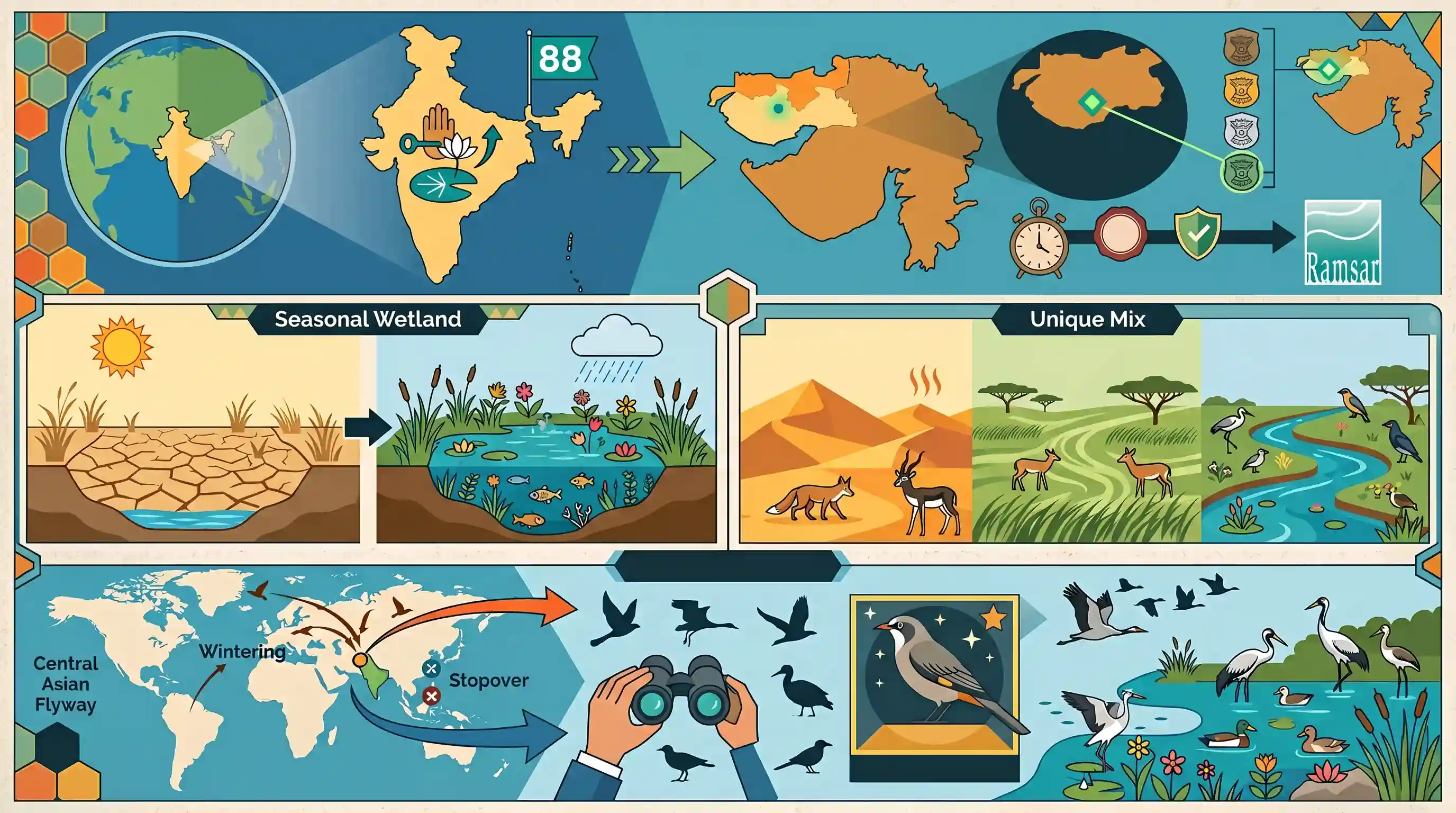
Gujarat's Chhari-Dhandh Wetland Conservation Reserve, situated in the ecologically distinct Banni grasslands of Kachchh, has been designated as a Ramsar Site, elevating India's tally of such internationally recognized wetlands to 88. As the first Ramsar Site in the Kachchh region and the fifth in Gujarat, the seasonal wetland serves as a vital wintering and stopover ground for migratory birds traveling via the Central Asian Flyway. The area hosts rare species like the Grey Hypocolius and offers a unique mix of desert, grassland, and wetland ecosystems. It was previously declared a Conservation Reserve in 2008 under the Wildlife (Protection) Act, 1972.
Key Points
- Gujarat's Chhari-Dhandh Wetland Conservation Reserve in the Kachchh district was declared a Ramsar Site on World Wetlands Day, becoming India's 88th recognized wetland of international importance.
- It is the fifth Ramsar site in Gujarat and notably the first in the Kachchh region, which boasts a unique ecological interface of wetlands, deserts, and grasslands.
- Located within the Banni grasslands, the shallow, seasonal lake is a crucial stopover on the Central Asian Flyway for thousands of migratory birds.
- The habitat supports several endangered and vulnerable species, including the rare migratory bird Grey Hypocolius, which is protected under Schedule I of the Wildlife (Protection) Act, 1972.
- Chhari-Dhandh was earlier declared a Conservation Reserve in 2008 under the Wildlife (Protection) Act.
Important Terms
Ramsar Convention

An intergovernmental treaty adopted in 1971 (Iran) for the conservation and 'wise use' of wetlands. It provides a framework for international cooperation to protect ecologically significant water bodies.
UPSC context
GS III Environment (Conservation, International Treaties); high importance for Prelims mapping and Mains environmental governance topics.
Wildlife (Protection) Act, 1972
India's primary legal framework for protecting plant/animal species, managing habitats, and regulating wildlife trade. It establishes Protected Areas like National Parks, Sanctuaries, and Conservation Reserves.
UPSC context
GS III (Biodiversity and Legislation); a foundational act frequently tested in Prelims and Mains Environment sections.
Chhari-Dhand Wetland Conservation Reserve
A seasonal desert wetland in Kachchh, Gujarat, situated within the Banni grasslands. It is a vital stopover for migratory birds and India's 88th designated Ramsar site.
UPSC context
Prelims (Geography/Mapping); represents key biodiversity hotspots and newly recognized sites of international importance.
Banni Grasslands
One of Asia's largest tropical grasslands located in the Kachchh district of Gujarat. It is an arid ecosystem known for rich biodiversity and the traditional Maldhari pastoralist community.
UPSC context
GS I Geography (Biomes) and GS III Environment (Conservation); significant for its unique ecology and potential cheetah reintroduction status.
Central Asian Flyway (CAF)
A major migratory bird route covering 30 countries from the Arctic/Siberia to the Indian Ocean. India serves as a critical core wintering and stopover hub for numerous species.
UPSC context
GS III (Biodiversity and Migratory Species); relevant for international conservation initiatives like the CMS (Bonn Convention).
Conservation Reserve
A protected area category under the WPA 1972 (added in 2002) for government-owned lands that act as buffers or ecological corridors, managed through community consultation.
UPSC context
GS III Environment (Protected Area Network); tests understanding of different legal categories of land protection in India.
Prelims Trap
Chhari-Dhandh is a permanent freshwater lake and a National Park in the Kachchh region.
It is actually a seasonal shallow wetland in the Banni grasslands and is legally designated as a Conservation Reserve, not a National Park.
Static Concepts Connected
What distinguishes a Conservation Reserve under the Wildlife Protection Act?
- Legal Basis: Introduced by the Wildlife (Protection) Amendment Act, 2002 to act as buffer zones or migration corridors.
- Ownership & Rights: Typically declared on government-owned lands adjoining protected areas, where communities may still have subsistence rights.
- Management: Managed by a Conservation Reserve Management Committee, ensuring local community participation in wildlife protection.
What are the defining ecological features of the Banni Grasslands?
- Location: Located in the arid landscape of Kutch, Gujarat, formed by ancient Indus river sediments.
- Ecology: One of the largest grasslands in Asia, featuring a unique mix of salt flats, seasonal wetlands, and rich biodiversity.
- Maldhari Community: Home to the Maldhari pastoralist community, famous for rearing the resilient Banni buffalo breed.
Cross-Topic Patterns
Flyways & Wetland Corridors
UPSC frequently links specific wetlands to their role in the Central Asian Flyway (CAF). Expect questions pairing stopover wetlands like Chhari-Dhandh with the seasonal migratory species they support.
Ecosystem-Specific Schedule I Species
The Grey Hypocolius relies on a unique desert-grassland-wetland matrix. UPSC historically pairs rare Schedule I species (like the Great Indian Bustard) with their highly specialized arid or semi-arid biomes.

Expect a 2026 Prelims question pairing newly added Ramsar sites like Chhari-Dhandh with their specific biomes (Banni) and flyway roles.
Linked PYQs · 5
Linked PYQs · 5
- 2019PrelimsGS1
Consider the following statements: 1. Under Ramsar Convention, it is mandatory on the part of the Government of India to protect and conserve all the wetlands in the territory of India. 2. The Wetlands (Conservation and Management) Rules, 2010 were framed by the Government of India based on the recommendations of Ramsar Convention. 3. The Wetlands (Conservation and Management) Rules, 2010 also encompass the drainage area or catchment regions of the wetlands as determined by the authority. Which of the statements given above is/are correct?
- 2023PrelimsGS1
Which one of the following is the best example of repeated falls in sea level, giving rise to present-day extensive marshland?
- 2023MainsGS3
Comment on the National Wetland Conservation Programme initiated by the Government of India and name a few India's wetlands of international importance included in the Ramsar Sites.
- 2017PrelimsGS1
In India, if a species of tortoise is declared protected under Schedule I of the Wildlife (Protection) Act, 1972, what does it imply?
- 2022PrelimsGS1
With reference to Indian laws about wildlife protection, consider the following statements : 1. Wild animals are the sole property of the government. 2. When a wild animal is declared protected, such animal is entitled for equal protection whether it is found in protected areas or outside. 3. Apprehension of a protected wild animal becoming a danger to human life is sufficient ground for its capture or killing. Which of the statements given above is/are correct?
