Viksit Data Center Policy and Digital Infrastructure in Gujarat
Source:vyqon ↗
આ શા માટે મહત્વનું છે
The policy represents a highly integrated approach to digital infrastructure, combining massive fiscal incentives with critical regulatory reforms (like Deemed DISCOM status) and mandatory sustainability (ESG) criteria. This makes it a prime example for GPSC questions on state-led economic initiatives, infrastructure development, and renewable energy mandates.
સારાંશ
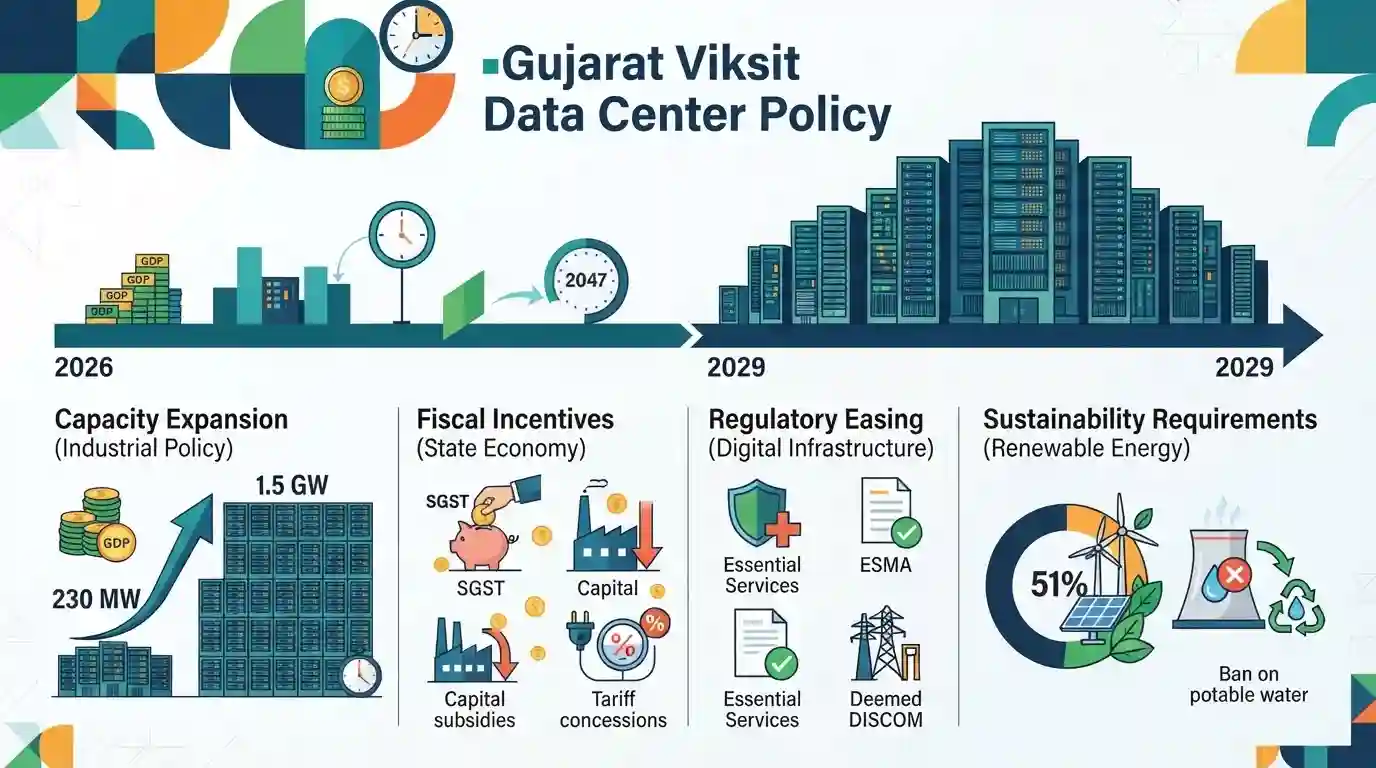
Gujarat has unveiled the Viksit Data Center Policy 2026-29 to establish the state as a leading hub for AI-ready hyperscale infrastructure. The policy targets a massive expansion of data center capacity from 230 MW to 1.5 GW by 2029, aligning with the state's vision of becoming a $3.5 trillion economy by 2047. Through an ₹11,500 crore outlay, the government is offering robust fiscal incentives, including capital subsidies, SGST reimbursement, and power tariff concessions. Uniquely, the policy provides regulatory easing by granting data centers 'Essential Services' status under ESMA and 'Deemed DISCOM' status for open access to power markets. It also embeds strong sustainability requirements, mandating 51% renewable energy usage and banning potable water for cooling.
મુખ્ય મુદ્દા
- Gujarat aims to increase its data center capacity from 230 MW to 1.5 GW by 2029 under the Viksit Data Center Policy 2026-29.
- The policy offers substantial fiscal incentives, including up to 25% capital subsidy, 100% SGST reimbursement for 10 years, and ₹1.5 per unit power tariff concession.
- Data centers are granted 'Essential Services' status under ESMA and 'Deemed DISCOM' status, facilitating Open Access power sourcing.
- Strict ESG mandates require sourcing 51% of energy from renewable sources within three years and prohibit the use of potable water for cooling systems.
- 75% of new capacity will be prioritized in special zones like Dholera SIR and GIFTCITY.
મહત્વપૂર્ણ શબ્દો
Viksit Gujarat Data Center Policy 2026-29

A dedicated regulatory framework targeting ₹6 lakh crore investment to build 7.5 GW of AI-ready hyperscale infrastructure. It mandates 51% green energy usage and desalination for cooling, while offering broad fiscal incentives to large operators.
UPSC context
Important for GS Paper 3 (Infrastructure). Highlights state-level industrial policies driving India's digital economy and sustainable AI expansion.
Deemed DISCOM Status
A special regulatory classification granting large data centers independent electricity distribution licenses. This enables facilities to bypass traditional state grids and procure renewable energy directly from third-party producers via open access.
UPSC context
Relevant to GS Paper 3 (Energy). Showcases regulatory innovations to meet the massive, uninterrupted power demands of modern AI infrastructure.
Gujarat Essential Services Maintenance Act (ESMA)
A 1972 law ensuring the continuity of critical state services by prohibiting strikes. The new policy classifies data center operations as an "essential service" under ESMA to guarantee uninterrupted 24/7 digital infrastructure operations.
UPSC context
GS Paper 2 (Governance) & GS Paper 3 (Cybersecurity). Demonstrates the adaptation of traditional public order laws to secure critical digital assets.
Viksit Gujarat @ 2047
The state's long-term economic roadmap aiming to transform Gujarat into a $3.5 trillion economy by 2047. It aligns with the national 'Viksit Bharat' objective, focusing heavily on digital infrastructure, AI capabilities, and renewable energy.
UPSC context
GS Paper 3 (Economic Development). Illustrates state-level economic planning and capacity building required to achieve India's centenary development targets.
પ્રિલિમ્સ ટ્રેપ
A state government can grant 'Deemed DISCOM' status to exempt a self-consuming data center from paying Cross-Subsidy Surcharges.
The Supreme Court (2026) ruled that entities utilizing power solely for self-consumption cannot claim Deemed Distribution Licensee benefits to bypass CSS.
સંલગ્ન સ્થિર ખ્યાલો
What is 'Open Access' and 'Deemed Licensee' under the Electricity Act, 2003?
- Open Access: Allows bulk electricity consumers to procure power directly from independent power producers or market exchanges instead of local DISCOMs.
- Deemed Licensee: Certain designated entities (like Railways) are legally treated as distribution licensees, allowing them to procure bulk power directly, bypassing retail supply networks.
- Cross-Subsidy Surcharge: A compensatory fee paid by open-access consumers to local DISCOMs to offset the loss of revenue used to subsidize agricultural and domestic users.
What is the statutory framework of the Essential Services Maintenance Act (ESMA)?
- Dual Jurisdiction: The central ESMA is an Act of Parliament, but states have enacted their own variants to maintain public order and essential supplies.
- Prohibition Powers: Empowers the government to prohibit strikes, lockouts, and lay-offs in services deemed vital to national or state-level public life.
આંતર-વિષય પેટર્ન
Federal friction in power distribution
Examines how state industrial policies granting 'Deemed DISCOM' status to private tech parks clash with central power sector reforms and judicial boundaries under the Electricity Act.
Water-Energy-Digital Nexus
Highlights how hyperscale AI computing forces states to ban potable water and mandate captive RE, shifting digital policies into critical ecological resource management.

GS-3 may contrast state-led digital infrastructure incentives (like ESMA/deemed DISCOMs) with federal power regulatory frameworks.
સંલગ્ન PYQ · 2
સંલગ્ન PYQ · 2
- 2025GPSC_PRELIMSGS1
Reliance industries has announced plans to build the world's largest data centre in ______
- 2025GPSC_PRELIMSGS1
Under the Green Open Access Rules, 2022, the minimum size of the renewable energy project eligible for open access is
