Gujarat Shipbuilding Policy for maritime manufacturing and investment
Source:dailypioneer ↗
આ શા માટે મહત્વનું છે
This policy is crucial for state-specific current affairs and economic geography. It demonstrates state-level alignment with national maritime goals (Maritime Vision 2047) and highlights significant infrastructure initiatives like the new Porbandar shipbuilding cluster, which are highly testable in GPSC Prelims.
સારાંશ
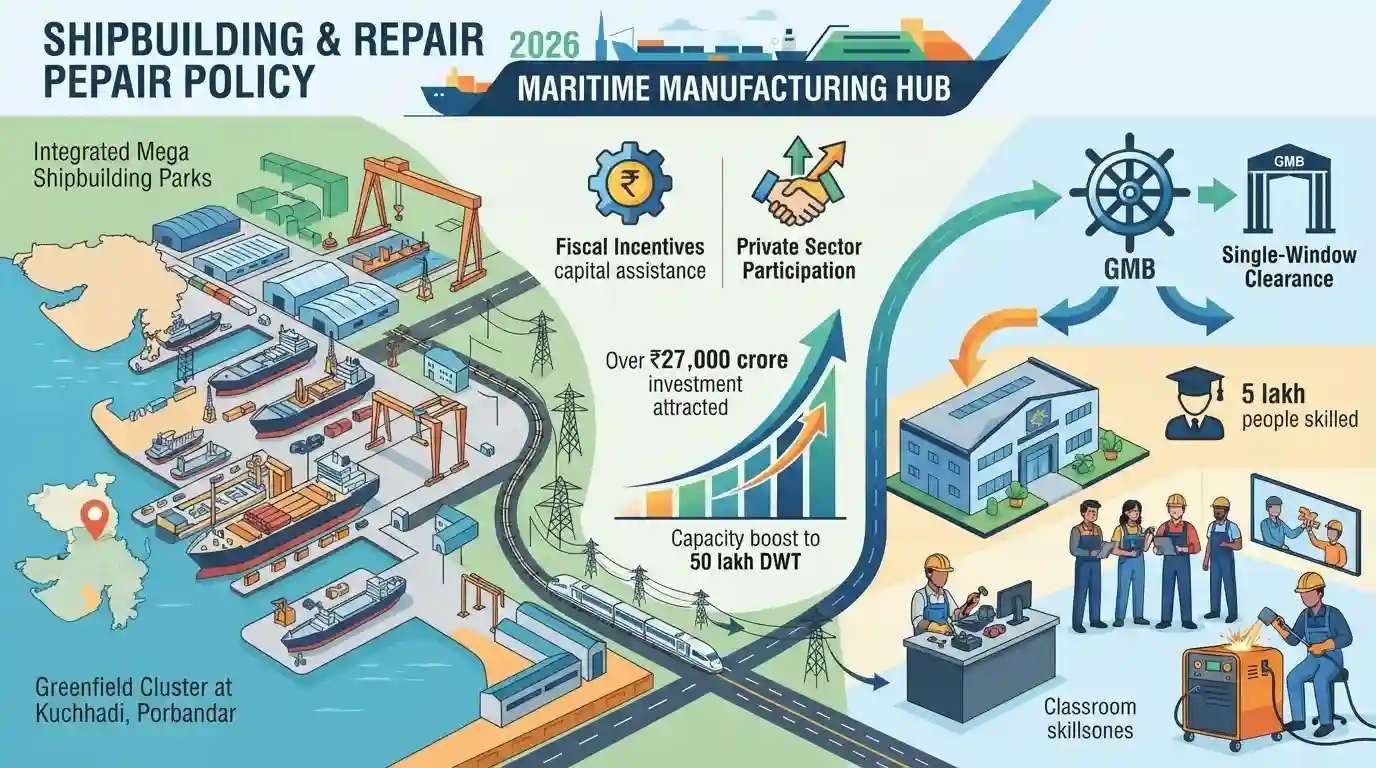
The Gujarat government has unveiled the Shipbuilding and Repair Policy 2026, aiming to transform the state into India's premier maritime manufacturing hub. Aligned with the national Maritime Vision 2047, the policy seeks to attract over ₹27,000 crore in investments by developing Integrated Mega Shipbuilding Parks, including a major greenfield cluster at Kuchhadi in Porbandar. The policy sets ambitious targets to boost the state's shipbuilding capacity to 50 lakh Deadweight Tonnage (DWT) and skill 5 lakh people. It introduces comprehensive fiscal incentives, such as stamp duty reimbursement, capital assistance, and single-window clearance through the Gujarat Maritime Board (GMB), to facilitate massive private sector participation in maritime infrastructure.
મુખ્ય મુદ્દા
- The Gujarat Shipbuilding and Repair Policy 2026 aims to develop the state into a leading maritime manufacturing hub, aligning with the Centre's Maritime Vision 2047 and Aatmanirbhar Bharat initiatives.
- The policy proposes setting up two Integrated Mega Shipbuilding Parks, with the Centre having approved a mega greenfield cluster at Kuchhadi in the Porbandar district.
- Key targets include increasing the state's shipbuilding capacity to more than 50 lakh Deadweight Tonnage (DWT) and generating skill development opportunities for over 5 lakh individuals.
- The policy offers robust fiscal incentives including capital assistance, stamp duty reimbursement, and electricity duty subsidies to attract an estimated ₹27,000 crore in infrastructure and private investments.
મહત્વપૂર્ણ શબ્દો
Gujarat Shipbuilding and Repair Policy 2026

A state policy aimed at transforming Gujarat into a maritime manufacturing hub by attracting over ₹27,000 crore in investments, establishing two Integrated Mega Shipbuilding Parks, and expanding shipbuilding capacity to over 50 lakh DWT.
UPSC context
GS Paper III (Infrastructure, Industrial Policy) — tests state-level initiatives in maritime manufacturing, port-led development, and economic growth.
Maritime Amrit Kaal Vision 2047
India's comprehensive blueprint to transform its maritime sector, aiming for 10,000 MMTPA port capacity, green port initiatives, enhanced shipping logistics, and self-reliance in shipbuilding by the centenary of independence in 2047.
UPSC context
GS Paper III (Infrastructure, Blue Economy) — tests long-term national shipping strategies, port modernization, and sustainable maritime development.
Shipbuilding Development Scheme
A central scheme with an outlay of ₹19,989 crore supporting greenfield shipbuilding clusters, brownfield shipyard modernization, establishing the India Ship Technology Centre, and offering credit risk coverage to boost domestic capacity.
UPSC context
GS Paper III (Government Schemes, Industrial Policy) — tests financial incentives, infrastructure creation, and indigenization in critical manufacturing sectors.
Gujarat Maritime Board
A statutory body established in 1982 to manage, regulate, and develop Gujarat’s non-major ports. It pioneered port privatization and public-private partnerships, facilitating the state's leading share in national cargo handling.
UPSC context
GS Paper II & III (Statutory Bodies, Port Infrastructure) — tests state-level regulatory frameworks, port governance, and public-private partnership models.
Ministry of Ports, Shipping and Waterways
The apex central ministry responsible for formulating and administering laws, policies, and programmes related to ports, shipping, shipbuilding/repair, and inland waterways in India to boost trade and the blue economy.
UPSC context
GS Paper II & III (Government Policies, Infrastructure) — tests the central regulatory framework, national logistics programs, and port-led development.
પ્રિલિમ્સ ટ્રેપ
Deadweight Tonnage (DWT) represents the physical weight of the empty vessel itself before cargo, fuel, or passengers are loaded.
DWT measures the weight of everything the ship carries to its safe limit, not the physical weight of the empty ship itself (which is measured by Light Displacement).
સંલગ્ન સ્થિર ખ્યાલો
What are the key tonnage metrics used in global shipping and maritime trade?
- Deadweight Tonnage (DWT): Measures the total weight of cargo, fuel, fresh water, ballast, crew, and provisions a ship can safely carry.
- Displacement Tonnage: The actual weight of the water displaced by the hull, representing the ship's physical weight at any given state of loading.
- Gross Tonnage (GT): A non-linear index metric of the overall internal volume of all enclosed spaces in a vessel.
What are the core strategic pillars of India's Sagarmala Programme?
- Port Modernization: Modernizing existing port infrastructure and building new mega deep-draft greenfield ports.
- Port Connectivity: Enhancing hinterland transport links through rail, road, and inland waterways to optimize cargo movement.
- Port-led Industrialization: Promoting coastal economic zones and maritime industrial clusters close to major shipping channels.
આંતર-વિષય પેટર્ન
Shipbuilding and National Security Autonomy
Enhancing domestic merchant shipbuilding capacity reduces strategic vulnerability, preventing critical reliance on foreign-flagged vessels during supply chain blockades or maritime security crises.
Port Industrialization vs Coastal Ecology
Setting up mega greenfield shipbuilding clusters like Porbandar tests the regulatory balance between Coastal Regulation Zone (CRZ) clearances and blue economy development targets.

Maritime Vision 2047 goals and DWT vs Displacement definitions are highly probable for a multi-statement Prelims 2026 question.
સંલગ્ન PYQ · 1
સંલગ્ન PYQ · 1
- 2025GPSC_PRELIMSGS1
According to the Socio-Economic Review, 2024-2025 of Gujarat, Gujarat comes in ______ category in Logistic Ease Across Different States (LEADS), 2024.
