Gujarat Child Protection Policy Framework Implementation
Source:theprint ↗
Why It Matters
State-level policy frameworks for child protection are crucial for effective grassroots implementation of national child rights mandates, making them highly relevant for governance and social justice sections of administrative exams.
Summary
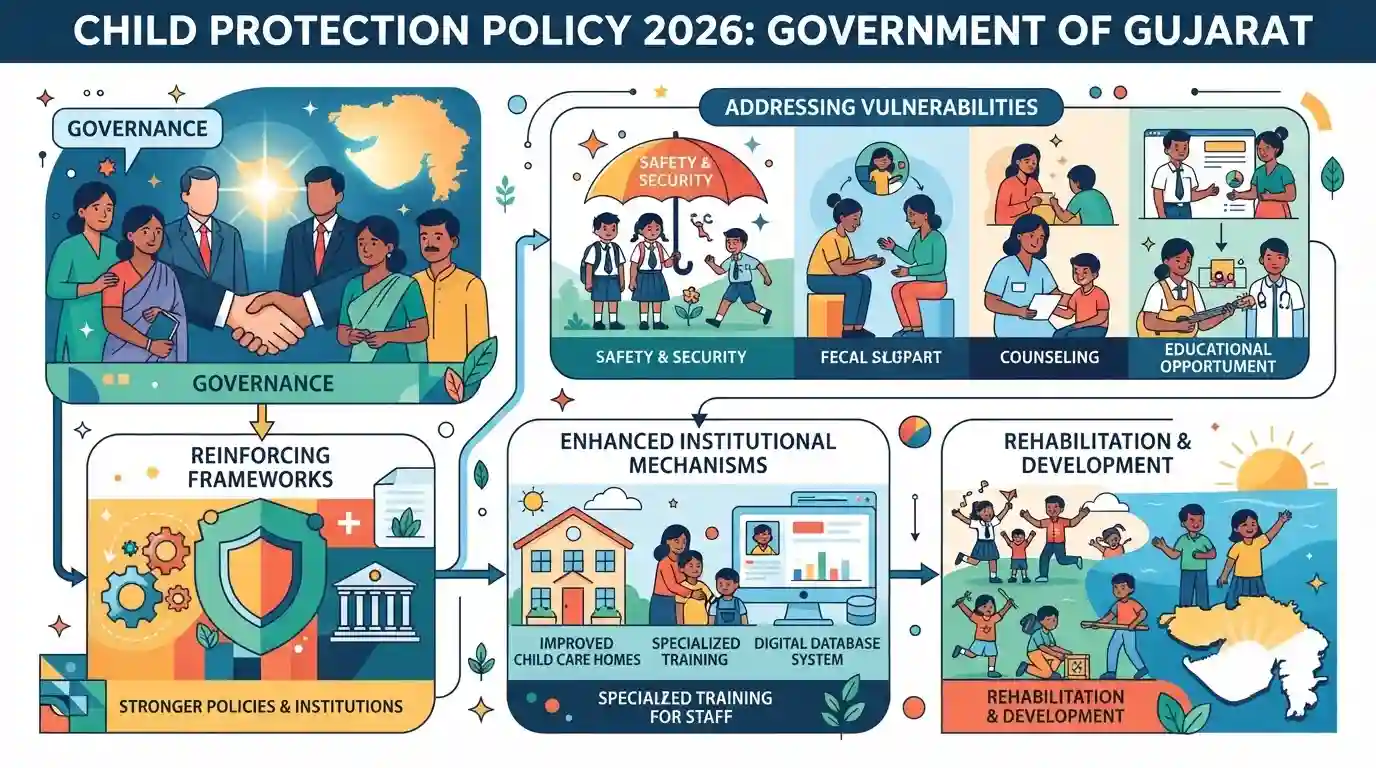
The Government of Gujarat has launched the Child Protection Policy 2026 to reinforce child safety frameworks, address vulnerabilities, and enhance institutional mechanisms for child welfare, protection, and rehabilitation across the state.
Key Points
- The Government of Gujarat unveiled the Child Protection Policy 2026 to strengthen the safety, welfare, and institutional frameworks for children across the state.
- The policy focuses on preventative measures, early intervention, rehabilitation, and inter-departmental coordination to address child rights, protection from abuse, and exploitation.
- Aligns with national legislation such as the Juvenile Justice Act and POCSO Act while introducing localized guidelines for grassroots implementation.
Important Terms
Gujarat Child Protection Policy 2026

A comprehensive state safeguarding framework introduced by the Government of Gujarat to ensure zero tolerance towards child abuse, exploitation, and neglect, focusing on prevention, institutional safety, and rehabilitation.
UPSC context
Important for GPSC Paper II (Social Justice and Governance), testing state-level initiatives, child rights, and vulnerable section welfare.
Government of Gujarat
The executive authority responsible for formulating and implementing state policies, welfare schemes, and governance measures for child protection and social justice in Gujarat.
UPSC context
Relevant for GPSC Paper II and Gujarat Administration topics, testing policy implementation, state governance, and statutory welfare frameworks.
Static Concepts Connected
What are the key institutional bodies under the Juvenile Justice (Care and Protection of Children) Act in India?
- CWC Mandate: Child Welfare Committee (CWC) handles children in need of care and protection at the district level.
- JJB Structure: Juvenile Justice Board (JJB) deals with children in conflict with law, comprising a metropolitan magistrate and two social workers.
- DCPU Role: District Child Protection Unit (DCPU) coordinates all child protection activities at the district level under state government oversight.
Cross-Topic Patterns
State Welfare Policies & Federal Legislative Alignment
State-level child welfare policies must seamlessly integrate national legal frameworks like POCSO and the Juvenile Justice Act while leveraging decentralized administrative machinery for last-mile grassroots implementation.
Child Rights & Digital Governance Intersect
Modern child protection mandates now intersect with digital governance by explicitly addressing online exploitation, cyberbullying, and digital safety for minors.

Gujarat Child Protection Policy 2026 features (nodal agency, mandatory background checks, review mechanisms) prime for multi-statement prelims.
Linked PYQs · 3
Linked PYQs · 3
- 2025GPSC_PRELIMSGS1
Which of the following statements is/are correct regarding the G-SAFAL scheme?
- 2024GPSC_PRELIMSGS1
Consider the following statements. 1. Access to justice for the weaker sections of the society is a constitutional mandate to ensure fair treatment under Indian legal system. 2. Legal Services Authorities Act, 1987, was enacted by Parliament to organise Lok Adalats outside the formal adjudicatory system, to address the problems of crowded cases. 3. Equal justice and free legal aid is one of the Directive Principles of State Policy (DPSP) under the Indian Constitution Which of the above statements is/are correct?
- 2019GPSC_PRELIMSGS1
Who among the following are eligible for free legal services in India? 1. Women and Children 2. Persons in Custody 3. Disabled Persons 4. Industrial Workmen
