Gujarat Establishes Unified Taluka Planning Committees
Source:indianmasterminds ↗
Why It Matters
Decentralization and the functioning of Panchayati Raj Institutions (PRIs) are central to the Polity and Governance syllabus. The formation of the UTPC illustrates ongoing state-level administrative reforms aimed at optimizing decentralized planning and addressing structural inefficiencies at the intermediate (block/taluka) tier of local self-government.
Summary
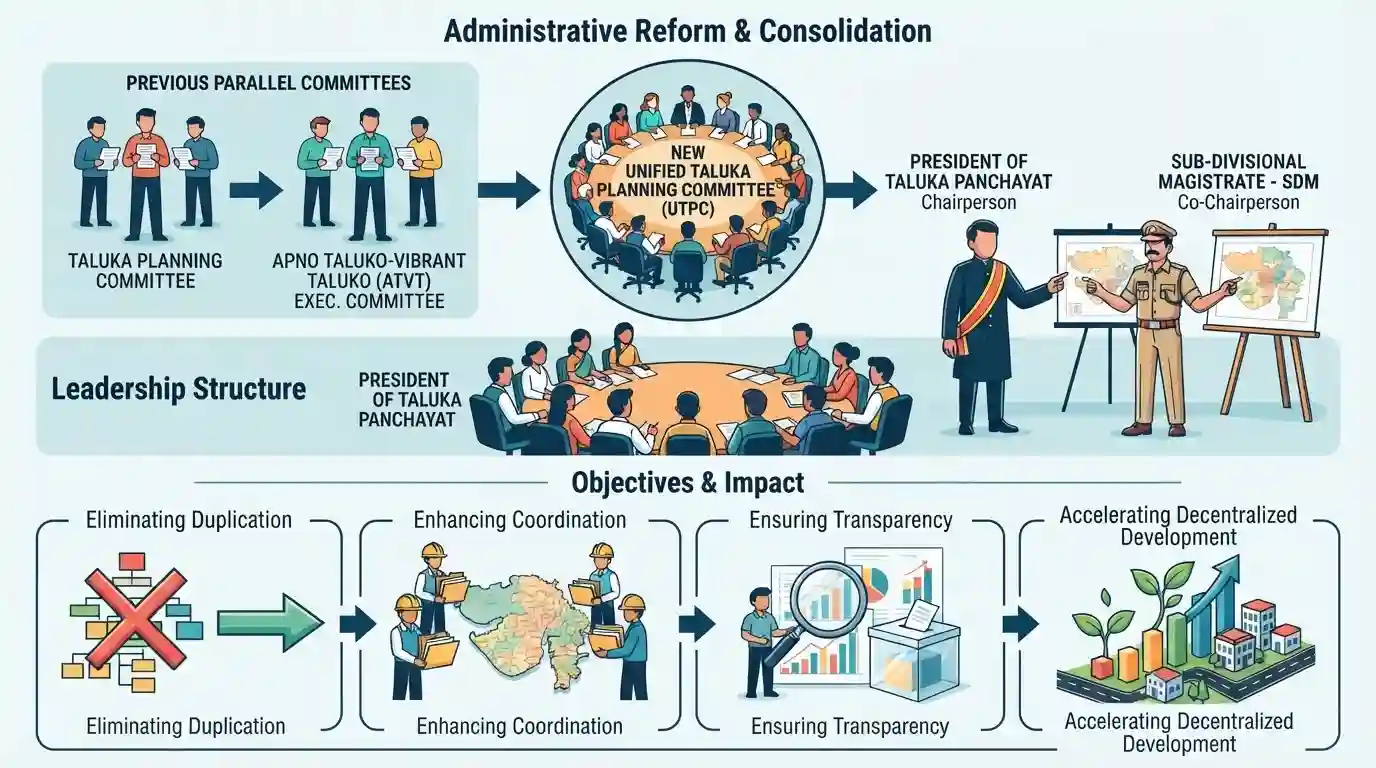
In a major administrative reform aimed at streamlining local governance, the Gujarat government has established an 18-member Unified Taluka Planning Committee (UTPC) in every taluka. Driven by the recommendations of the Fourth Report of the Gujarat Administrative Reforms Commission (GARC), the UTPC effectively merges the previously parallel Taluka Planning Committee and the Aapno Taluko-Vibrant Taluko (ATVT) Executive Planning Committee. The new committee will be chaired by the President of the Taluka Panchayat, with the Sub-Divisional Magistrate (SDM) as Co-Chairperson. This consolidation is designed to eliminate administrative duplication, enhance coordination among line departments, ensure transparency, and accelerate decentralized grassroots development.
Key Points
- The Gujarat government has introduced an 18-member Unified Taluka Planning Committee (UTPC) across all talukas to streamline local development.
- The UTPC replaces the dual-track taluka planning system, merging the existing Taluka Planning Committee and the ATVT Executive Planning Committee.
- The reform is based on the recommendations of the Fourth Report of the Gujarat Administrative Reforms Commission (GARC).
- The UTPC will be chaired by the President of the Taluka Panchayat, with the Sub-Divisional Magistrate (SDM) as Co-Chairperson and the Taluka Development Officer (TDO) as Member Secretary.
- The move aims to eliminate duplication, accelerate the approval and execution of local development schemes, and foster decentralized planning.
Important Terms
Unified Taluka Planning Committee (UTPC)

An 18-member local planning body in Gujarat merging parallel taluka committees to streamline decentralized development, accelerate project approvals, and optimize funds under a unified sub-district administrative framework.
UPSC context
GS Paper II: Decentralized planning and Panchayati Raj; tests administrative streamlining and sub-district local governance reforms.
Gujarat Administrative Reforms Commission (GARC)
A state-level commission constituted to recommend structural governance reforms, modernize administration, and enhance decentralization, whose fourth report recommended the establishment of the Unified Taluka Planning Committee.
UPSC context
GS Paper II: Administrative reforms; tests familiarity with state-level administrative commissions and recommendations for governance efficiency.
Aapno Taluko-Vibrant Taluko (ATVT)
A sub-district citizen-centric initiative in Gujarat designed to empower local talukas with grassroots planning, discretionary funding, and decentralized governance to drive localized growth.
UPSC context
GS Paper II: Welfare schemes and decentralized planning; tests knowledge of state-specific models for localized rural development.
Taluka Panchayat
The intermediate or block-level tier of the three-tier Panchayati Raj system in India, responsible for implementing rural development, education, and health schemes within a sub-district.
UPSC context
GS Paper II: Panchayati Raj Institutions (PRIs); tests structure and delegation of rural local bodies under the 73rd Amendment.
Prelims Trap
Every intermediate Panchayat (Taluka level) is constitutionally mandated to have a Unified Planning Committee under the 73rd Amendment.
The 73rd/74th Amendments constitutionally mandate District Planning Committees (DPCs) under Art 243ZD, but intermediate-level unified planning committees are state-specific administrative creations.
Static Concepts Connected
What is the constitutional mandate for decentralized planning under Article 243ZD?
- District Planning Committee: Mandates every state to constitute a DPC to consolidate plans prepared by rural Panchayats and urban Municipalities.
- Draft Development Plan: The DPC prepares a draft development plan for the district as a whole, considering common spatial, environmental, and infrastructure interests.
- Elected Representation: At least four-fifths of DPC members must be elected by the elected members of the district panchayat and municipalities.
How did the Second ARC recommend strengthening decentralized planning?
- Active DPCs: Recommended making DPCs the primary planning organ, eliminating parallel executive or line department planning bodies.
- Technical Support: Suggested establishing a permanent technical secretariat and planning unit to assist local bodies with spatial and economic data.
- Rural-Urban Integration: Highlighted the need for unified planning to address peri-urban growth and rural-urban resource sharing conflicts.
Cross-Topic Patterns
Cooperative Federalism and Local Devolution
State-level Administrative Reforms Commissions customize governance models, demonstrating how states adapt the 73rd Amendment's broad decentralization mandate to local administrative realities.
Bureaucracy versus Democratic Decentralization
Placing the SDM as Co-Chair alongside the elected Panchayat President highlights the structural tension between bureaucratic state oversight and autonomous local self-governance.

State-level innovations in local planning structures (like UTPC vs DPC) are likely to be tested under GS-2 federalism in 2026.
Linked PYQs · 4
Linked PYQs · 4
- 2020GPSC_PRELIMSGS1
Which report of the Second Administrative Reforms Commission is related with recommendations on Panchayati Raj?
- 2017GPSC_PRELIMSGS1
District planning Committees have been constituted as mandated by
- 2019GPSC_PRELIMSGS1
Which of the following statements is/are correct regarding Ashok Mehta Committee Report (1978)? 1. Committee recommended for two-tier system of Panchayati Raj. 2. A district should be the first point for decentralization below the state-level. 3. ZilaParishad should be the executive body and should be responsible for planning at the district level.
- 2022GPSC_PRELIMSGS1
As per the 73rd Constitutional Amendment Act of Panchayati Raj, who specifies a "Village"?
