Presidential Assent Granted To Gujarat Uniform Civil Code Bill
Source:gktoday ↗
Why It Matters
It highlights the implementation of Directive Principles of State Policy (Article 44) at the state level via a legislative bill obtaining presidential assent, which is vital for civil services aspirants studying Indian polity, Centre-State relations, and federal legislative procedures.
Summary
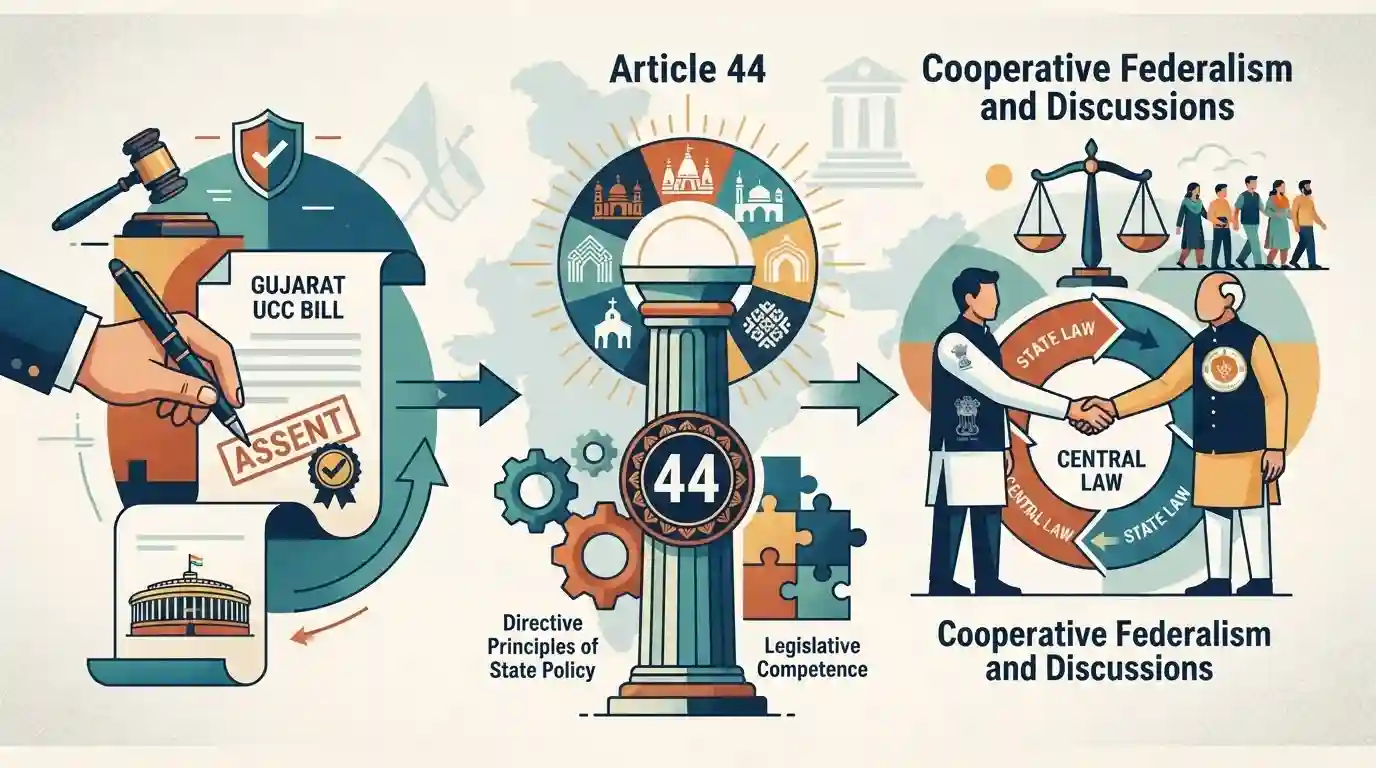
The Gujarat Uniform Civil Code (UCC) Bill has officially received presidential assent. This development ties closely with Article 44 of the Constitution of India, which envisions a Uniform Civil Code as part of the Directive Principles of State Policy, opening up crucial discussions on cooperative federalism, personal laws, and state-level legislative competence.
Key Points
- The Gujarat Uniform Civil Code (UCC) Bill has received presidential assent, marking a significant legal and administrative milestone for the state.
- Article 44 of the Directive Principles of State Policy (DPSP) under Part IV of the Indian Constitution calls upon the State to secure a Uniform Civil Code for citizens throughout the territory of India.
- State-level legislation on subjects in the Concurrent List (like personal laws) requires presidential assent under Article 254 if there is any inconsistency with central laws.
Important Terms
Uniform Civil Code (UCC) Bill

The state-level legislation passed by Gujarat that unifies personal laws concerning marriage, divorce, and inheritance, requiring presidential approval due to concurrent legislative overlaps.
UPSC context
Crucial for GS Paper II (Indian Polity - Federalism, Legislature, and DPSP implementation). Tests student understanding of state-level social legislation and constitutional provisions.
Article 44 of the Constitution of India
A constitutional provision under Part IV (Directive Principles of State Policy) that directs the state to secure a Uniform Civil Code for all citizens throughout India.
UPSC context
Important for GS Paper II under Indian Constitution features and DPSPs, evaluating the tension between religious freedom and uniform legal standards.
President of India
The executive head of the Indian Union whose formal assent under Article 201 is required for state bills reserved by the Governor, ensuring national legal coherence.
UPSC context
Essential for GS Paper II (Union and State Executive, Legislative Powers, and President's Role in Indian Federalism).
Gujarat State Legislature
The unicameral law-making body of Gujarat responsible for enacting state laws, subject to constitutional checks, gubernatorial assent, and presidential approval for specific reserved bills.
UPSC context
Relevant for GS Paper II (State Legislature, Legislative Competence, and State-Level Policy-Making under the Indian Federal Structure).
Prelims Trap
Since UCC is a Directive Principle under Article 44, only Parliament has the constitutional competence to legislate on personal laws across India.
Article 44 is non-justiciable and merely directs the State to endeavor to secure a UCC; it does not automatically make personal laws a Union-only subject. Personal laws fall under the Concurrent List.
Static Concepts Connected
What are the constitutional provisions regarding Personal Laws and the Concurrent List?
- Concurrent Entry: Entry 5 of the Concurrent List (Seventh Schedule) covers marriage and divorce; infants and minors; adoption; wills; intestacy and succession; joint family and partition.
- Presidential Assent: Under Article 254(2), if a state law on a Concurrent List subject contains provisions repugnant to an earlier parliamentary law, it needs presidential assent to prevail in that state.
Cross-Topic Patterns
UCC and Federal Legislative Competence
While personal laws fall under the Concurrent List, state-level legislation requires presidential assent under Article 254 to override central inconsistencies, touching upon federal dynamics.
DPSP Justiciability vs. State Legislation
Article 44 is non-justiciable under Part IV, yet states can legislate upon it, testing the boundary between directive principles and judicial review.

Expect a statement-based question combining Article 44 (DPSP), Entry 5 of the Concurrent List, and Article 254 presidential assent requirements.
Linked PYQs · 2
Linked PYQs · 2
- 2017GPSC_PRELIMSGS1
Which Article of the Constitution directs the state to Endeavour secure uniform Civil Code throughout the country ?
- 2020GPSC_PRELIMSGS1
Which of the following Statement is INCORRECT regarding Directive Principles of State Policy and Fundamental Duties? CANCELLED
