Gujarat UCC Bill receives presidential assent for state implementation
Source:timesofindia-indiatimes ↗
Why It Matters
Crucial for understanding the implementation of Directive Principles of State Policy (DPSP) at the state level and the evolution of the Uniform Civil Code in India.
Summary
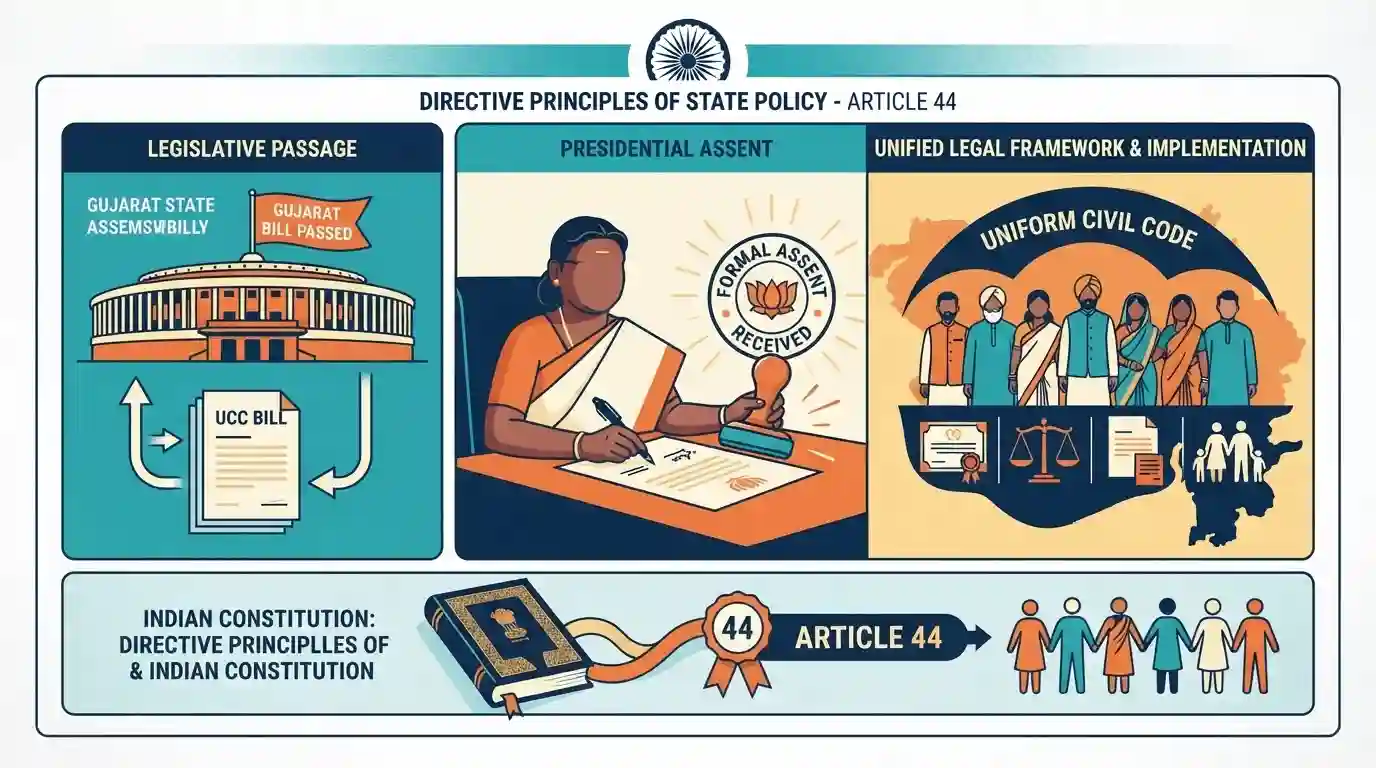
The Uniform Civil Code (UCC) Bill passed by the Gujarat state legislature has received formal assent from President Droupadi Murmu, marking a significant milestone for its implementation. The law seeks to provide a unified legal framework for personal matters across communities in the state, aligning with the constitutional mandate under Article 44.
Key Points
- The Uniform Civil Code (UCC) Bill for Gujarat has received the assent of President Droupadi Murmu, paving the way for its implementation in the state.
- Uniform Civil Code aims to establish a common set of laws governing personal matters such as marriage, divorce, inheritance, and adoption for all citizens irrespective of religion.
- Under the Indian Constitution, Uniform Civil Code falls under Article 44, which is a Directive Principle of State Policy (DPSP).
Important Terms
Uniform Civil Code (UCC) Bill

A legislative proposal seeking to provide a unified set of personal laws governing matters like marriage, divorce, and inheritance across all communities in Gujarat, following Article 44.
UPSC context
Important for GS Paper II under Indian Polity, DPSP, and federal legislation regarding personal laws and secularism.
Article 44 of the Constitution
A Directive Principle of State Policy (DPSP) under Part IV of the Indian Constitution which mandates that the State shall endeavor to secure a Uniform Civil Code throughout India.
UPSC context
Crucial for GS Paper II (Indian Constitution and DPSP) examining the balance between fundamental rights and directive principles.
President of India
The executive head of the Indian Union whose formal assent is required for state legislation under specific constitutional provisions like Article 201 when reserved by the Governor.
UPSC context
Tested in GS Paper II under Executive powers, legislative process, and Centre-state legislative relations.
Prelims Trap
Uniform Civil Code is a justiciable fundamental right under Article 44 that applies without exception to all citizens across every state.
Aspirants often assume UCC is a justiciable fundamental right or that state legislation automatically applies universally without tribal exemptions.
Static Concepts Connected
What are the key constitutional provisions and judicial milestones concerning the Uniform Civil Code in India?
- Article 44: Enshrined in Part IV as a Directive Principle directing the state to secure a UCC throughout India.
- Judiciary Stance: Shah Bano case (1985) and Sarla Mudgal case (1995) urged Parliament and the executive to enact a national UCC.
- Legislative Competence: Personal laws fall under the Concurrent List (List III) of the Seventh Schedule, enabling both Parliament and state legislatures to enact laws.
Cross-Topic Patterns
UCC Legislation and Cooperative Federalism Dynamics
Article 44 sits in Part IV as a non-justiciable DPSP, raising federalism questions when states legislate on Concurrent List subjects like personal law without central uniformity.
Tribal Customary Law and State-Level UCC Exemptions
Exemptions granted to Scheduled Tribes in state-level UCC bills link directly to Fifth and Sixth Schedule protections and tribal customary law safeguards.

Expect a statement-based question pairing Article 44 constitutional status with exceptions regarding tribal customary laws and prior state enactments.
Linked PYQs · 2
Linked PYQs · 2
- 2025GPSC_PRELIMSGS1
Which of the following statements accurately reflect/(s) the provisions of the Indian Constitution? Statements: 1. The Directive Principles of State Policy (DPSP) are enforceable by the courts. 2. The Indian Constitution provides a federal system with unitary features. 3. The Fundamental Rights can be amended by the Parliament without any restrictions. Which of the statement/statements given above is/are correct?
- 2020GPSC_PRELIMSGS1
'Economic Justice' as one of the objectives of the Indian Constitution has been provided in
