IAS and GAS Administrative Reshuffle in Gujarat
Source:indianmasterminds ↗
આ શા માટે મહત્વનું છે
Routine but large-scale administrative reshuffles reflect state governance priorities and illustrate the practical execution of public administration. Understanding the roles of civil servants across diverse portfolios—from district administration (DDOs, Municipal Commissioners) to managing state-owned power discoms—is crucial for insights into decentralized governance and structural administration in India.
સારાંશ
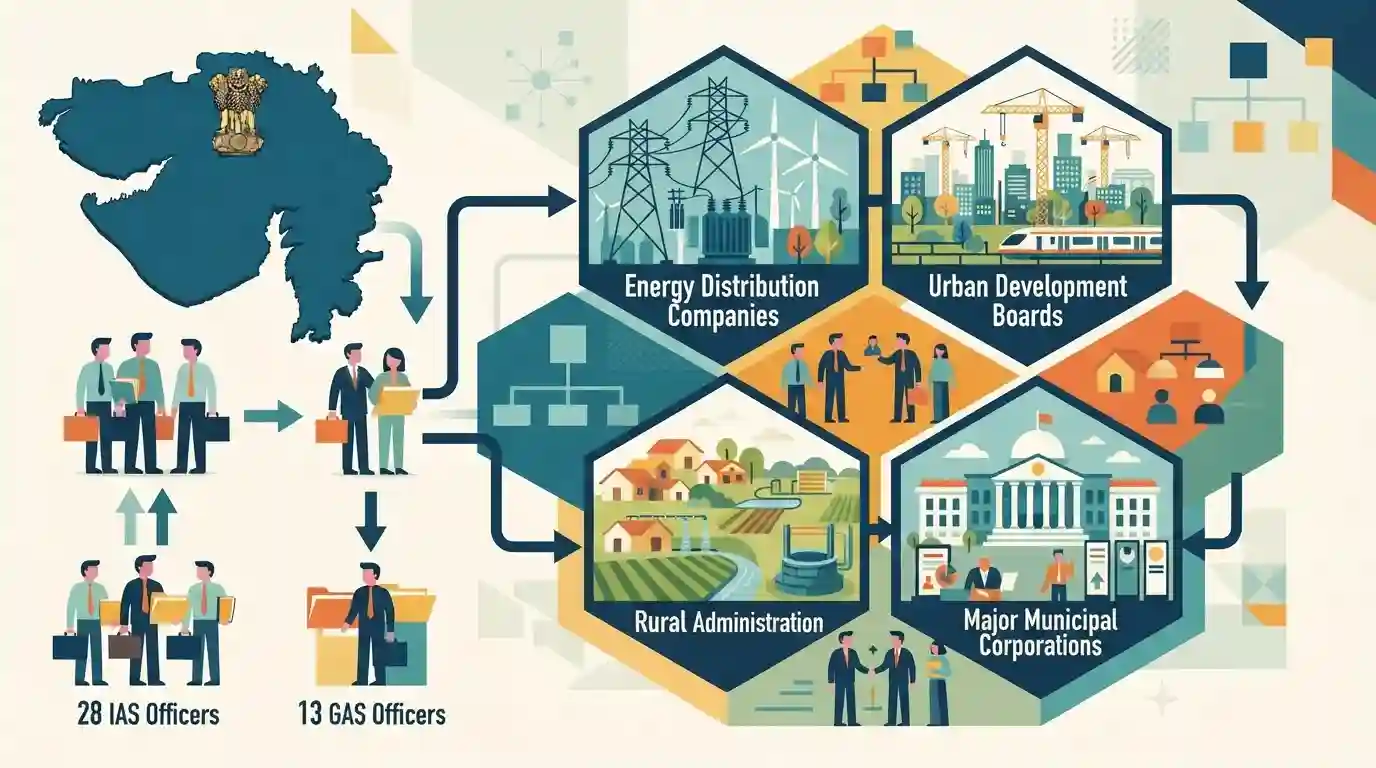
The Government of Gujarat executed a significant administrative reshuffle, transferring 28 Indian Administrative Service (IAS) officers and 13 Gujarat Administrative Service (GAS) officers. The restructuring involved key appointments across critical state sectors, including energy distribution companies, urban development boards, rural administration, and major municipal corporations. The reshuffle emphasizes the dynamic role of civil servants in steering state public sector enterprises and managing local self-governance at the district level.
મુખ્ય મુદ્દા
- The Gujarat government enacted a major administrative reshuffle, transferring 28 IAS and 13 GAS officers across the state.
- The reshuffle included strategic appointments for District Development Officers (DDOs) and Municipal Commissioners to enhance local governance.
- Top leadership changes were made in key state public sector undertakings, including major power distribution companies (Discoms) such as UGVCL, DGVCL, and PGVCL.
- The transfers highlight the diverse roles of civil servants in managing critical sectors like urban development, energy infrastructure, and rural administration.
મહત્વપૂર્ણ શબ્દો
Indian Administrative Service (IAS)

Premier all-India civil service responsible for policy formulation, administrative governance, public service delivery, and the maintenance of law and order at central, state, and district levels.
UPSC context
GS Paper II (Polity & Governance): Role of civil services in a democracy, executive organ of state, and policy implementation.
Gujarat Administrative Service (GAS)
The premier state-level Class I civil service in Gujarat, recruited via GPSC, managing revenue administration, development programs, and acting as a primary feeder cadre for the IAS.
UPSC context
GS Paper II (Polity & Governance): Structure and functioning of State Services, federalism, and personnel management.
Gujarat Industrial Development Corporation (GIDC)
A statutory body established in 1962 under the Gujarat Industrial Development Act to promote rapid and orderly industrialization by developing industrial estates and essential infrastructure.
UPSC context
GS Paper III (Economy & Infrastructure): Industrial policy, growth models, statutory bodies, and regional economic development.
Gujarat Urban Development Company Ltd (GUDC)
A state-owned public enterprise incorporated in 1999 to facilitate sustainable urban development, formulate policies, build institutional capacity, and implement civic infrastructure projects.
UPSC context
GS Paper I (Urbanization) & GS Paper III (Infrastructure): Urban planning, sustainable development, and public sector-led infrastructure.
Uttar Gujarat Vij Company Limited (UGVCL)
A state-owned power distribution company (DISCOM) operating under GUVNL, responsible for electricity supply, solar net metering, and power infrastructure across northern districts of Gujarat.
UPSC context
GS Paper III (Economy & Infrastructure): Energy sector reforms, functioning of state DISCOMs, and renewable energy integration.
Paschim Gujarat Vij Company Limited (PGVCL)
A state-owned power distribution company under GUVNL, responsible for electricity distribution across Saurashtra and Kutch regions, managing rural and agricultural electrification challenges.
UPSC context
GS Paper III (Economy & Infrastructure): Power sector management, rural electrification, and financial sustainability of public sector enterprises.
પ્રિલિમ્સ ટ્રેપ
"Employees of State Public Sector Undertakings (PSUs) enjoy constitutional protection against dismissal under Article 311."
Article 311 protects members of civil services or those holding civil posts under the Union/State, not employees of legally distinct corporate entities like PSUs.
સંલગ્ન સ્થિર ખ્યાલો
What are the dual constitutional safeguards provided to civil servants under Article 311?
- Appointing Authority: A civil servant cannot be dismissed or removed by an authority subordinate to the one by which they were appointed.
- Right to Hearing: The officer must be given a reasonable opportunity of being heard following a formal inquiry into the charges.
- Initiating Proceedings: The SC ruled in 2025 that prior approval from the appointing authority is not needed merely to initiate disciplinary proceedings or issue a charge-sheet.
What did the Supreme Court mandate in the T.S.R. Subramanian Case (2013)?
- Civil Services Board: The Court mandated all States and UTs to constitute a Civil Services Board (CSB) to recommend transfers and postings of bureaucrats.
- Minimum Tenure: It directed the government to ensure a minimum fixed tenure for bureaucrats to insulate them from political pressure and frequent, arbitrary reshuffles.
આંતર-વિષય પેટર્ન
Generalists vs. Specialists in PSUs
Posting generalist IAS officers to head technical power distribution companies highlights the recurring GS-2 debate over generalists vs. specialists in managing complex State Public Sector Enterprises.
Tenure Instability and Local Governance
Frequent transfers of DDOs and Municipal Commissioners disrupt capacity-building at the grassroots, exacerbating governance issues highlighted in the 2nd ARC's 6th Report on Local Governance.

Expect Prelims statements testing Article 311's scope (excluding PSU employees) or the T.S.R. Subramanian mandate on minimum tenures.
સંલગ્ન PYQ · 4
સંલગ્ન PYQ · 4
- 2026GPSC_PRELIMSGS1
Examine the following statements regarding 'Article 311' of the Constitution and protection granted to Civil Servants: 1. No civil servant shall be dismissed by an authority subordinate to the one by which they were appointed. 2. No officer shall be removed without informing them of the charges and giving them an opportunity for inquiry. 3. In the interest of national security, the President or Governor can remove an officer without an inquiry. 4. This protection is available only to All India Services officers and not to state service officers. Which of the above statements are correct?
- 2025GPSC_PRELIMSGS1
Which of the following statements about Local Self-Government in India is correct? 1. The Panchayati Raj System is based on the recommendations of the Balwant Rai Mehta Committee (1957). 2. The 73ʳᵈ Amendment Act, 1992 provided for the establishment of three-tier Panchayati Raj institutions in all states. 3. The 11ᵗʰ Schedule of the Indian Constitution deals with powers and responsibilities of Panchayati Raj institutions. 4. The State Election Commission is responsible for conducting elections to both Panchayati Raj institutions and State Legislatures. Select the correct answer using the codes below:
- 2020GPSC_PRELIMSGS1
Which report of the Second Administrative Reforms Commission is related with recommendations on Panchayati Raj?
- 2024GPSC_PRELIMSGS1
Public Administration is the study of
